
Trump pursues Iranian decapitation without a plan for what comes next

By: Greg Miller, Karen DeYoung (The Wall Street Journal via MSN)
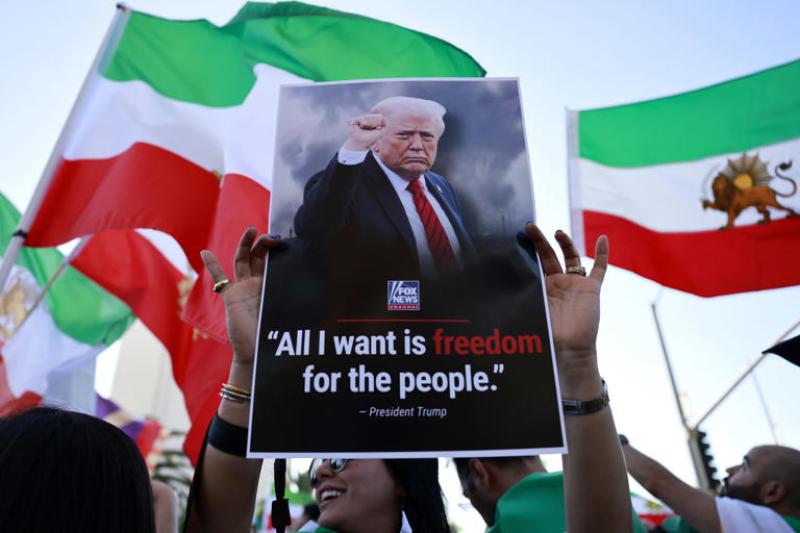

Who needs a stinkin' plan? Trump only hopes to break things, create chaos, and then cherry pick opportunities. Trump is trading global stability for small personal wins.
 S E E D E D C O N T E N T

It took only hours into military strikes on Iran for the United States to find itself in a familiar but unsettling position: the swift removal of a global foe only to confront an aftermath that history suggests will prove difficult to navigate.
The killing of Ayatollah Ali Khamenei marked the latest decapitation or defeat of a bitter U.S. adversary overseas, following the ouster of the Taliban in 2001, the overthrow of Saddam Hussein in Iraq two years later, the breaking of Moammar Gaddafi’s grip on power in Libya in 2011 and the capture of Venezuelan leader Nicolás Maduro just two months ago.
The United States has often followed such triumphant moments with attempts to fill the void — deploying thousands of troops, spending billions of dollars, seeking to nurture fledging democracies or, in the case of Venezuela, leaving the decapitated government in power. But those efforts have largely brought disappointment, yielding states that remain riven by conflict, have revolted against the U.S. role or hardly rank as robust U.S. allies.
President Donald Trump appears to be pursuing a starkly different approach with Iran, signaling that he has no intention to use American troops to steer the path of a country whose fate has been buffeted by U.S. power since Iran’s last democratically elected government was ousted in 1953 in a CIA-backed coup.
Instead, Trump has sought to put the onus on Iran’s besieged and divided population, saying in a video address early Saturday morning: “When we are finished, take over your government. It will be yours to take. This will be probably your only chance for generations.”
Trump’s inclination to bomb first then wash his hands of whatever comes next in Iran has alarmed U.S. allies. Security officials in the Middle East and in Europe have raised concerns that the United States is unleashing forces that could spill across borders, disrupt global trade and lead to asymmetric terror attack reprisals — all with no certainty that the remaining Islamic hardliners won’t ultimately retain their hold on power.
Some lawmakers, primarily Democrats, have expressed similar concerns. “It’s like we’re going to break all the china and you guys decide how to put it back together. It seems like that is the strategy,” Sen. Tim Kaine (D-Virginia) said Sunday.
Sen. Lindsey Graham (R-South Carolina), a longtime Trump supporter, professed no U.S. plan was needed. “It’s not my job, it’s not the president’s job” to select or even support a new government in Iran, Graham said on NBC’s “Meet the Press.” In the “new Iran, whether it’s a cleric or a representative democracy, our goal is to make sure it does not become the largest state sponsor of terrorism. That’s a win for us.”
Before the Iran strikes began, the CIA examined multiple scenarios for a post-Khamenei government, according to people familiar with the matter who spoke on the condition of anonymity to discuss sensitive intelligence assessments.
Agency analysts concluded that the Islamic Revolutionary Guard Corps, the elite armed force that answered directly to the ayatollah, would be best positioned to take power, but stopped short of predicting that outcome, they said. The Iranian opposition, which has no clear leader, was seen as less likely to assume control of the government, which has been ruled since 1979 by theocrats overseeing a nominal democracy.
Western security officials cited similar projections in interviews Sunday and warned that Iran — a nation the size of France, Germany, Italy and the United Kingdom combined — could face years of infighting among Shiite Muslims who represent the majority of its 90 million people, as well as Kurdish and Baluchi factions.
On Sunday, in phone calls with multiple journalists at several news outlets, Trump seemed to revel in the incapacitation of the Iranian regime, saying that the strikes had wiped out potential successors to the supreme leader.
After assessing Trump’s comments and the impact of U.S.-Israeli attacks, a German security official said the worry in Berlin and other European capitals is that “the plan is to have no plan.”
Detailed examinations of contingencies “obviously have not played out in the American mind,” the official said, leaving unclear what will happen “when the bombing ends if people really go to the streets,” as Trump has urged them.
Trump has already expressed willingness to deal with an interim ruling council announced in Tehran after Khamenei’s death, as long as it has no intention of reconstituting the nuclear or ballistic missile programs the U.S. says it is eliminating.
“They want to talk, and I have agreed to talk, so I will be talking to them,” he told The Atlantic magazine Sunday. Asked whether the United States would support Iranians if they took to the streets to demand a completely new government, Trump said he would “have to look at the situation at the time it happens.”
A senior White House official, speaking on the condition of anonymity about the ongoing effort, noted that the president did not commit to immediate talks with the newly-announced ruling council and said only that “eventually he will talk.”
“For now, Operation Epic Fury continues unabated,” the official said, using the Defense Department’s name for the military action.
Direct in-and-out U.S. military interventions have had some success in quickly leading to lasting democratic rule, including in Grenada in 1983 and Panama in 1989. But these efforts, and more recent wars of regime change, included troops on the ground — something the Trump White House has pledged will not happen.
Trump’s perceived lack of post-conflict planning stands in contrast to major U.S. military missions in recent decades that were often accompanied by detailed — if ultimately futile — blueprints for bringing democracy to states ruled by autocrats.
The most extreme example is Iraq, where the George W. Bush administration’s aspirations of erecting an American-friendly ally in the Middle East involved planning as extensive as for the invasion itself. Even before thousands of U.S. troops massed around Iraq’s borders, an entire suite of Pentagon offices was dedicated to organizing a new Iraqi government, with every expectation it would be warmly welcomed by the liberated population.
Hussein’s government in Baghdad was quickly toppled and within months the dictator was captured and executed. In October 2023, Bush delivered a triumphant speech aboard a U.S. aircraft carrier before a “Mission Accomplished” banner.
By then, insurgent groups had already begun mounting bloody attacks on U.S. and allied forces and an offshoot of the al-Qaeda terror network — which would eventually become the Islamic State — was gaining a dangerous foothold. The country soon plunged into a civil war that the United States often seemed powerless to quell during a near-decade long occupation.
Trump, then a New York businessman, initially supported the Iraqi invasion before quickly turning against it.
The massive U.S. investment of resources and attention in Iraq was also a factor in the failures to secure a democratic Afghanistan after the rapid ouster of the Taliban government, which had sheltered Sept. 11 mastermind Osama bin Laden.
After an overwhelming display of U.S. and proxy forces prompted Taliban leaders to flee, the United States spent the next two decades struggling to pacify the country. Eventually, U.S. troops withdrew amid a chaotic collapse in 2021 as the Taliban swept back into power.
President Barack Obama, seeking to avoid the perceived mistakes of his predecessors, approved a limited allied air campaign with no ground forces in Libya in 2011 that toppled the regime of Gaddafi, who fled his compound and was captured and killed by a Libyan mob after being dragged from a culvert.
Fifteen years later, that country remains split in two pieces controlled by rival factions, though bloodshed has diminished since a 2020 ceasefire.
After campaigning as an opponent of costly U.S. wars overseas, Trump has now presided over two military campaigns aimed at regime change in as many months — the overnight capture of Maduro in early January and the death of Khamenei and other Iranian leadership figures on Saturday in an Iran campaign he now says will likely be finished within the month.
Trump’s efforts to avert any ongoing U.S. presence in either country, let alone bear responsibility for rebuilding, appears to reflect a determination to avoid the enormous costs earlier conflicts inflicted on the United States and the tarnished political legacies of his predecessors.
Be a good human. Grossly derogatory comments, blatantly inflammatory comments, excessive trolling, mean-spirited taunting and insults, scamming, spamming, and off topic comments may be removed in compliance with the site's Terms of Service and the Code of Conduct. The moderators have the final word.

Tags
Who is online
92 visitors
The problem is that the Iranian regime has not yet been decapitated. If Trump would be a fool if he expected that killing Khamenei would cause the Iranian regime to implode. The Assembly of Experts who will select the next Supreme Leader have dispersed. The clerics hold the power to legitimize the next Supreme Leader. The IRGC manages the bureaucracy but doesn't have the authority to become the government. The transition council are only care takers while the clerics make their selection.
The next Supreme Leader is unlikely to assume office before the 40 day period of mourning is finished. Ali Khamenei is still the Supreme Leader even in death. That's one of the odd aspects of a theocracy.
Seems like it's up to the people of Iran to do what they want so long as they don't develop nukes, sponsor international terrorism etc..
On Saturday morning Trump said a goal of attacking Iran was to effect regime change and free the people of Iran. 48 hours later that idea is on the ash heap of Trump's "thinking".
What are you talking about? Iran has already gone through two regime changes since Saturday.
This morning Hegseth said this is not a war for regime change. About a half hour ago Trump spoke and didn't even mention the Iranian people,
If it's not for regime change and trmp apparently doesn't care about the Iranian people....then why the hell have 3 American service members died?
It's up to some of the people to do what they want.
Others would like to have a glass of wine. Or show their hair. Or wear a sundress. Or eat a pulled pork sandwich. Or exercise any of the freedoms we tend to take for granted.
I get that there is a limited amount we can do to remove the Islamic oppression, but I would love to see an open, modern, free Iran.
People of Iran? Ali Khamenei was the religious leader for Shia Islam. Trump's goals would be analogous to changing the regime of the Roman Catholic Church by killing Pope Leo XIV. One of the odd features of a theocracy is that the religion acts as the national charter or constitution. Killing the leader won't end the religion or the government.
Ali Khamenei will be leading Iran (and Shia Islam) until April 9, 2026, when the period of mourning ends. That's when the next Supreme Leader can legitimately assume office.
Everyone ignores that the West's hardline sanctioning and containment of Iran resulted in a diaspora of Shia Islam to Europe, central and eastern Asia, and the United States. Ali Khamenei was the religious leader for that Shia diaspora. The consequence of the hardline international isolation is what Trump does in Iran won't stay in Iran.
Since when does Trump have a plan for anything? That’s why he’s TACO. That’s why so many Americans are newly uninsured. That’s why every commercial venture he engaged in in his personal life failed. That’s why he had sex with a porn star and most likely sexually abused children. He had no feasible plan to counter any of these actions, he just does what feels good at the moment and tells the future to go fuck itself. This is the guy with the nuclear codes, thanks to Republicans.
The blind commitment to blindly parroting the approved talking points in the face of overwhelming evidence to the contrary is truly amazing. I'm not sure the English language has language strong enough to capture just how dumb it is to make that claim after Trump just took out the Ayatollah.
CNN just posted a new poll saying 71% of Americans 18-34 disapprove of this war.
The number for all Americans disapproval is 59%.
The people in favor are basically the Trump cult.
after Trump just took out the Ayatollah.
Oooooh … what a devastating charge. Unfortunately for you it only supercharges my point. What comes next? Trump doesn’t know or care, he just cares that the Ayatollah is dead because of him. Bravo, both of you. I guess the “plan” is to tell the Iranians to run towards the machine guns trained on them, using their dead brothers and sisters to shield them from the gunfire, and take back the water scarce country that he just turned into further chaos.
Then you don't understand your point. You are just reciting rote dogma.
For your claim to make sense, Trump would have threatened Iran and chickened out from actually doing something.
My point was that he never has a plan for anything. The lack of a plan then leads him into any number of unknown outcomes - which could include chickening out, or reneging on promises, or severing ties with allies, or losing supporters, or damaging the environment, or stripping healthcare from sick children, or marching half naked elderly people out into the street by untrained ICE agents, or making groceries more expensive, or making fuel more expensive, or destroying iconic landmarks, ….
Stop me when something positive comes out of this moron’s inability to have a plan.
Hahahahahaah
Yea...that poll is accurate s/
You mean they guy that said "Don't", then when they did, he did nothing?
Biden's message to Iran about retaliatory strike on Israel: 'Don't' - ABC News
Trump cannot TACO this time.
Trump attacked a religion. Now Trump has absolutely no control over the consequences. There's no going back. Trump has tied his bootlaces together so now the only thing that can be done is stand and deliver. Or fall flat on his face.
I'm not sure Trump realizes it but now he is on the front line of what could become a religious war. By legitimizing political assassination of a religious leader, Trump is now a target for religious vengeance and justice. Even after he leaves office.
We are witnessing the lengths Trump will go to to get voters to think about something other than him releasing the evidence that he is a pedophile that protects other pedophiles.
And how much money did Tusli make off of these tee shirts?