
The Boston Massacre | March 5, 1770

By: Annette McDermott (HISTORY)

The Minnesota resistance to a King's tyranny has historical precedent.
 S E E D E D C O N T E N T

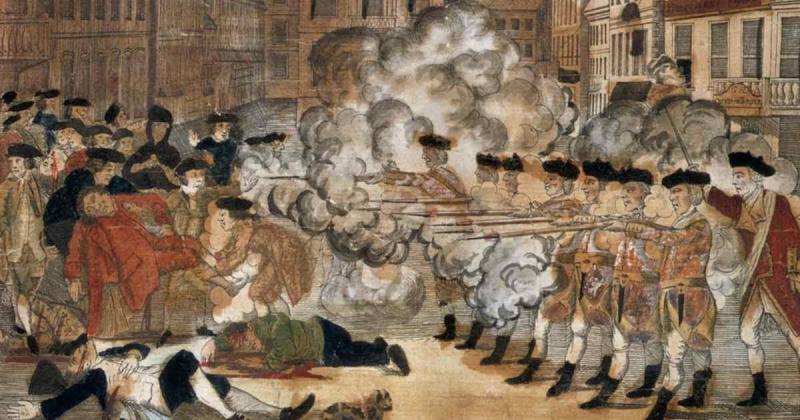
On the cold, snowy night of March 5, 1770, a mob of American colonists gathers at the Customs House in Boston and begins taunting the British soldiers guarding the building. The protesters, who called themselves Patriots, were protesting the occupation of their city by British troops, who were sent to Boston in 1768 to enforce unpopular taxation measures passed by a British parliament that lacked American representation.
Boston Massacre Sparks a Revolution
The shooting of several men by British soldiers in 1770 inflames passions in the colonies.
1:42m watch
British Captain Thomas Preston, the commanding officer at the Customs House, ordered his men to fix their bayonets and join the guard outside the building. The colonists responded by throwing snowballs and other objects at the British regulars, and Private Hugh Montgomery was hit, leading him to discharge his rifle at the crowd. The other soldiers began firing a moment later, and when the smoke cleared, five colonists were dead or dying—Crispus Attucks, Patrick Carr, Samuel Gray, Samuel Maverick and James Caldwell—and three more were injured. Although it is unclear whether Crispus Attucks, an African American, was the first to fall as is commonly believed, the deaths of the five men are regarded by some historians as the first fatalities in the American Revolutionary War.
The British soldiers were put on trial, and patriots John Adams and Josiah Quincy agreed to defend the soldiers in a show of support of the colonial justice system. When the trial ended in December 1770, two British soldiers were found guilty of manslaughter and had their thumbs branded with an "M" for murder as punishment.
The Sons of Liberty, a Patriot group formed in 1765 to oppose the Stamp Act, advertised the "Boston Massacre" as a battle for American liberty and just cause for the removal of British troops from Boston. Patriot Paul Revere made a provocative engraving of the incident, depicting the British soldiers lining up like an organized army to suppress an idealized representation of the colonist uprising. Copies of the engraving were distributed throughout the colonies and helped reinforce negative American sentiments about British rule.
In April 1775, the American Revolution began when British troops from Boston skirmished with American militiamen at the battles of Lexington and Concord. The British troops were under orders to capture Patriot leaders Samuel Adams and John Hancock in Lexington and to confiscate the Patriot arsenal at Concord. Neither missions were accomplished because of Paul Revere and William Dawes, who rode ahead of the British, warning Adams and Hancock and rousing the Patriot minutemen.
Eleven months later, in March 1776, British forces had to evacuate Boston following American General George Washington's successful placement of fortifications and cannons on Dorchester Heights. This bloodless liberation of Boston brought an end to the hated eight-year British occupation of the city. For the victory, General Washington, commander of the Continental Army, was presented with the first medal ever awarded by the Continental Congress. It would be more than five years before the Revolutionary War came to an end with British General Charles Cornwallis' surrender to Washington at Yorktown, Virginia.
Also on This Day in History
Discover more of the major events, famous births, notable deaths and everything else history-making that happened on March 5th
1839 -- Charlotte Bronte declines marriage
Charlotte Bronte writes to the Reverend Henry Nussey, declining marriage. The 23-year-old Bronte told him that he would find her "romantic and eccentric" and not practical enough to be a clergyman's wife. Rather than marry, Bronte struggled as a teacher and governess to help support her brother Branwell's literary aspirations. In the end, Branwell's excesses destroyed him; his sisters, […]
1868 -- Impeachment trial of Andrew Johnson begins
For the first time in U.S. history, the impeachment trial of an American president gets underway in the U.S. Senate. President Andrew Johnson, reviled by the Republican-dominated Congress for his views on Reconstruction, stood accused of having violated the controversial Tenure of Office Act, passed by Congress over his veto in 1867. At the outbreak […]
1917 -- Swedish prime minister resigns over WWI policy
Prime Minister Hjalmar Hammarskjold of Sweden, father of the famous future United Nations Secretary General Dag Hammarskjold, resigns on this day in 1917 after his policy of strict neutrality in World War I—including continued trading with Germany, in violation of the Allied blockade—leads to widespread hunger and political instability in Sweden. The elder Hammarskjold, a professor of […]
1929 -- David Buick dies
On March 5, 1929, David Dunbar Buick, the founder of the Buick Motor Company, dies in relative obscurity and meager circumstances at the age of 74. In 1908, Buick's company became the foundation for the General Motors Corporation; however, by that time David Buick had sold his interest in the company. Buick was born in […]
1946 -- Churchill delivers Iron Curtain speech
In one of the most famous orations of the Cold War period, former British Prime Minister Winston Churchill condemns the Soviet Union's policies in Europe and declares, "From Stettin in the Baltic to Trieste in the Adriatic, an iron curtain has descended across the continent." Churchill's speech is considered one of the opening volleys announcing […]
1953 -- Joseph Stalin dies
Joseph Stalin, leader of the Soviet Union since 1924, dies in Moscow. Ioseb Dzhugashvili was born in 1878 in Georgia, then part of the old Russian empire. The son of a drunk who beat him mercilessly and a pious washerwoman mother, Stalin learned Russian, which he spoke with a heavy accent all his life, in an […]
1960 -- Iconic photo of Che Guevara taken
Moments before he was shot to death by a soldier of the Bolivian government, the revolutionary Ernesto "Che" Guevara told his executioner, "Shoot, coward! You are only going to kill a man!" Guevara died a short time later, on October 9, 1967 at the age of 39, but he was correct in his assertion that […]
1963 -- Hula Hoop patented
March 5, 1963: the Hula Hoop, a hip-swiveling toy that became a huge fad across America when it was first marketed by Wham-O in 1958, is patented by the company's co-founder, Arthur "Spud" Melin. An estimated 25 million Hula Hoops were sold in its first four months of production alone. In 1948, friends Arthur Melin […]
1966 -- Staff Sergeant Barry Sadler hits #1 with "Ballad of the Green Berets"
Thanks to Hollywood, America's collective memory of the Vietnam War is now inextricably linked with the popular music of that era. More specifically, it is linked with the music of the late-'60s counterculture and antiwar movement. But opposition to the war was far from widespread back in 1966—a fact that was reflected not just in […]
1966 -- Marvin Miller elected first full-time MLB Players Association executive director
On March 5, 1966, Marvin Miller, the 48-year-old assistant to the president of the United Steelworkers of America, is elected the first full-time executive director of the Major League Baseball Players Association. Miller, whose role with the United Steelworkers of America included serving as lead negotiator, takes over at a time when the average yearly […]
1969 -- Jim Morrison is charged with lewd behavior at a Miami concert
The Dade County Sheriff's Office issues an arrest warrant for Doors' lead singer Jim Morrison. He is charged with a single felony count and three misdemeanors for his stage antics at a Miami concert a few days earlier. When Morrison first got word of the charges for lewd and lascivious behavior, indecent exposure, profanity, and […]
Be a good human. Grossly derogatory comments, blatantly inflammatory comments, excessive trolling, mean-spirited taunting and insults, scamming, spamming, and off topic comments may be removed in compliance with the site's Terms of Service and the Code of Conduct. The moderators have the final word.

Tags
Who is online
79 visitors
When did American Patriots turn coat and become mercenaries for a King? Winning that battle may lose all.
Wrong analogy.
What has happened in sanctuary cities is directly related to the southern states acts of secession when President Lincoln tried to enforce federal law and protect federal property.
The medal was authorized by a resolution in 1776, but because of the war was not designed and "minted" until 1790 in France and was presented to Washington March 25, 1790,
in the second year of his first term as POTUS.
In 1875 a consortium of 50 prominent business men and citizens procured the medal from Washington's heirs and gifted it to the City of Boston for the Centennial.
It now resides in a collection in the free Library of Boston.
Washington Before Boston Medal - Wikipedia