
Iran war may fracture dollar dominance, trigger ‘petroyuan’ shift: Deutsche Bank

By: FirstPost
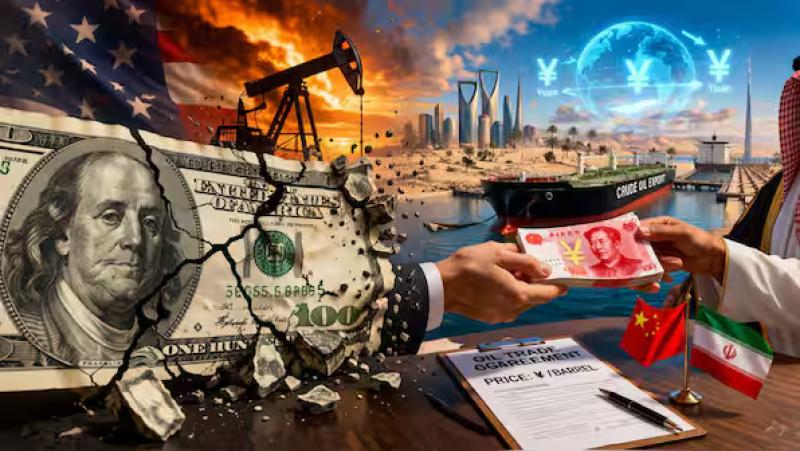


Has President Trump accelerated a growing problem that cannot be repaired with threats?
 S E E D E D C O N T E N T
March 25, 2026 -- The ongoing US-Israel-Iran conflict could mark a historic inflection point for the global monetary system, potentially accelerating the erosion of the US dollar’s dominance in energy trade and international reserves, according to a new report by Deutsche Bank.
In a sharply worded note, strategist Mallika Sachdeva warned that the war may become “the perfect storm for the petrodollar,” threatening the decades-old system that has underpinned the dollar’s global supremacy.
“The long-term legacy of the Iran conflict for the dollar could be the way it tests the foundations of the petrodollar regime,” Sachdeva wrote, cautioning that deeper fractures could have “significant downstream effects” on global trade, savings, and reserve currency dynamics.
A system built on oil—and security
At the heart of the warning lies a simple but powerful reality: the world uses dollars because it trades in dollars—especially oil.
Since the 1974 US-Saudi agreement, crude oil has been priced almost exclusively in dollars, creating a feedback loop where countries earn, save, and reinvest dollars into US assets. This “petrodollar” system has long anchored the dollar’s reserve currency status.
But Deutsche Bank argues that this foundation is now under unprecedented strain.
“The world saves in dollars in large part because it pays in dollars,” the report notes, highlighting how global value chains—from manufacturing to transport—have been structurally “dollarised” due to oil’s central role.
Cracks were already forming
Even before the current conflict, the system was beginning to shift. Asia now dominates Middle East oil demand, with roughly 85 per cent of exports heading east, not to the US. China is pushing yuan-based trade, including oil invoicing. In fact, sanctioned Russian and Iranian crude is already being traded outside dollar channels. New payment rails like Project mBridge are bypassing SWIFT and the US financial system.
As highlighted in the report’s data, Saudi Arabia now exports over four times more oil to China than to the US, highlighting a structural shift in energy geopolitics.
War may accelerate the shift.
The conflict has now introduced a far more destabilising variable: security uncertainty. The petrodollar system was never just about pricing—it was about US military protection of Gulf oil flows. That assumption is now being tested. The US bases and Gulf energy infrastructure have come under attack. The Strait of Hormuz—through which ~20 per cent of global oil flows—has faced disruptions. Maritime security is no longer guaranteed by Washington alone.
Crucially, Deutsche Bank flags emerging reports that Iran may allow oil shipments in exchange for yuan payments, a potential watershed moment. “The conflict could be remembered as a key catalyst for erosion in petrodollar dominance and the beginnings of the petroyuan,” Sachdeva noted.
A fragmented oil market?
The bank outlines a possible future where oil markets split along geopolitical lines. You can have the Middle East, which will have Asian trade priced in yuan, and then the Western Hemisphere, where allies are priced in dollars.
Such fragmentation would weaken the dollar’s network effects—arguably its biggest strength. At the same time, Gulf nations—sitting on nearly $8 trillion in reserves and sovereign wealth—may begin drawing down dollar assets to stabilise domestic economies hit by war, further reducing global dollar recycling.
The bigger threat: moving beyond oil
Perhaps the most profound risk, Deutsche Bank argues, is not currency substitution but energy transition itself. A world less dependent on globally traded oil is, by definition, less dependent on the dollar. Europe and Asia may accelerate renewables and nuclear energy. Countries could prioritise domestic energy security over imports. China already dominates clean energy supply chains, producing 70–80 per cent of key components.
“The move away from oil could be as powerful as the pressure to price it in other currencies,” the report states.
In the near term, the dollar retains some strength due to US energy independence and safe-haven demand. But even here, Deutsche Bank notes the response has been muted amid rising US fiscal pressures and reserve diversification.
The real shift, the bank argues, is structural. “A world that becomes more self-sufficient in defence and energy would also be a world that holds fewer USD reserves,” Sachdeva wrote, adding that economic security is increasingly tied to national security.
The Iran conflict may not dethrone the dollar overnight. But it could do something more consequential, break the system that made dollar dominance inevitable.
From yuan oil trades to energy independence and fractured alliances, the forces now in motion suggest a gradual but decisive shift. If the 1970s oil shocks created the petrodollar, this conflict may well mark the beginning of its decline.
Be a good human. Grossly derogatory comments, blatantly inflammatory comments, excessive trolling, mean-spirited taunting and insults, scamming, spamming, and off topic comments may be removed in compliance with the site's Terms of Service and the Code of Conduct. The moderators have the final word.

Tags
Who is online

122 visitors
Trump smearing lipstick on the GOAT won't hide that it's been screwed.
This whole "excursion" screams of inattention to details and possibilities better known as
Answer; because they were mostly all pretty well-balanced adults and realized the god damn stupidity of it.
But not Taaco.