
Dr. Jonas Salk announces polio vaccine | March 26, 1953

By: (HISTORY)


A little history, anyone?
 S E E D E D C O N T E N T
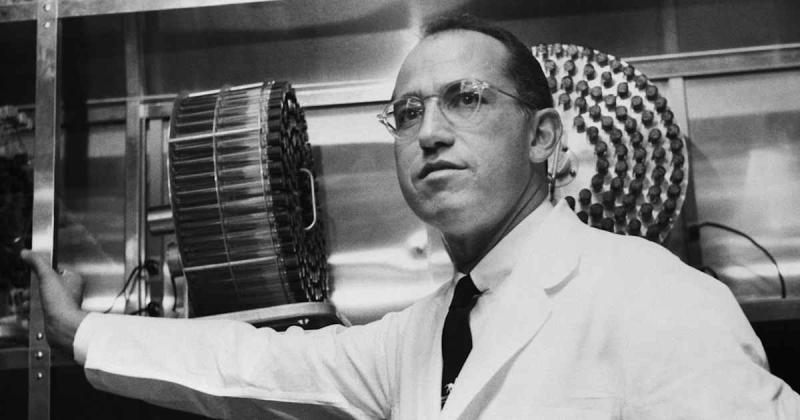
On March 26, 1953, American medical researcher Dr. Jonas Salk announces on a national radio show that he has successfully tested a vaccine against poliomyelitis, the virus that causes the crippling disease of polio.
In 1952—an epidemic year for polio—there were 58,000 new cases reported in the United States, and more than 3,000 died from the disease. For his work in helping to eradicate the disease, which is known as "infant paralysis" because it mainly affects children, Dr. Salk was celebrated as the great doctor-benefactor of his time.
History Shorts: The Doctor Who Stopped An American Epidemic (Forged in Crisis)
Dr. Maurice Hilleman was already an expert in viruses and vaccines when a strange flu broke out in Hong Kong in 1957. But only he saw the threat it could pose around the world.
1:03m watch
Polio, a disease that affected humanity many times throughout recorded history, attacks the nervous system and can cause varying degrees of paralysis. Since the virus is easily transmitted, epidemics were commonplace in the first decades of the 20th century. The first major polio epidemic in the United States occurred in Vermont in the summer of 1894, and by the 20th century thousands were affected every year. In the first decades of the 20th century, treatments were limited to quarantines and the infamous "iron lung," a metal coffin-like contraption that aided respiration. Although children, and especially infants, were among the worst affected, adults were also often afflicted, including future president Franklin D. Roosevelt, who in 1921 was stricken with polio at the age of 39 and was left partially paralyzed. Roosevelt later transformed his estate in Warm Springs, Georgia, into a recovery retreat for polio victims and was instrumental in raising funds for polio-related research and the treatment of polio patients.
Salk, born in New York City in 1914, first conducted research on viruses in the 1930s when he was a medical student at New York University, and during World War II helped develop flu vaccines. In 1947, he became head of a research laboratory at the University of Pittsburgh and in 1948 was awarded a grant to study the polio virus and develop a possible vaccine. By 1950, he had an early version of his polio vaccine.
Salk's procedure, first attempted unsuccessfully by American Maurice Brodie in the 1930s, was to kill several strains of the virus and then inject the benign viruses into a healthy person's bloodstream. The person's immune system would then create antibodies designed to resist future exposure to poliomyelitis. Salk conducted the first human trials on former polio patients and on himself and his family, and by 1953 was ready to announce his findings. This occurred on the CBS national radio network on the evening of March 26 and two days later in an article published in the Journal of the American Medical Association. Dr. Salk became an immediate celebrity.
In 1954, clinical trials using the Salk vaccine and a placebo began on 1.3 million American schoolchildren. In April 1955, it was announced that the vaccine was effective and safe, and a nationwide inoculation campaign began. Shortly thereafter, tragedy struck in the Western and mid-Western United States, when more than 200,000 people were injected with a defective vaccine manufactured at Cutter Laboratories of Berkeley, California. Thousands of polio cases were reported, 200 children were left paralyzed and 10 died.
The incident delayed production of the vaccine, but new polio cases dropped to under 6,000 in 1957, the first year after the vaccine was widely available. In 1962, an oral vaccine developed by Polish-American researcher Albert Sabin became available, greatly facilitating the distribution of the polio vaccine. Today, there is no year-round transmission of poliovirus in the United States. Among other honors, Jonas Salk was awarded the Presidential Medal of Freedom in 1977. He died in La Jolla, California, in 1995.
Also on This Day in History
Discover more of the major events, famous births, notable deaths and everything else history-making that happened on March 26th
1804 -- President Jefferson presented with a "mammoth loaf" of bread
On March 26, 1804, President Thomas Jefferson attends a public party at the Senate and leads a diverse crowd in consuming an enormous loaf of bread dubbed the mammoth loaf. The giant bread was baked to go with the remnants of an enormous block of cheese. Two years earlier, a group of Baptist women from […]
1920 -- F. Scott Fitzgerald's first novel published
This Side of Paradise is published, immediately launching 23-year-old F. Scott Fitzgerald to fame and fortune. Fitzgerald, named for his ancestor Francis Scott Key, author of "The Star Spangled Banner," was born in St. Paul, Minnesota, to a once well-to-do family that had descended in wealth and influence. With the funding of a well-off aunt, […]
1945 -- Fighting on Iwo Jima ends, island declared "secure"
The west Pacific volcanic island of Iwo Jima is declared secured by the U.S. military after weeks of fiercely fighting its Japanese defenders. The Americans began applying pressure to the Japanese defense of Iwo Jima in February 1944, when B-24 and B-25 bombers raided the island for 74 days straight. It was the longest pre-invasion […]
1950 -- Public learns Joseph McCarthy named Owen Lattimore as a Soviet spy
During a radio broadcast dealing with a Senate investigation into communists in the U.S. Department of State, news is leaked that Senator Joseph McCarthy has charged Professor Owen Lattimore with being a top spy for the Soviet Union. Lattimore soon became a central figure in the Red Scare hysteria created by McCarthy's reckless charges and […]
1955 -- Black music gets whitewashed, as Georgia Gibbs hits the pop charts with 'The Wallflower (Dance With Me, Henry)'
On March 26, 1955, white pop singer Georgia Gibbs scores a hit with "Dance With Me Henry (Wallflower)," setting off a dubious trend in the music industry known as "whitewashing." For its time, the mid-1950s, the lyrical phrase "You got to roll with me, Henry" was considered risque just as the very label "rock and […]
1968 -- "Wise Men" advise President Johnson to negotiate peace in Vietnam
After being told by Defense Secretary Clark Clifford that the Vietnam War is a "real loser," President Johnson, still uncertain about his course of action, decides to convene a nine-man panel of retired presidential advisors. The group, which became known as the "Wise Men," included the respected generals Omar Bradley and Matthew Ridgway, distinguished State […]
1969 -- Antiwar demonstration in Washington
A group called Women Strike for Peace demonstrate in Washington, D.C., in the first large antiwar demonstration since President Richard Nixon's inauguration in January. The antiwar movement had initially given Nixon a chance to make good on his campaign promises to end the war in Vietnam. However, it became increasingly clear that Nixon had no […]
1979 -- Israel-Egypt peace agreement signed
In a ceremony at the White House, Egyptian President Anwar el-Sadat and Israeli Prime Minister Menachem Begin sign a historic peace agreement, ending three decades of hostilities between Egypt and Israel and establishing diplomatic and commercial ties. Less than two years earlier, in an unprecedented move for an Arab leader, Sadat traveled to Jerusalem, Israel, […]
1997 -- Heaven's Gate cult members found dead
Following an anonymous tip, police enter a mansion in Rancho Santa Fe, an exclusive suburb of San Diego, California, and discover 39 victims of a mass suicide. The deceased—21 women and 18 men of varying ages—were all found lying peaceably in matching dark clothes and Nike sneakers and had no noticeable signs of blood or […]
2024 -- Container ship collides with Baltimore's Key Bridge
The subsequent bridge collapse killed six and crippled the Port of Baltimore for months.
Be a good human. Grossly derogatory comments, blatantly inflammatory comments, excessive trolling, mean-spirited taunting and insults, scamming, spamming, and off topic comments may be removed in compliance with the site's Terms of Service and the Code of Conduct. The moderators have the final word.

Tags
Who is online
122 visitors
Another turn on the merry-go-round.
Morning..can still remember getting the polio vaccine at State School..
Was a pink liquid on a small spoon..all I know was the word polio created terror in our parents at the time..
We had quite a few people in iron lungs here, the last one passed away 2009 after spending 60 years in an iron lungs..
She was 83....
A true hero.
Dr Salk made no money on the vaccine, either, if I'm remembering my facts correctly.
I had a teacher who was affected by polio. I personally don't remember receiving the vaccine but my kids got the oral dose and I can't remember if that was the pink liquid or a sugar cube