
Vital radar aircraft destroyed by Iranian strike on US base in Saudi Arabia, photos show

By: Chantal Da Silva (NBC News via MSN)
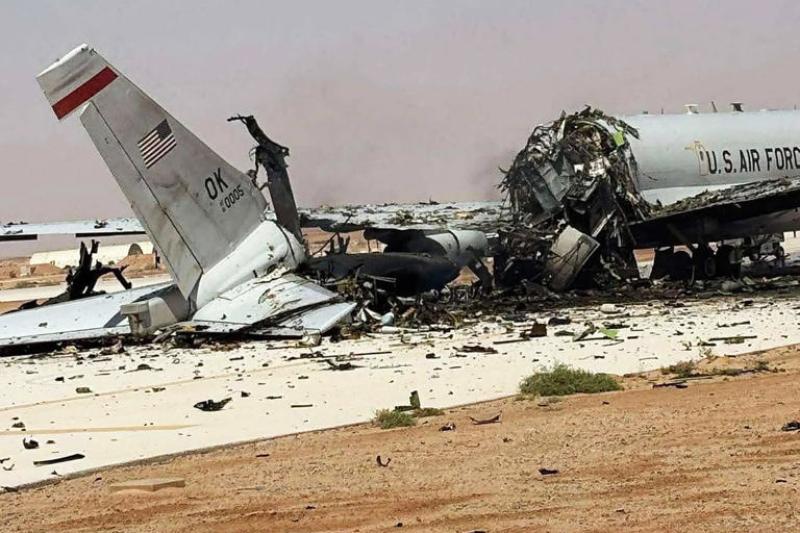

Somebody miscalculated.
 S E E D E D C O N T E N T

March 30, 2026 -- The destruction of a warning and control system aircraft in an Iranian attack on an American base in Saudi Arabia could impact the U.S. military’s ability to monitor threats from Iran — and raises questions around its preparedness for a “longer war,” experts say.
Images verified by NBC News after they surfaced online appear to show much of the back end of E-3 Sentry jet was destroyed at the Prince Sultan Air Base, the tail lying at an angle on the ground surrounded by debris.
Several American service members were injured in Friday's strike on the facility which sits around 80 miles southeast of the kingdom's capital, Riyadh, and at least one aircraft had been damaged in the strike, two U.S. officials who spoke on the condition of anonymity confirmed to NBC News.
NBC News has reached out to U.S. Central Command for comment.
“Iran is gradually eating away at the network of early warning systems that the US has built over decades in the region,” Andreas Krieg, a senior lecturer at King’s College London’s School of Security Studies, said in written comments to NBC News on Monday.
“Collectively each radar or (Intelligence, Surveillance, and Reconnaissance) platform destroyed further degrades the overall monitoring capability of the U.S.,” he said.
The E-3 Sentry, an airborne warning and control system, or AWACS, jet was one six stationed at Prince Sultan Air Base prior to Friday's attack, according to Air & Space Forces Magazine, one of the world's foremost publications on the aerospace industry. Prior to the strike, the U.S. had 16 in total, the magazine reported.
NBC News has reached out to U.S. Central Command for comment on the number of E-3 Sentry planes.
Krieg said the U.S. should have foreseen such an attack and “should have been prepared better for a longer war,” particularly “fighting from permanent installations, especially in a theatre where the other side has large numbers of ballistic missiles, cruise missiles and one-way attack drones.”
Still, he said he believed the U.S. was still doing a “reasonably effective job overall of protecting its assets in a very difficult theatre,” with “most incoming threats” reportedly being intercepted.
Retired U.S. Army Lt. Col. Daniel Davis, a Bronze Star winner who served for 21 years, disagreed.
“We’re not doing OK at all,” he said in a telephone interview Monday. Dennis, a senior fellow and military expert at Defense Priorities, a Washington-based think tank, added that the U.S. was “not militarily prepared for this to be a sustained war.”
“There were too many in the administration that thought this was going to be a quick and easy thing,” he said, adding that the “Iranian side still has plenty of missiles to keep going at a sustained rate.”
“If we’ve had this much trouble with what was considered a militarily inferior Iran, what does anybody think would happen if we had to fight on the ground, in the sea and in the air against a Russia or a China?”
But Burcu Ozcelik, a senior research fellow at the Royal United Services Institute, a London-based think tank, said in a separate interview that there was “a risk of underestimating or understating the nature of the damage inside Iran,” particularly given the communications blackouts in the Islamic Republic.
People should be “cautious at this stage of the war about overstating the extent of damage that the U.S. forces have a sustained,” she said.
Meanwhile, Ukrainian intelligence shared with NBC News by President Volodymyr Zelenskyy in an interview over the weekend suggested that Russia could also be playing a role in aiding Iran in its attacks on U.S. assets in the region.
In an interview in Qatar on Saturday, Zelenskyy said he was “100%” confident Moscow was sharing such intelligence with Tehran to aid in targeting U.S. forces across the Middle East in the war, which began after the U.S. and Israel launched strikes on Iran on Feb. 28.
“Moscow has every incentive to tie down U.S. military resources in the Middle East, raise costs for Washington, and reward Tehran for the military support Iran has given Russia elsewhere,” Krieg said.
Still, he said he would not go so far as to suggest that Russian assistance might be “the reason Iran is succeeding.”
Ultimately, he said, “U.S. protection has been competent” in its war with Iran, “but not optimal.”
“It has been good enough to preserve operations, but not good enough to prevent embarrassing and costly losses.”
Be a good human. Grossly derogatory comments, blatantly inflammatory comments, excessive trolling, mean-spirited taunting and insults, scamming, spamming, and off topic comments may be removed in compliance with the site's Terms of Service and the Code of Conduct. The moderators have the final word.

Tags
Who is online
122 visitors
How long can the United States sustain losses of critical military systems? The loss of ground radar, airborne radar, and refueling capacity is considerably more serious than just normal cost of doing business.
If our military is that thin that it can be handicapped by the losses we've sustained so far, we need to double the military budget.
Spending the entire Federal budget on the military won't alter the fact that losing a critical unit requires repositioning a replacement from somewhere else. And there's a gap in the theater capability until the replacement arrives.
Why were E-3 Sentries parked in a vulnerable area without adequate defense? Somebody did not do their job.
The loss of the USS Gerald R. Ford to sloppy housekeeping has required repositioning the USS George H.W. Bush away from the Venezuela/Caribbean mission to the Middle East.
Why should we double, triple, quadruple military spending to overcome inattention to detail, lack of adequate planning, and complacency in performance of duties? Parking 10 times more E-3 Sentries in a vulnerable area is not a viable defense.
The Engineering officer has had his hands full, so to speak.
The laundry room fuck up caused a loss of 100 sleeping units and presumably the personal effects of 100 sailors, maybe more if they were hot swaps.
Prior to that the plumbing system has been a nightmare
The Navy insists that this doesn't affect operational readiness.
Not even Sean Hannity believes that lie.
The problem is geography. Can we afford to pull them away from other assignments.
Instead of a gold Air Force One, maybe Boeing should be rushing an AWACS replacement contract.
The KC problem isn't as pronounced, several are already repaired and air worthy.
Plus they are in the process of determining which to retire as the Pegasus comes on line. (K-46)
There are generally about 300 available in one variation or another.
Boeing stopped producing 707 airframes in 1991. The replacements must come from boneyards.
Boeing stopped producing the passenger 767 airframes in 2014 and plans to end 767 freight airframes next year. The 767 is another end-of-life aircraft kept alive with military contracts.
The 747 airframe is also an obsolete aircraft kept alive by military contracts.
The KC 135 is shorter and narrower than the 707 airliner.
There were 820 total Tankers. The contract for the Pegasus was 178 but has been extended to produce 288
so there should be no shortage s there are over 370 KC 135 s left in flying status in the us military.
There were only 68 E-3s based on that 707 airliner so while there were thousands of 707 airliners built they are all older than 36 years,
not a great idea to modify a 36 year old plane like that, but possible as opposed to taking something appropriate
like a USAF 737 Wedgetail and starting a new AWACS project based on that airframe.