
American Revolution begins at Battle of Lexington | April 19, 1775

By: HISTORY
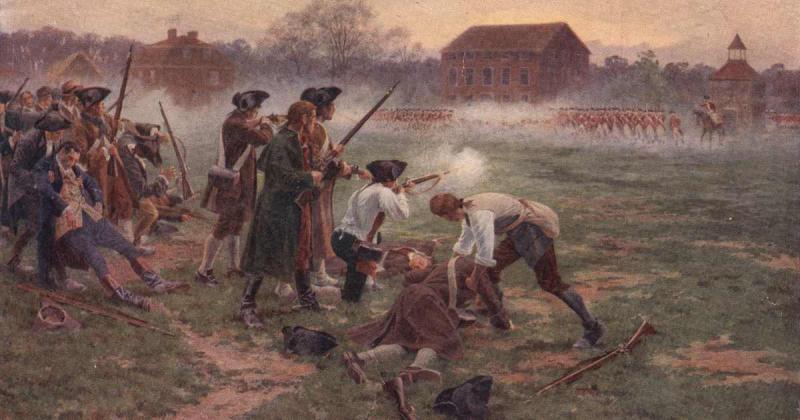

The day a single shot, in a misguided show of force, reverberated round the world and throughout time to today.
 S E E D E D C O N T E N T

April 19, 1775: At about 5 a.m., 700 British troops, on a mission to capture Patriot leaders and seize a Patriot arsenal, march into Lexington to find 77 armed minutemen under Captain John Parker waiting for them on the town's common green. British Major John Pitcairn ordered the outnumbered Patriots to disperse, and after a moment's hesitation, the Americans began to drift off the green. Suddenly, a shot was fired from an undetermined gun, and a cloud of musket smoke soon covered the green. When the brief Battle of Lexington ended, eight Americans lay dead or dying and 10 others were wounded. Only one British soldier was injured, but the American Revolution had begun.
Boston Massacre Sparks a Revolution
The shooting of several men by British soldiers in 1770 inflames passions in the colonies.
1:42m watch
By 1775, tensions between the American colonies and the British government approached the breaking point, especially in Massachusetts, where Patriot leaders formed a shadow revolutionary government and trained militias to prepare for armed conflict with the British troops occupying Boston. In the spring of 1775, General Thomas Gage, the British governor of Massachusetts, received instructions from England to seize all stores of weapons and gunpowder accessible to the American insurgents. On April 18, he ordered British troops to march against the Patriot arsenal at Concord and capture Patriot leaders Samuel Adams and John Hancock, known to be hiding at Lexington.
The Boston Patriots had been preparing for such military action by the British for some time, and upon learning of the British plan, Patriots Paul Revere and William Dawes were ordered to set out to rouse the militiamen and warn Adams and Hancock. When the British troops arrived at Lexington, a group of militiamen was waiting. The Patriots were routed within minutes, but warfare had begun, leading to calls to arms across the Massachusetts countryside.
When the British troops reached Concord at about 7 a.m., they found themselves encircled by hundreds of armed Patriots. They managed to destroy the military supplies the Americans had collected but were soon advanced against by a gang of minutemen, who inflicted numerous casualties. Lieutenant Colonel Francis Smith, the overall commander of the British force, ordered his men to return to Boston without directly engaging the Americans. As the British retraced their 16-mile journey, their lines were constantly beset by Patriot marksmen firing at them from behind trees, rocks, and stone walls. At Lexington, Captain Parker's militia had its revenge, killing several British soldiers as the Red Coats hastily marched through his town. By the time the British finally reached the safety of Boston, nearly 300 British soldiers had been killed, wounded or were missing in action. The Patriots suffered fewer than 100 casualties.
The battles of Lexington and Concord were the first battles of the American Revolution, a conflict that would escalate from a colonial uprising into a world war that, seven years later, would give birth to the independent United States of America.
Also on This Day in History
Discover more of the major events, famous births, notable deaths and everything else history-making that happened on April 19th
1809 -- Thomas Jefferson sells indentured servant to newly elected President James Madison
On April 19, 1809, former President Thomas Jefferson writes up a contract for the sale of an indentured servant named John Freeman to newly sworn-in President James Madison. Slavery and indentured servitude were major components of the early American economy. Enslaved workers performed most of the manual and domestic labor on the large plantations owned […]
1824 -- Lord Byron dies in Greece
George Gordon Byron, 6th Baron Byron, dies in what is now Greece, where he had traveled to support the Greek struggle for independence from Turkey. Even today, he is considered a Greek national hero. Byron's scandalous history, exotic travels, and flamboyant life made such an impression on the world that the term "Byronic" was coined […]
1861 -- First blood in the Civil War
On April 19, 1861, the first blood of the American Civil War is shed when a secessionist mob in Baltimore attacks Massachusetts troops bound for Washington, D.C. Four soldiers and 12 rioters were killed. One week earlier, on April 12, the Civil War began when Confederate shore batteries opened fire on Union-held Fort Sumter in […]
1863 -- Union Colonel Abel Streight's raid into Alabama and Georgia begins
Union Colonel Abel Streight begins a raid into northern Alabama and Georgia with the goal of cutting the Western and Atlantic Railroad between Chattanooga, Tennessee and Atlanta. The raid ended when Confederate General Nathan Bedford Forrest captured Streight's entire command near Rome, Georgia. The plan called for Streight and General Grenville Dodge to move from […]
1897 -- First Boston Marathon held
On April 19, 1897, John J. McDermott of New York won the first Boston Marathon with a time of 2:55:10. The Boston Marathon was the brainchild of Boston Athletic Association member and inaugural U.S. Olympic team manager John Graham, who was inspired by the marathon at the first modern Olympic Games in Athens in 1896. […]
1919 -- Discussion of Italian claims begins at Paris peace conference
On April 19, 1919, the Saturday before Easter, tense and complicated negotiations begin at the Paris peace conference over Italy's claims to territory in the former Austro-Hungarian Empire. The Italians must somehow be mollified, wrote Britain's foreign secretary, Arthur Balfour, and the only question is how to mollify them at the smallest cost to mankind. […]
1943 -- Warsaw Ghetto Uprising begins
In Warsaw, Poland, Nazi forces attempting to clear out the city's Jewish ghetto are met by gunfire from Jewish resistance fighters, and the Warsaw Ghetto Uprising begins. Shortly after the German occupation of Poland began, the Nazis forced the city's Jewish citizens into a "ghetto" surrounded by barbwire and armed SS guards. The Warsaw ghetto […]
1947 -- President Truman inaugurates White House bowling alley
President Harry S. Truman officially opens the first White House bowling alley on April 19, 1947. The two-lane bowling alley, situated in the West Wing, had been constructed earlier that year. According to Smithsonian magazine, a group of Truman's fellow Missourians funded the construction of the bowling alley in honor of the president. They had […]
1956 -- Grace Kelly and Prince Rainier of Monaco marry in "wedding of the century"
On April 19, 1956, American film actress Grace Kelly, 26, marries Prince Rainier of Monaco, 32, in a spectacular ceremony—a "royal wedding of the century" watched by more than 30 million viewers on live television. The two had begun a secret correspondence after the Hollywood star was introduced to the prince in May of 1955 […]
1971 -- Vietnam Veterans Against the War demonstrate
As a prelude to a massive antiwar protest, Vietnam Veterans Against the War begin a five-day demonstration in Washington, D.C. The generally peaceful protest, called Dewey Canyon III in honor of the operation of the same name conducted in Laos, ended on April 23 with about 1,000 veterans throwing their combat ribbons, helmets, and uniforms […]
1989 -- Central Park jogger attack shocks New York City
On April 19, 1989, a 28-year-old female investment banker is beaten and sexually assaulted while jogging in New York City's Central Park. Five teenagers from Harlem were wrongly convicted of the crime, which shocked New Yorkers for its randomness and viciousness and became emblematic of the perceived lawlessness of the city at the time. The […]
1993 -- Waco Siege ends; Branch Davidian compound burns
At Mount Carmel in Waco, Texas, on April 19, 1993, the Federal Bureau of Investigation (FBI) launches a tear-gas assault on the Branch Davidian compound, ending a tense 51-day standoff between the federal government and an armed religious cult. By the end of the day, the compound was burned to the ground, and some 80 […]
1995 -- Oklahoma City bombing
Just after 9 a.m. on April 19, 1995, a massive truck bomb explodes outside the Alfred P. Murrah Federal Building in Oklahoma City, Oklahoma. The blast collapsed the north face of the nine-story building, instantly killing more than 100 people and trapping dozens more in the rubble. Emergency crews raced to Oklahoma City from across […]
Be a good human. Grossly derogatory comments, blatantly inflammatory comments, excessive trolling, mean-spirited taunting and insults, scamming, spamming, and off topic comments may be removed in compliance with the site's Terms of Service and the Code of Conduct. The moderators have the final word.

Tags
Who is online
105 visitors
The moral of that day, 251 years ago, is that force can rouse independence more readily than it can secure surrender.