
Adolf Hitler commits suicide in his underground bunker | April 30, 1945

By: HISTORY
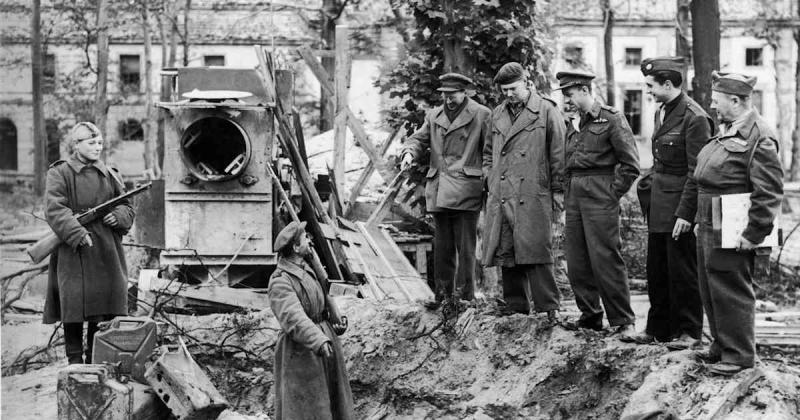


There's a photo scroll in the seed article that shows what Victory really looks like. Check it out.
 S E E D E D C O N T E N T
On April 30, 1945, holed up in a bunker under his headquarters in Berlin, Adolf Hitlercommits suicide by swallowing a cyanide capsule and shooting himself in the head. Soon after, Germany unconditionally surrendered to the Allied forces, ending Hitler's dreams of a "1,000-year" Reich.
Since at least 1943, it was becoming increasingly clear that Germany would fold under the pressure of the Allied forces. In February of that year, the German 6th Army, lured deep into the Soviet Union, was annihilated at the Battle of Stalingrad, and German hopes for a sustained offensive on both fronts evaporated. Then, in June 1944, the Western Allied armies landed at Normandy, France, and began systematically to push the Germans back toward Berlin. By July 1944, several German military commanders acknowledged their imminent defeat and plotted to remove Hitler from power so as to negotiate a more favorable peace. Their attempts to assassinate Hitler failed, however, and in his reprisals, Hitler executed over 4,000 fellow countrymen.
Hitler Commits Suicide
In this scene, Hitler comes to the realization that this is the end as the Allies successfully invade Europe and continue to liberate territories.
2:05m watch
In January 1945, facing a siege of Berlin by the Soviets, Hitler withdrew to his bunker to live out his final days. Located 55 feet under the chancellery, the shelter contained 18 rooms and was fully self-sufficient, with its own water and electrical supply. Though he was growing increasingly mad, Hitler continued to give orders and meet with such close subordinates as Hermann Goering, Heinrich Himmler and Josef Goebbels. He also married his long-time mistress Eva Braun just one day before his suicide.
In his last will and testament, Hitler appointed Admiral Karl Donitz as head of state and Goebbels as chancellor. He then retired to his private quarters with Braun, where he and Braun poisoned themselves and their dogs, before Hitler then also shot himself with his service pistol.
Hitler and Braun's bodies were hastily cremated in the chancellery garden, as Soviet forces closed in on the building. When the Soviets reached the chancellery, they removed Hitler's ashes, continually changing their location so as to prevent Hitler devotees from creating a memorial at his final resting place. Only eight days later, on May 8, 1945, the German forces issued an unconditional surrender, leaving Germany to be carved up by the four Allied powers.
<<PHOTO SCROLL>>
Also on This Day in History
Discover more of the major events, famous births, notable deaths and everything else history-making that happened on April 30th
1789 -- George Washington gives first presidential inaugural address
On April 30, 1789, George Washington is sworn in as the first American president and delivers the first inaugural speech at Federal Hall in New York City. Elements of the ceremony set tradition; presidential inaugurations have deviated little in the two centuries since Washington's inauguration. In front of 10,000 spectators, Washington appeared in a plain […]
1803 -- United States and France complete the Louisiana Purchase
On April 30, 1803, representatives of the United States and Napoleonic France complete negotiations for the Louisiana Purchase, a massive land sale that doubles the size of the young American republic. What was known as Louisiana Territory comprised most of modern-day United States between the Mississippi and the Rocky Mountains, with the exceptions of Texas, […]
1859 -- First installment of "A Tale of Two Cities" is published
On April 30, 1859, the first chapter of Charles Dickens' serialized novel, A Tale of Two Cities, is published in Dickens' circular, All the Year Round. It rolls out over 31 weekly installments, with the last one appearing that November. Dickens was born in 1812 and attended school in Portsmouth. His father, a clerk in […]
1863 -- Battle of Chancellorsville begins
On April 30, 1863, the Battle of Chancellorsville begins in Virginia. Earlier in the year, General Joseph Hooker led the Army of the Potomac into Virginia to confront Robert E. Lee's Army of Northern Virginia. Hooker had recently replaced Ambrose Burnside, who presided over the Army of the Potomac for one calamitous campaign the previous […]
1897 -- British physicist J.J. Thomson announces the discovery of electrons
On April 30, 1897, British physicist J.J. Thomson announced his discovery that atoms were made up of smaller components. This finding revolutionized the way scientists thought about the atom and had major ramifications for the field of physics. Though Thomson referred to them as "corpuscles," what he found is more commonly known today as the […]
1917 -- Battle of the Boot takes place between Anglo-Indian and Turkish forces
On April 30, 1917, the so-called Battle of the Boot marks the end of the British army's Samarrah Offensive, launched the previous month by Anglo-Indian forces under the regional commander in chief, Sir Frederick Stanley Maude, against the important Turkish railroad at Samarra, some 130 kilometers north of Baghdad, in Mesopotamia (modern-day Iraq). Fresh from […]
1939 -- New York World's Fair opens
On April 30, 1939, the New York World's Fair opens in New York City. The opening ceremony, which featured speeches by President Franklin D. Roosevelt and New York Governor Herbert Lehman, ushered in the first day of television broadcasting in New York. Spanning 1,200 acres at Flushing Meadow Park in Queens, the fairground was marked […]
1948 -- Original Land Rover debuts at auto show
The Land Rover, a British-made all-terrain vehicle that will earn a reputation for its use in exotic locales, debuts at an auto show in Amsterdam on April 30, 1948. The first Land Rover, known as the Series 1, was the brainchild of Maurice Wilks, the head designer for the British car company Rover, of which […]
1975 -- Fall of Saigon: South Vietnam surrenders
The South Vietnamese stronghold of Saigon (now known as Ho Chi Minh City) falls to People's Army of Vietnam and the Viet Cong on April 30, 1975. The South Vietnamese forces had collapsed under the rapid advancement of the North Vietnamese. The most recent fighting had begun in December 1974, when the North Vietnamese had […]
1977 -- Over 2,000 protesters occupy the Seabrook Nuclear Power Plant construction site
On April 30, 1977, more than 2,000 protesters occupy the Seabrook Nuclear Power Plant construction site in New Hampshire; 1,414 of these activists are arrested in what becomes one of the largest mass arrests in American history. Anti-nuclear demonstrators set up tents and toted signs reading "Split Wood, Not Atoms" and "Go Fishing, Not Fission" […]
1993 -- World Wide Web (WWW) launches in the public domain
On April 30, 1993, four years after publishing a proposal for "an idea of linked information systems," computer scientist Tim Berners-Lee releases the source code for the world's first web browser and editor. Originally called Mesh, the browser that he dubbed WorldWideWeb becomes the first royalty-free, easy-to-use means of browsing the emerging information network that […]
1993 -- Tennis star Monica Seles stabbed
Top women's tennis player Monica Seles is stabbed by a deranged German man during a match in Hamburg. The assailant, a fan of German tennis star Steffi Graf, apparently hoped that by injuring Seles his idol Graf would be able to regain her No. 1 ranking. Seles became the youngest woman to win the French […]
1997 -- Controversial "coming out" episode of "Ellen" airs
On April 30, 1997, in a widely publicized episode of the ABC sitcom "Ellen," TV character Ellen Morgan (played by Ellen DeGeneres) announces that she is gay. DeGeneres, a former stand-up comedian who was born on January 26, 1958, became part of the ensemble cast of the ABC series "These Friends of Mine" in 1994. […]
1997 -- Big Ben clock stops at 12:11 p.m. for 43 minutes
On April 30, 1997, at exactly 12:11 pm, London's iconic Big Ben clock stops ticking. For 43 minutes, the most famous clock in the world, which strikes the note of E every hour, failed to keep time. According to Britain's Daily Telegraph, engineers traced the problem to the mechanism that controls the hands on the […]
2019 -- Japan's Emperor Akihito abdicates
On April 30, 2019, Japan's 85-year-old Emperor Akihito steps down from the throne, becoming the first Japanese monarch to abdicate in over 200 years. Akihito was born on December 23, 1933, the eldest son of Emperor Hirohito, who had ruled Japan since 1926. Akihito was born two years after the Japanese invasion of Manchuria, the […]
Be a good human. Grossly derogatory comments, blatantly inflammatory comments, excessive trolling, mean-spirited taunting and insults, scamming, spamming, and off topic comments may be removed in compliance with the site's Terms of Service and the Code of Conduct. The moderators have the final word.

Tags
Who is online
114 visitors
Some days really are momentous.
It really is a stark contrast when thinking about how far we've come as a nation since some momentous days, and also to reflect on how far we have to go to make our founders dreams of a more perfect union come true.
I doubt very much Washington bragged to anyone about his inauguration crowd size, he had far more important things to worry about and accomplish. Any objective review would likely see that as telling commentary on where we are today and how far from our founder's vision we have fallen.
You know, they ARE putting an underground bunker under Trump's ballroom, and Hitler IS his favorite author.......Just sayin'.
[✘]
It's likely Mo Willems. He writes books at Donalds reading level.
It's pretty obvious Trump has a hard time reading anything that doesn't have pictures to clue him in on the plot. It's a trait he shares with many of his supporters.
[✘]
[✘]