
Trump's European car tariffs show why his 'deals' are worthless

By: Eric Boehm (Reason. com)
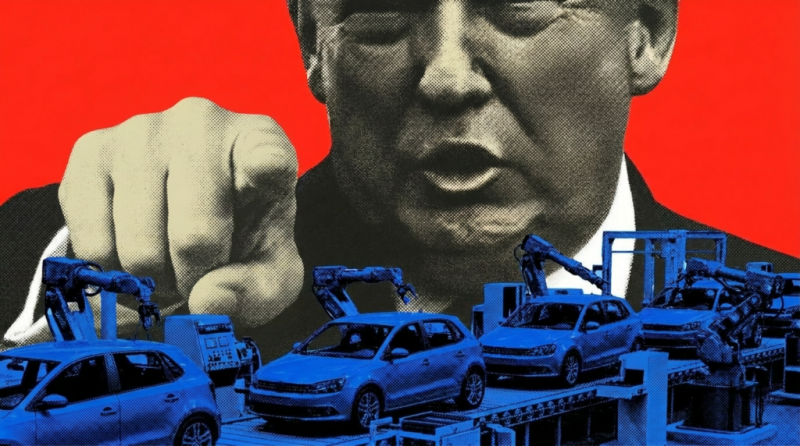


President Trump's deals aren't worth the paper they're written on. Now that everyone is catching on to the scam, Trump will have to increasingly rely on violent threats to get any sort of deal in the future.
 S E E D E D C O N T E N T
May 4, 2026 -- When President Donald Trump struck a trade deal with the European Union in July, officials on both sides stressed how it would ensure long-term stability to trans-Atlantic trade.
The Trump administration called the deal a "generational modernization of the transatlantic alliance." European Commission President Ursula von der Leyen said it "restores stability and predictability" by locking in 15 percent tariffs on most European goods exported to the U.S., while most American imports to Europe would be exempt from tariffs.
In other words, Trump got what he wanted out of that deal: A reduction in tariffs on American exports and the establishment of a new, permanent baseline tariff on European goods. European leaders also felt like they'd won something: the 15 percent tariff was lower than the 25 percent tariff Trump had threatened, and the deal would stop Trump from hiking tariffs the next time he was in a bad mood.
So much for that.
On Friday, Trump announced that he would raise tariffs on European-made cars to 25 percent. (Those tariffs are authorized by Section 232 of the Trade Expansion Act of 1962, so they are not affected by the Supreme Court's ruling in February that limited some of the president's power to impose tariffs unilaterally.)
Those higher tariffs could cost automakers $4 billion this year.
In a post on Truth Social, Trump said the tariff hike was in response to the E.U. "not complying with our fully agreed to Trade Deal."
The trade deal, however, is not fully agreed to, so it is hard to understand how the Europeans could be breaking it. The E.U. is still in the process of ratifying it—even though it cleared the main legislative hurdle in March—and the Trump administration has not even asked Congress to approve it. Adding to the confusion is the fact that European trade officials visited the White House just weeks ago, and everyone seemed to be getting along. After that meeting, the U.S. and E.U. announced a new joint partnership for some strategically important minerals.
Trump's sudden decision to hike tariffs has now put the entire deal at risk—and once again escalated tensions with Europe.
Bernd Lange, chair of the European Parliament's International Trade Committee, wrote on Twitter that Trump's sudden tariff hike was "unacceptable."
"Trust is good, but against arbitrariness, only clear rules help," he added.
He's right. Friday's announcement reveals, once again, how little any trading partner can trust Trump. The president's word is effectively worthless, and his "deals" are subject to change at any time, for any reason. Who would enter into serious negotiations with someone like that?
Convincing other countries to negotiate better trading terms with the U.S. had been a central promise of Trump's tariff regime. But this new spat over imported cars shows that Trump still doesn't understand why trade deals matter in the first place.
The whole point of a trade deal is to provide stability for individuals and businesses as they plan transactions and capital investments. A 15 percent tariff is costly, but a 15 percent tariff that can be hiked to 25 percent (or higher) at the drop of a hat will have consequences that go well beyond the higher taxes.
That means Trump's threat to blow up the E.U. trade deal also undermines the ability of private citizens and businesses in other parts of the world to invest in the United States.
A tariff increase would "threaten the progress that has already been made to open EU markets and grow the U.S. auto industry," Jennifer Safavian, CEO of Autos Drive America, an industry group, told the Associated Press.
Those tariffs would be another blow to an auto industry that's already suffering from America's tariffs on steel and aluminum, and from the ongoing costs of Trump's illegal war with Iran. Thanks to the tariffs and the closure of the Strait of Hormuz, aluminum prices are 90 percent higher than they were one year ago, The Wall Street Journalreports.
It's not clear what Trump hopes to accomplish by slapping higher tariffs on European cars. Indeed, it's not even clear why he made this decision.
Regardless, a trade "deal" that can be torn up by one person at the drop of a hat is not really a trade deal at all. That's why Congress must take away presidential power over tariffs.
Be a good human. Grossly derogatory comments, blatantly inflammatory comments, excessive trolling, mean-spirited taunting and insults, scamming, spamming, and off topic comments may be removed in compliance with the site's Terms of Service and the Code of Conduct. The moderators have the final word.

Tags
Who is online
105 visitors
President Donald Trump has earned a reputation of being a dishonest scammer. No one wants to make deals with Trump because they're worthless.
That's why Iran won't negotiate with Trump. Trump's promises mean nothing.
Trump did the equivalent when he took office in 2025. He imposed tariffs on Canada, which was operating under the USMCA trade deal that Trump 'negotiated' in his first term.
Everything touched by Trump dies...