
2026 World Cup Is at Risk of Being a Colossal Dud

By: Hugh Cameron (Newsweek)
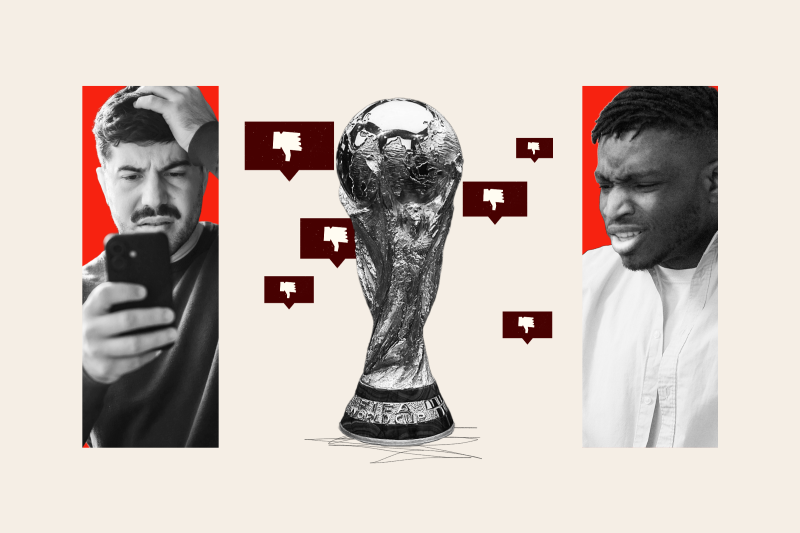


President Trump fought hard to bring foreign football and an invasion of foreign tourists to celebrate America's 250th anniversary? And now it appears that the FIFA spectacular will benefit foreigners while dumping the burden on Americans. But, hey, Trump received a 'peace' participation award. First ever. The world's never seen anything like it before.
Typical Trump. Seeking global accolades at America's expense.
 S E E D E D C O N T E N T
May 11, 2026 -- Years of preparations and the promise of a multibillion-dollar economic boost were supposed to make the 2026 FIFA World Cup a summer-long victory lap for the United States.
"I worked hard on this, along with a Great Team of talented people," Trump said in a post on X when the U.S. secured the co-hosting bid with Canada and Mexico during his first term. "We never fail, and it will be a great World Cup!"
Overlapping with America's 250th anniversary, the competition has been framed as the jewel in America's crowning year, as well as a major lift for the U.S. tourism sector. But with only a month until kick-off, hotels remain under-booked, tickets unsold, and travelers unconvinced, leaving the world's most-watched sporting event at risk of falling short of its most ambitious expectations.
Newsweek has contacted FIFA for comment.
The World Cup's $30-billion Promise
FIFA and its president Gianni Infantino have billed the 48-team competition as a pivotal opportunity for soccer in general and the U.S. in particular—set to host 78 of the record 104 matches across 11 of its cities, including the July 19 final at MetLife Stadium.
In a joint study with the World Trade Organization (WTO) published last March, FIFA forecast that the tournament would generate $80.1 billion in gross economic impact, with $30.5 billion of this going toward the U.S.
And the wave of fans is expected to fuel a windfall for businesses of all stripes and cities aside from those where matches are taking place.
"The numbers are striking," the U.S. Travel Association wrote in a recent report. "International World Cup visitors expect to spend more than $5,000 per person; 1.7 times more than typical international trips to the U.S."
The nonprofit trade group found, based on surveys of over 9,500 prospective attendees, that around a third intend to stay beyond two weeks, and that over 80 percent are "open to visiting destinations beyond the largest gateway cities, unlocking economic opportunity in communities across the country."
Federal and local officials say years of planning and hundreds of millions in security and infrastructure spending have gone into preparing host cities for the tournament.
The Harsh Realities of Hosting
Yet for all the lofty promises and costly preparations that have been made, data on travel, tickets and hotel occupancy rates are previewing a tournament that will fall shy—at least economically—of the "104 Super Bowls" FIFA's president forecast last year.
"Every match is sold out," Infantino said back in February, a claim the organization walked back only days later. This followed an inquiry from The Athletic as to how this could be true when tickets were still listed on FIFA's website. And now four weeks out, many remain available through its recently opened "last-minute" batch.
And then there are resale markets, where prices for nearly every match appear to be in free fall, according to TicketData.com. Fans are now able to secure a seat at Saudi Arabia v. Cabo Verde for around $160, down from $234 in late April and over $600 for December buyers.
The trend points to softer-than-expected appetite among fans, one FIFA's president apparently failed to anticipate. Infantino previously likened the pull of this competition to "1,000 years of World Cups at once," but supply, for now, is outstripping demand when it comes to tickets as well as the broader services ecosystem sustaining the spectacle.
Travel indicators also point to weaker demand. During the October-January booking period, European airline reservations to the U.S. for July were down 14 percent year-over-year, according to Cirium data cited in Forbes. For host cities, bookings for June—made between December and January—fell five percent and 3.6 percent from Europe and Asia, respectively.
And hotels tell the downstream story. Game-day room rates across several host cities have dropped by around a third from earlier peaks, according to figures from Lighthouse Intelligence quoted in the Financial Times.
In December, Baird Equity Research projected that the competition would lift U.S. hotels' revenue per available room (RevPAR) by 75 to 100 basis points. But Michael Bellisario, senior research analyst at Baird, told Newsweek that he would now scale this back to a more modest 25-50 basis points amid, among other things, "hesitancy from foreign travelers to come to the United States."
This aligns with a report from OysterLink, which forecast "a modest gain compared to previous World Cup cycles" for America's hoteliers.
The Boston Business Journal reported in March that FIFA itself had cancelled tens of thousands of reserved rooms across host cities in the U.S., Canada and Mexico.
And a survey of owners and operators by the American Hotel and Lodging Association (AHLA) found that 80 percent of those in U.S. host markets said bookings were "tracking below initial forecasts." This figure rose to 85-to-90 percent in Kansas City, where demand is "trailing a typical June or July."
"Many respondents describe the tournament as a 'non-event' in these cities," the report read, "citing late FIFA room releases and weak international fan travel as the dominant concerns across markets."
Other markets are faring better. Chris Hardman, the president of the Georgia Hotel & Lodging Association, told Newsweek that Atlanta continues to "stand out nationally in booking pace sentiment ahead of the FIFA World Cup," and said activity was expected "to accelerate significantly" in the coming days and weeks.
But Vijay Dandapani, President and CEO of the Hotel Association of New York City, told Newsweek that demand tied to the World Cup had so fallen far short of expectations. While hotels had anticipated an additional 1.2 million international visitors during the competition, Dandapani said bookings at New York hotels were up by "a maximum of 10 percent year-on-year," and that nearly half had "seen no business thus far."
"While there may be a late-stage uptick as we get to the middle of May we do not expect it to measure up to what was previously predicted," he said, adding that the city's hotels now expect to miss out on more than $100 million in anticipated room revenue.
What Is Behind the Softer Demand?
Even for an event as globally magnetic as the World Cup, traveler enthusiasm remains governed by the need for stability and security.
"Visitors aren't just coming for the matches, they are coming to experience America," Geoff Freeman, president and CEO of the U.S. Travel Association, wrote in a recent analysis.
Studies and conversations with industry insiders reveal several reasons behind currently muted demand—from a strong dollar to rising airfares—but international unease about travelling to Trump's America emerged as a common motif.
Last week, over 120 groups issued a warning to prospective attendees, urging them to exercise caution when travelling to the U.S.
"Visa processing concerns, rising travel costs, transportation surcharges, and proposed tax increases in some host markets are all contributing to uncertainty and could impact international visitation if not addressed thoughtfully," Hardman said.
Dandapani similarly pointed to "the federal government's draconian approach to visas" as a major deterrent.
And the AHLA survey revealed that 70 percent of hotel owners and operators say visa barriers alongside "broader geopolitical concerns" were "significantly suppressing international demand."
"Forward indicators show there is still meaningful opportunity ahead," a spokesperson for the AHLA told Newsweek. "We expect the stadiums will be full, but to fully realize the opportunity, the U.S. and FIFA must ensure a welcoming and seamless experience for international travelers."
Has FIFA Oversold the Spectacle?
Hoping to assuage concerns around immigration enforcement and potential difficulties at the border, FIFA's president last year insisted that "the world is welcome in America."
But safety assurances are not the only barrier to attendance, and slow sales reveal that sky-high ticket prices for even the less bankable matches have proven an effective way of keeping some fans at home.
According to an analysis by The Guardian in December, this year's cheapest seats are still around six times more costly than the 2006-2022 average. In response, Football Supporters Europe—a non-profit member association of soccer fans—filed a formal complaint with the European Commission in March against FIFA for abusing "its monopoly position to impose excessive ticket prices."
And while even the cheapest seats are now several times costlier than those in Qatar in 2022, FIFA's "dynamic pricing" model allows prices to surge significantly based on day-to-day demand.
FIFA's president has defended the costs as justified in a country where attending a "college game" can command prices into the hundreds of dollars, and said that resellers would always abide by market rates.
But the argument fell flat among one likely attendee.
In an interview with the New York Post last week, Trump was asked for comment on the $1,000 price tag for the home team's opening game against Paraguay on June 12.
"I wouldn't pay it either, to be honest with you," he said.
Be a good human. Grossly derogatory comments, blatantly inflammatory comments, excessive trolling, mean-spirited taunting and insults, scamming, spamming, and off topic comments may be removed in compliance with the site's Terms of Service and the Code of Conduct. The moderators have the final word.

Tags
Who is online
105 visitors
Betcha President Trump won't give back his 'peace prize'. Trump got his. The rest of us can just pound sand.
Next on the agenda? Asian kickboxing on White House grounds. And a European Grand Prix on the streets of D.C. Can't get more un-American than that.
With all that is going on, because of Trump, it is very sensible that people choose to boycott America. Who could blame them? We already know that tourism and other travel to the USA is down, almost certainly due to the tariff and trolling antics of the buffoon in chief.
Per ChatGPT:
No one wants to risk coming here because of ICE.
Morning...nah here it's a case of who wants to be sitting on a 14 hour flight only to be denied entry because some bogan official in Immigration is having a bad day...
Regardless if you have all the appropriate visas etc it comes down to that one individual at the airport.. nope not worth the risk of your dollars to get there and staying in the US...
And it's not just the World Cup it's general tourism to the States that is taking a hit now...never seen so many adds for holidaying in the US..they are falling on deaf ears...
Our cousin who comes every two years said sorry, maybe next trip. This time the ladies were all invited to Honolulu for a week instead of my house for two weeks.
My wife declined because we are dealing with wills, burials and hospice, I knew nothing until i saw the texts this week.
ICE apparently has a much lower profile in HI.