
Shift in Gulf states' alignment with U.S. foreign policy

By: Brahma Chellaney (The Hill)
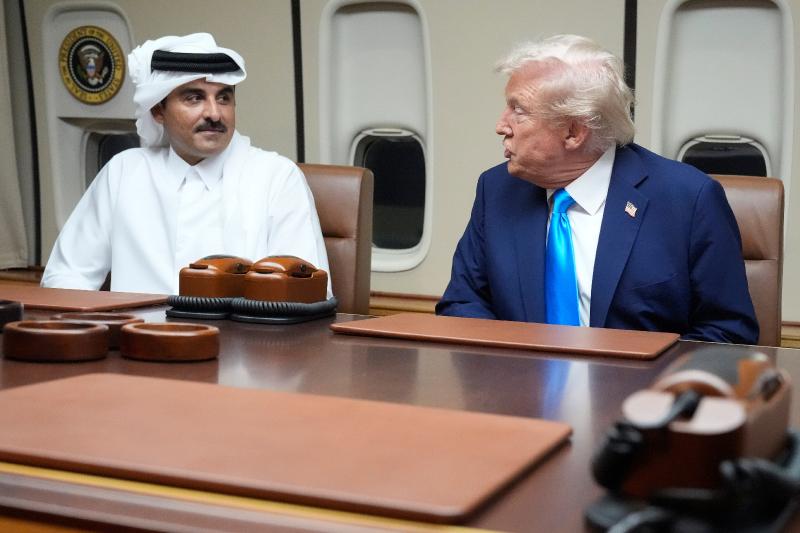


What is the value of an alliance with the United States? President Trump's stagecraft is no substitute for statecraft. Removing Trump won't repair the damage he has caused because the Republican Party is now nothing more than a rubber stamp glee club.
Under Donald Trump the United States is quickly becoming a 'former' Great Power.
 S E E D E D C O N T E N T
May 14, 2026 -- For decades, Washington treated the Gulf monarchies as the immovable pillars of American power in the Middle East. The U.S. military presence there evolved into a vast, interconnected web of bases and infrastructure stretching across Qatar, Saudi Arabia, the United Arab Emirates, Bahrain, Kuwait and Oman.
These states hosted U.S. troops, bought American weapons and aligned themselves with Washington's regional priorities. In return, they expected the ultimate prize: protection under the American security umbrella.
That bargain is now fraying — and perhaps breaking.
The most important geopolitical shift in the Middle East today is not happening in Tehran, Tel Aviv or Ankara. It is happening quietly inside the royal courts of the Gulf sheikhdoms, which are reassessing whether the U.S. is still a reliable security guarantor or merely a power that uses their territory while leaving them exposed to retaliation.
President Trump's Iran war has accelerated this reassessment dramatically.
When the U.S., in concert with Israel, launched war on Iran earlier this year, Gulf Arab states cooperated. American warplanes operated from bases on their soil. Trump singled out Saudi Arabia, Qatar and the UAE as "excellent" partners while deriding NATO allies and Indo-Pacific partners for refusing to participate.
But the praise concealed a deeper problem: The Gulf states discovered that supporting American military operations carried potentially catastrophic costs for them, as their energy facilities and desalination plants became targets of Iranian reprisals. Gulf rulers watched as the U.S. deployed enormous military resources (including Aegis-equipped destroyers and advanced interceptors) to shield Israel from Iranian retaliation while Gulf states absorbed the payback for enabling American strikes.
That experience appears to have fundamentally altered their calculations.
Another turning point came recently when Trump announced "Project Freedom," a U.S. naval initiative to escort commercial shipping through the Strait of Hormuz after Iran disrupted maritime traffic. Washington viewed the mission as a demonstration of resolve. Tehran viewed it as an escalation. The Gulf monarchies viewed it as a potential disaster.
Saudi Arabia refused to grant the U.S. access to its airspace and bases to support the operation. Kuwait followed suit. Qatar, seeking de-escalation, imposed restrictions on activity from Al-Udeid Air Base, the largest U.S. military installation in the Middle East. Without Gulf cooperation, the mission quickly became logistically and politically unsustainable. Trump abruptly suspended it after just two escorted U.S.-flagged vessels passed through the strait.
In effect, Gulf states vetoed a major American military initiative — something that would have been almost unthinkable only a year ago. Only after Trump paused the operation did Gulf governments restore U.S. access to basing and overflight rights, underscoring that such cooperation is no longer automatic but conditional.
Washington had long operated under the assumption that Gulf bases were essentially available on demand during crises in return for American military protection. Now, however, Gulf states are increasingly asking a different question: Protection for whom?
From their perspective, the current arrangements look dangerously asymmetric. The U.S. can launch operations, rotate forces and eventually withdraw. But the six Gulf states remain geographically trapped beside Iran permanently. In any confrontation between Washington and Tehran, the Gulf monarchies become the frontline targets.
The lesson these states appear to have learned from recent hostilities is stark: They are platforms for American power, not equal partners in American protection. That realization is driving a profound strategic shift.
The Gulf states no longer appear willing to practice automatic alignment with Washington. Instead, they are moving toward what might be called "transactional neutrality." In effect, they are applying Trump's own worldview back onto the U.S. itself.
"America First" is increasingly being answered with "the Gulf First."
That means Gulf monarchs are becoming far more selective about which American operations they support. The shift extends beyond military access. Major Gulf states are diversifying their defense partnerships, purchasing non-American technologies and exploring alternative security arrangements. Some Gulf governments are also intensifying diplomatic outreach to regional rivals, including Iran itself.
For them, de-escalation is no longer simply diplomacy; it is strategic self-preservation.
This should deeply concern Washington. The entire architecture of American regional dominance — air operations, naval deployments, intelligence coordination and energy security — has depended on nearly unconditional Gulf cooperation. That era may be ending.
Ironically, Trump himself has helped accelerate the process. His transactional approach to alliances convinced Gulf rulers that relationships with Washington are no longer rooted in enduring strategic commitments but in fluctuating cost-benefit calculations.
Once alliances become transactional, partners naturally begin asking whether the transaction remains worthwhile. The Gulf monarchies increasingly seem to believe it is not.
The implications extend far beyond the current Iran crisis. If Gulf states become reluctant hosts for American military operations, Washington's ability to project power across the Middle East will shrink dramatically. The U.S. may still possess unmatched military hardware, but hardware alone is insufficient without reliable access, basing and political support.
This is the strategic paradox now confronting Washington. In alienating NATO and Indo-Pacific allies while simultaneously alarming Gulf partners, Washington risks discovering that even a superpower cannot operate effectively in isolation.
The Gulf monarchies are not abandoning the U.S., but they are redefining the relationship on narrower terms. The age of blank-check cooperation is over. Gulf allies are no longer willing to be the lightning rods for U.S. military campaigns while relying on uncertain protection when retaliation arrives.
And once allies learn they can say "no" to Washington, they rarely return to automatic obedience.
Brahma Chellaney is the author of nine books, including the award-winning "Water: Asia's New Battleground."
Be a good human. Grossly derogatory comments, blatantly inflammatory comments, excessive trolling, mean-spirited taunting and insults, scamming, spamming, and off topic comments may be removed in compliance with the site's Terms of Service and the Code of Conduct. The moderators have the final word.

Tags
Who is online
199 visitors
It is rather amazing how those who covet money above all things are so easily bankrupted by reality. Donald Trump and his deluded followers have crucified the United States for a handful of silver.
Is the GOAT really a Judas, after all?
Was he ever anything else ?