
Constitutional Convention begins | May 25, 1787

By: (HISTORY)


 S E E D E D C O N T E N T
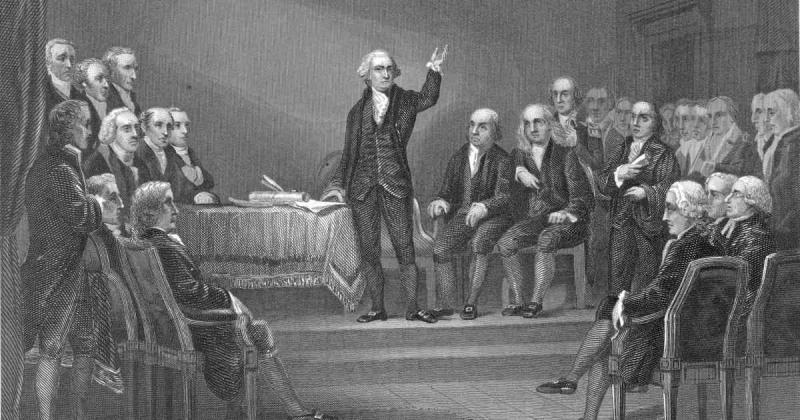
Four years after the United States won its independence from Great Britain, 55 state delegates, including George Washington, James Madison and Benjamin Franklin, convene in Philadelphia to compose a new U.S. constitution on May 25, 1787.
The Articles of Confederation, ratified several months before the British surrender at Yorktown in 1781, provided for a loose confederation of U.S. states, which were sovereign in most of their affairs. On paper, Congress—the central authority—had the power to govern foreign affairs, conduct war, and regulate currency, but in practice these powers were sharply limited because Congress was given no authority to enforce its requests to the states for money or troops. By 1786, it was apparent that the Union would soon break up if the Articles of Confederation were not amended or replaced. Five states met in Annapolis, Maryland, to discuss the issue, and all the states were invited to send delegates to a new constitutional convention to be held in Philadelphia.
History Shorts: Who Wrote the U.S. Constitution?
The U.S. Constitution was a group effort of some of the country's greatest minds, but the bulk of the document can actually be credited to one Founding Father.
1:02m watch
On May 25, 1787, delegates representing every state except Rhode Island convened at Philadelphia's Pennsylvania State House for the Constitutional Convention. The building, which is now known as Independence Hall, had earlier seen the drafting of the Declaration of Independence and the signing of the Articles of Confederation. The assembly immediately discarded the idea of amending the Articles of Confederation and set about drawing up a new scheme of government. Revolutionary War hero George Washington, a delegate from Virginia, was elected convention president.
During three months of debate, the delegates devised a brilliant federal system characterized by an intricate system of checks and balances. The convention was divided over the issue of state representation in Congress, as more populated states sought proportional legislation, and smaller states wanted equal representation. The problem was resolved by the Connecticut Compromise, which proposed a bicameral legislature with proportional representation in the lower house (House of Representatives) and equal representation of the states in the upper house (Senate).
On September 17, 1787, the Constitution of the United States of America was signed by 38 of the 41 delegates present at the conclusion of the convention. As dictated by Article VII, the document would not become binding until it was ratified by nine of the 13 states.
Beginning on December 7, five states—Delaware, Pennsylvania, New Jersey, Georgia, and Connecticut—ratified it in quick succession. However, other states, especially Massachusetts, opposed the document, as it failed to reserve un-delegated powers to the states and lacked constitutional protection of basic political rights, such as freedom of speech, religion, and the press. In February 1788, a compromise was reached under which Massachusetts and other states would agree to ratify the document with the assurance that amendments would be immediately proposed. The Constitution was thus narrowly ratified in Massachusetts, followed by Maryland and South Carolina. On June 21, 1788, New Hampshire became the ninth state to ratify the document, and it was subsequently agreed that government under the U.S. Constitution would begin on March 4, 1789.
8 Things You Should Know About the Bill of Rights
The first 10 amendments to the U.S. Constitution, known collectively as the Bill of Rights, became law on December 15, 1791.
By: History.com Staff
On September 25, 1789, the first Congress of the United States adopted 12 amendments to the U.S. Constitution-the Bill of Rights-and sent them to the states for ratification. Ten of these amendments were ratified in 1791. In November 1789, North Carolina became the 12th state to ratify the U.S. Constitution. Rhode Island, which opposed federal control of currency and was critical of compromise on the issue of slavery, resisted ratifying the Constitution until the U.S. government threatened to sever commercial relations with the state. On May 29, 1790, Rhode Island voted by two votes to ratify the document, and the last of the original 13 colonies joined the United States. Today the U.S. Constitution is the oldest written national constitution in operation in the world.
Also on This Day in History
Discover more of the major events, famous births, notable deaths and everything else history-making that happened on May 25th
1660 -- Charles II returns to England to claim his throne
May 25, 1660: Under invitation by leaders of the English Commonwealth, Charles II, the exiled king of England, sets sail for Dover, England, to assume the throne and end 11 years of military rule. Prince of Wales at the time of the English Civil War, Charles fled to France after Oliver Cromwell's Parliamentarians defeated King […]
1895 -- Oscar Wilde is sent to prison for indecency
Writer Oscar Wilde is sent to prison after being convicted of sodomy. The famed writer of Dorian Gray and The Importance of Being Earnest brought attention to his private life in a feud with Sir John Sholto Douglas, whose son was intimately involved with Wilde. Homosexuality was a criminal offense and serious societal taboo at this […]
1935 -- Babe Ruth hits last home run
On May 25, 1935, at Forbes Field in Pittsburgh, Pennsylvania, Babe Ruth hits his 714th home run, a record for career home runs that would stand for almost 40 years. This was one of Ruth's last games, and the last home run of his career. Ruth went four for four on the day, hitting three […]
1961 -- JFK asks Congress to support the space program
On May 25, 1961, President John F. Kennedy announces to Congress his goal of sending an American to the moon by the end of the decade and asks for financial support of an accelerated space program. He made the task a national priority and a mission in which all Americans would share, stating that it […]
1977 -- "Star Wars" opens in theaters
Memorial Day weekend opens with an intergalactic bang as the first of George Lucas' blockbuster Star Wars movies hits American theaters.
1977 -- Chinese government removes ban on Shakespeare
A new sign of political liberalization appears in China, when the communist government lifts its decade-old ban on the writings of William Shakespeare. The action by the Chinese government was additional evidence that the Cultural Revolution was over. In 1966, Mao Tse-Tung, the leader of the People's Republic of China, announced a "Cultural Revolution," which […]
1979 -- 6-year-old Etan Patz—boy on milk carton—goes missing
On the morning of May 25, 1979, six-year-old Etan Patz walked the two blocks from his home to his bus stop in Manhattan. It was his first time walking there alone before school, and the last day his parents would ever see him. That's because someone abducted Etan during that walk. In his parents' effort […]
1979 -- American Airlines plane crashes in Chicago, killing all aboard
Almost 300 people are killed on May 25, 1979 when an American Airlines flight crashes and explodes after losing one engine just after takeoff. It was the beginning of Memorial Day weekend in 1979 when 277 passengers filled Flight 191 from Chicago's O'Hare Airport bound for Los Angeles. The DC-10 jet took off normally but […]
1994 -- Pennsylvania man buried with his beloved Corvette
On May 25, 1994, the ashes of 71-year-old George Swanson are buried (according to Swanson's request) in the driver's seat of his 1984 white Corvette in Irwin, Pennsylvania. Swanson, a beer distributor and former U.S. Army sergeant during World War II, died the previous March 31 at the age of 71. He had reportedly been […]
2020 -- George Floyd is killed by a police officer, igniting historic protests
On the evening of May 25, 2020, white Minneapolis police officer Derek Chauvin kills George Floyd, a Black man, by kneeling on his neck for almost 10 minutes. The death, recorded by bystanders, touched off what is possibly the largest protest movement in U.S. history and a nationwide reckoning on race and policing. The 46-year-old […]
Be a good human. Grossly derogatory comments, blatantly inflammatory comments, excessive trolling, mean-spirited taunting and insults, scamming, spamming, and off topic comments may be removed in compliance with the site's Terms of Service and the Code of Conduct. The moderators have the final word.

Tags
Who is online
78 visitors
The work of Congress has always required bargaining and compromise.
Missed one in 1977, last use of the guillotine in France .
1521 Edict of Worms outlaws Martin Luther and his followers
1571 Pope Pius V forms The Holy League to fight the Ottomans with other Catholic maritime states including Spain, Venice, Naples and Sicily
1842 Christian Doppler presents his idea, now known as the Doppler Effect (through the changing colors of binary stars), to the Royal Bohemian Society, Prague
First Battle of Winchester
1862 First Battle of Winchester, Virginia: Stonewall Jackson 's Confederate forces achieve major victory
Battle of New Hope Church
1864 US Civil War: Battle of New Hope Church, Georgia: Major William T. Sherman 's Union forces launch attack but suffers heavy losses and entrenchment on both sides
Oscar Wilde Sentenced
1895 Writer Oscar Wilde is sentenced to two years imprisonment for gross indecency
Stengel Releases a Sparrow
1919 Casey Stengel releases a sparrow from under his baseball cap after it flies underneath
The Greatest 45 Minutes in Sports
1935 Legendary American athlete Jesse Owens equals or breaks four world records in 45 minutes at a Big Ten meet at Ferry Field in Ann Arbor, Michigan; remembered as "the greatest 45 minutes ever in sport"
We Choose to go to the Moon
1961 JFK announces the US goal of putting a man on the Moon before the end of the decade