
Have people stopped trusting science? The data tell a surprising story

By: Pearson Helen (Nature)


Note that this is a political science and marketing analysis that relies on fuzzy language, fudged results, and blaming scapegoats. There's no hint that institutional science bears some culpability for loss of trust. And the 'pat on back' conclusions certainly don't justify any need for introspection by the scientific community.
 S E E D E D C O N T E N T
From the United States to Europe to Brazil, there is a pervasive sense that trust in science has collapsed.
A UK survey 1 published in January found that only 40% of people think that science information they hear is "generally true". Another global poll showed that 70% of people believe at least one false or unproven claim, such as that the risks of childhood vaccines outweigh the benefits 2 .
In the United States, President Donald Trump and his administration are using the idea that science is not trustworthy as one reason to cut research budgets, reject evidence-based medical advice and exert unprecedented political control over research. "Over the last 5 years, confidence that scientists act in the best interests of the public has fallen significantly," said Trump in an executive order last year.
Even the Vatican is voicing concern. This September, a meeting at the Pontifical Academy of Sciences will examine how "the crisis of trust in science has become a pressing issue".
But is trust in science really that weak? Researchers studying this have reached some surprising conclusions. From a global perspective, public trust in science and scientists is high, they say. One of the largest studies 3 , which surveyed nearly 72,000 people across 68 countries in 2022-23, reported a "moderately high" average trust score of 3.6 out of 5. "The idea that there's a generalized, pervasive lack of trust in science and experts is just completely unfounded in my mind," says David Bersoff, head of research at the Edelman Trust Institute, a think tank in New York City.
But trust has dropped in certain groups, notably among Republican-leaning people in the United States. And research in the United Kingdom shows that the proportion of people who have "a lot" of trust in science tends to be lower among politically right-leaning groups than those on the left. "Trust in science is politicized and becoming more so," says sociologist Gordon Gauchat at the University of Wisconsin-Milwaukee. In many countries, people are also increasingly questioning definitive evidence on divisive issues such as vaccines, partly because scientific information is being drowned out online.
Researchers say this is a problem because it undermines support for urgent policies — such as ones that tackle climate change — and because it can lead to personal decisions that harm health, such as shunning vaccines or medical treatments. "When science rejection leads to loss of life, that's concerning," says Natalia Zarzeczna, who studies people's beliefs at the University of Essex in Colchester, UK.
Pandemic problems
Concerns about trust in science have simmered for years, but they exploded during the COVID-19 pandemic, when misinformation flourished and vocal groups questioned recommendations — such as vaccination and face masks — that research suggested could save lives.
In June 2022, as the pandemic waned, researchers Niels Mede and Viktoria Cologna put a call out on Twitter (now known as X) for people interested in surveying trust in science. Their tweets blew up — and before long they had a team of about 240 people, an international project called TISP (Trust in Science and Science-Related Populism) and the 68-country survey. "It got quite some attention," says Mede, who is now at Wageningen University & Research in the Netherlands and co-led the study with Cologna, now at the Swiss Federal Institute of Aquatic Science and Technology in Dubendorf.
The online survey asked 12 questions about scientists' competence, integrity, openness and benevolence, which are different dimensions of trust. This aimed to address criticism that surveys about trust in science in general are simplistic, because 'trust' and 'science' are broad terms. The team combined the results into a scale of trustworthiness, from 1 (very low) to 5 (very high). The 3.6 global average largely fits with earlier global surveys suggesting that trust in science is high (see 'Solid support for science').
Source: Ref. 3.
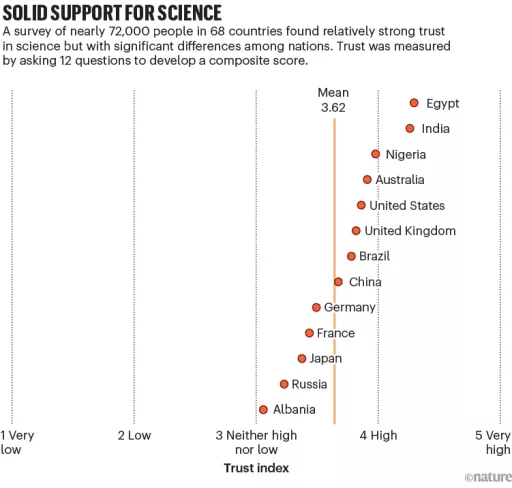
The TISP analysis showed some regional variation. Trust was relatively high in some African countries, including Nigeria and Kenya, and low in Russia and some nations that were part of the former Soviet Union, such as Kazakhstan. (Mede says that high trust in some places, such as certain African nations, might be because people view scientists more favourably than governments that are seen as corrupt.) The United States ranked in the top third, and China near the middle.
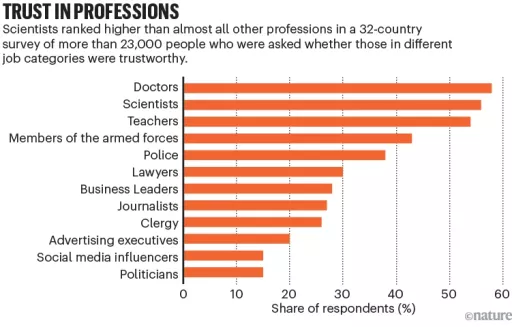
Other data show that trust in scientists is high relative to that in other professions. A 28-country survey 4 run by the Edelman Trust Institute in 2025 found that 76% of respondents trusted scientists, a proportion on a par with teachers (73%) and well above that for journalists (54%) and government leaders (49%). "Probably a lot of other sectors and professions would like to be in science's shoes," says Gideon Skinner, head of political research at market-research firm Ipsos in London, which has conducted international surveys that also show scientists in the top tier of trusted professions (see 'Trust in professions').
Source: Ipsos Global Trustworthiness index 2024.
Kathleen Hall Jamieson, a specialist in science communication at the University of Pennsylvania in Philadelphia, argues that there's "a rhetoric of science in crisis", rather than an actual one — and that it's nothing new. She traces the idea back to the widening recognition by scientists and the media in the 2010s, that many results in biomedicine and psychology could not be reproduced, a situation often portrayed as a 'reproducibility crisis'.
But data and experts largely point in the same direction. "Scientists are still regarded as quite trustworthy," sums up Eileen Yam, who directs science and society research at the Pew Research Center in Washington DC. Or at least, that's "the glass half-full rendering", she says.
Fractures in trust
The glass half-empty view, however, has data to support it, too. In a survey of people living in Britain, published in April 5 , 84% of respondents said they had at least some trust in science. But the proportion who trusted science "a lot" dropped from 63% in 2020 to 34% — one of the "emerging fractures" in trust that the study identified.
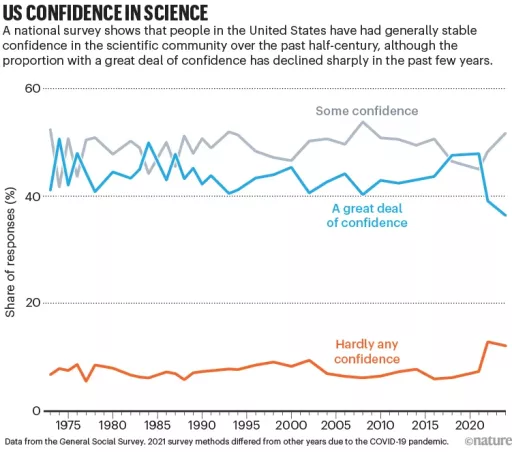
One of the most prominent changes is taking place in the United States. Here, data collected by the General Social Survey (GSS) from 1973 to 2024 show that, overall, the proportion of people with some or a great deal of confidence in the scientific community remained stably high (above 80%) over 50 years 6 . But the proportion with a great deal of confidence declined sharply in 2022 (see 'US confidence in science').
Source: General Social Survey.
This drop is part of a wider loss of trust in civic institutions, rather than being unique to science, research indicates 7 . A survey 8 by the Pew Research Center shows that the proportion of people with confidence in scientists to act in the public's interest fell from 87% in 2020 to 73% in 2023. But confidence in police officers, business leaders and elected officials similarly fell over this time.
"There are trend lines down in science, but those look very much like the trend lines in other institutions," says Jamieson. "There's an institutional crisis that is being reflected in science."
Dicing the data further reveals a growing political divide in the United States. Pew Research figures 8 show that the proportion of people who self-identify as Republicans or Republican-leaning and who have confidence in scientists fell from 85% in 2020 to 65% in 2025. Democrats' confidence barely budged, from 91% to 90%. The GSS data suggest the political divide emerged around 2005-10 (see 'Political polarization in science').
Source: General Social Survey.
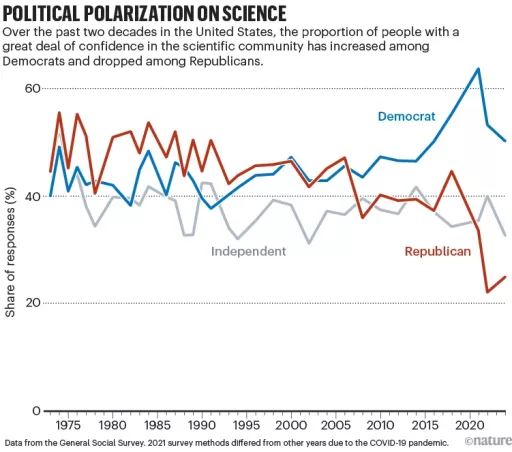
James Druckman, a political scientist at the University of Rochester in New York, has studied this split. He argues that it's partly explained by people in demographic groups that have, for decades, had relatively lower trust in science (particularly religious people) moving towards the Republican party and higher trusters (especially those with university degrees) moving towards the Democrats 6 . "They re-sorted," he says.
But that's not the only explanation for the polarization in the United States: politicians have fuelled it, too. Gauchat says that, starting in the mid-1990s, some politicians "realized they could mobilize groups of people" in the United States who were becoming critical of higher education in part because of its high cost. They helped to power the populist view that scientists, other academics and their institutions are part of an intellectual elite, "making them the villains", who do not represent the views of ordinary citizens, says Gauchat.
The pandemic accelerated and amplified the partisan divergence, say researchers, as some people grew sceptical of regulations on COVID-19 vaccines, face masks, lockdowns and other measures that science suggested could limit infections, while politicians fanned the flames of science distrust. Jamieson argues that often people object to policies that stem from science rather than the science itself. "If your ideology says we shouldn't be regulated, and the implication of the science is [that] politicians put regulation on the table, it's going to be easy for people to say, 'I don't like that'," she says.
The threat now, say researchers, is that the Trump administration is using science scepticism to justify drastic cuts to research and the undermining of evidence-based interventions such as vaccines. "They're saying, we're going to destroy these things, because this whole institution is not trustworthy," Druckman says.
References
-
UK Research and Innovation. Public Attitudes to Science 2025 (UKRI, 2026).
-
Edelman Trust. 2026 Edelman Trust Barometer Special Report: Trust and Health (Edelman Trust, 2026).
-
Cologna, V. et al. Nature Hum. Behav. 9 , 713-730 (2025). Article PubMed Google Scholar
-
Edelman Trust. 2026 Edelman Trust Barometer Global Report: Trust Amid Insularity (Edelman Trust, 2026).
-
Herrick, A., Tryl, L. & Henderson, M. Britain Talks Trust in Science (Wellcome and More In Common, 2026).
-
Schulman, J. et al. Public Opin. Q. 89 , 1200-1238 (2025). Article Google Scholar
-
Lupia, A. et al. Proc. Natl Acad. Sci. USA 121 , e2319488121 (2024). Article PubMed Google Scholar
-
Kennedy, B. & Kikuchi, E. Do Americans Think the Country Is Losing or Gaining Ground in Science? (Pew Research Center, 2026).
-
UNICEF. The State of the World's Children 2023 (UNICEF, 2023).
-
Mede, N. G. et al. Sci. Commun . https://doi.org/10.1177/10755470251376615 (2025). Article Google Scholar
-
European Commission. Special Eurobarometer 557: European Citizens' Knowledge and Attitudes Towards Science and Technology (European Union, 2025).
-
Southwell, B. et al. J. Public Health Mgmt Pract. 32 , 135-143 (2026). Article Google Scholar
-
Druckman, J. N. et al. Nature Hum. Behav. 10 , 476-491 (2026). Article PubMed Google Scholar
Be a good human. Grossly derogatory comments, blatantly inflammatory comments, excessive trolling, mean-spirited taunting and insults, scamming, spamming, and off topic comments may be removed in compliance with the site's Terms of Service and the Code of Conduct. The moderators have the final word.

Tags
Who is online
147 visitors
Public perceptions and attitudes are the focus of institutional science; not to improve science but rather to influence public opinion. The scientific community can do no wrong. Admitting otherwise would endanger the flow of money.
I think there's something to what you say, but I think it's more complicated than that. The thing that strikes me most, though, is that science is much less certain than we're usually encouraged to believe. Now, when I watch a program about some scientific thing, I always keep in mind what they usually don't emphasize, which is that what they're really saying is, "We think this is what's happening." Science seems to find out it was wrong about something almost as often as they discover something new. That isn't to denigrate science. Just that even when we think we've got it, the universe always seems to be telling us it's more complicated than we imagined.
I've watched nearly every episode of NOVA and the fact is, they ALWAYS tell you this is what science "thinks is what's happening". I cannot think of any times where they claimed absolutes. They leave claiming unfounded absolutes for religion to try and market and sell to gullible morons.
So when scientists claim that the warming, ice melt, and sea level rises are all due to AGW, that should also be considered not absolute? Well that's good to know.
Science welcomes testing and challenges.
I am not so sure that the scientists, who built their reputations and fortunes on an assumption which then led to another assumption, would accept being challenged.
It's all based on what the evidence shows. The strongest conclusions are those when scientists who have opposite ideas on a matter come to the same conclusion. Follow the evidence to where it leads, not to where you want it to go.
And that is what happened, the evidence showed there were multiple ice ages and the scientists of the time, assuming the climate had to get colder to create these ice ages, came up with different theories and Milankovitch won out. Scientific consensus, assuming the same colder reason, agreed and it is still believed to this day.
Follow the evidence to where it leads, not to where you want it to go.
Scientists are ignoring pieces of evidence and are steering in the direction that climate change is man's doing, therefore man can stop it, and that is where all the big money is steering them to go. So when someone comes out and says that climate change is just the natural water cycle of the planet and not Milankovitch's assumption or the CO2 assumption you get no support or funds.
Scientists say, with as much absolutism as they can, that humans exist. Hopefully, those on the right won't disagree. Scientists say, with as much absolutism as they can, that the climate is changing, and they have always admitted that this is something that has been happening on our planet for billions of years. Clearly scientists are NOT saying that ALL climate change is due to human activity.
Imagine there was a massive asteroid on a direct collision course with earth. It would have been no humans' actions that caused such a thing. But with our technology it's theoretically possible we could send up a spacecraft and nudge or push that asteroid on a different trajectory to avoid the impact with earth wiping us all out.
Climate change isn't much different; it's a natural phenomenon that would be occurring with or without us. However, human activity has, in the last hundred years especially, been pushing or nudging climate change in a direction that is making life less hospitable for humans. Refusing to accept this basic logical fact may make some idiots happy, but whether scientists tell us it's happening or not, we're having to deal with the consequences that one would have to be a complete idiot not to recognize.
Sadly, we seem to have a lot of complete idiots and for them, nudging the climate closer to uninhabitable for humans seems to be their passion so they lie and snivel and try and worm their war around the facts. But that is to be expected, no one with more than half a brain really thought the poorly educated religious conservatives would have much to contribute to saving the world, they're way too busy eagerly stuffing their heads of a fat greasy fascists orange ass.
That is correct, except that an asteroid we may be able to do something about it, the climate, however, we cannot stop the next ice age.
When I speak of the evidence that is being ignored that even Milankovitch knew nothing about, the sea levels prior to each ice age were up to 25' higher than they are now, another is that mammoths populated Greenland which wouldn't happen if Greenland kept it's ice sheets and also the sea levels wouldn't rise that much without the melting of Greenland's ice sheets and some of Antarctica's also. To melt all that ice for the sea level rise, sorry to say, but it needs to get warmer in the colder latitudes.
But we can certainly try to stop pushing it towards it faster.
Yes, and it is.
I don't think anyone has denied there have been multiple ice ages. Science also supports the idea that human activity is affecting the climate, especially through the release of greenhouse gasses over many years. And its effects are being noticed. That's not really in dispute except by science deniers and/or the willfully ignorant.
And I didn't make an argument that there weren't multiple ice ages, to the contrary I'm using that fact and the sea level rise, higher than they are now before each one, as part of the evidence.
Science also supports the idea that human activity is affecting the climate, especially through the release of greenhouse gasses over many years. And its effects are being noticed.
These effects are they human caused or just the natural progression of the natural water cycle of earth? That's what I see as the dispute. As DP pointed out above, the colder climates are where you would suspect the warming to increase the most as more and more warm water invades the colder latitudes.
So do you believe I am a "science denier and/or the willfully ignorant"? Do you believe that Milankovitch's assumption was right that to begin an ice age the climate needs to get colder?
An ice age is caused by more precipitation falling in the colder latitudes and freezing in than the next summer can melt, you can agree to that, right? The Antarctica ice sheet is up to 2-1/2 miles thick and took 800,000 years to sustain that, right? The northern hemisphere ice sheets built up to an impressive 1-2 miles thick seven times in the last 800,000 years, right? Heat evaporates and lifts water into the atmosphere, not cold. An ice age ends once the sea levels drop 125 feet and the colder latitudes no longer receive the warming from the much lower sea levels, the climate gets colder, the atmosphere dries up, and the summer melts catch up to the winters. It is a really simple cycle.
I think that sentiment has only been pushed by those who distrust science, not by scientists themselves. Science welcomes testing and challenges.
I think claiming otherwise has become just as lucrative for others. It's why there is such a low confidence in science among rightwing conservatives. Their political leaders have leaned into anti-science rhetoric all in an effort to keep the dirty fossil fuels money train going.
I guess it's easier to believe religious fantasy for some than to take the time to get educated and actually understand that science isn't evil, it's simply the study of the universe. What's truly evil are those trying to use the fact that science hasn't explained everything in the universe yet to claim it's untrustworthy.
When a scientist has an epiphany or learns something new through rigorous testing, it can change an entire scientific fields way of thinking. When the religious have an epiphany or think they learned something new from scripture, it's still just as unfounded and lacking evidence as the prior understanding of invisible untestable intangible things.
There have been unethical and shitty stuff happening in the scientific community like any other group of people. Rather than just point that out with facts, its the anit-scince cherrypickers that use it for their own aims.
I mean... it's not like they are claiming we need to stop modern medicine because a surgeon botched an operation.
People who don't understand science or who poo poo it got D's in their jr high science classes. Then they said fuck it when they got to sr high
Hey I got D's and don't poo poo science
You got better
Lol that's hilarious, as within the scientific community the next best thing to discovering something new is disproving some other schientists discovery
I have noticed it is those who are scientifically illiterate who tend to be hostile towards science. This has been noticeable the last few decades.
Did you also notice the article published by Nature is a poly sci marketing analysis of public perception. Political candidates perform these same types of 'trust' analyses. And the article blames the public just as you do. There's no introspective questioning of methods of communication. The article is premised on the presumption that 'science can do no wrong'.
I do not know of anyone, especially scientists, who claim science can do no wrong. If anything, science freely admits when it's wrong and course corrects as needed. The perception of "science can do no wrong" illustrates people's ignorant hostility towards science.
Place the scientist in front of a Congressional appropriations committee. Give the scientist a multi-million dollar NSF grant.
Scientist never admit being absolutely wrong. They only admit when the results of a research effort have been inconclusive. However, institutional science has no problem declaring the scientific claims of a consensus identified 'denier' are absolutely wrong.
Science will admit to bring wrong when information comes forward showing it to be wrong. Science is tough on itself like that.
Could you provide some examples of institutional science admission of being wrong since 1970?
EPA was created in December, 1970, which marked a shift in institutional science toward regulatory policymaking and government funding. By the 1990s the role of science was to deliver political truth and the regulatory influence of institutional science accelerated. By 2020 and the COVID pandemic "believing the science" had become a political litmus test demanding unquestioning acceptance of consensus views from institutional science.
The political demands of funding sources now expect infallibility from institutional science.
Some people who stopped trusting science are open to the idea that the earth is flat or man never went to the moon.