
How I Felt Writing for CBS Anchor Walter Cronkite

By: Alison Owings (AARP)



 S E E D E D C O N T E N T
In the 1970s and early ’80s, one American journalist received so much public esteem as the embodiment of professional impartiality and probity that he was called “the most trusted man in America.” That man was Walter Cronkite, anchor of CBS Evening News.
I wrote for him.
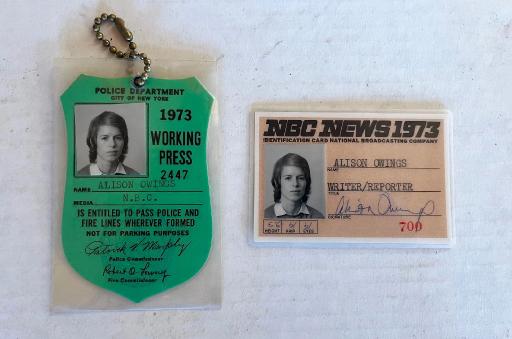
My job came thanks in part to a whispered phone call from a friend of a friend, part of an informal, invaluable women’s network, telling me CBS News had an opening for a newswriter. At the time, I was working at NBC’s local New York City station in Rockefeller Center as a newswriter and occasional reporter. I was fond of my colleagues, even an editor (like most people in charge, a man), who said, dramatically, when a second woman writer arrived, “Here comes another one.”
Before working at CBS, the author was a reporter at WNBC TV in New York. Courtesy Alison Owings
At CBS, I was hired as a pool writer. That meant I’d write for whichever news broadcast needed someone. I knew Walter Cronkite had his own trio of assigned writers, but I figured at some point I might sub for any of them. Before such a challenging and possibly terrifying event took place, I was glad to have some time learning CBS’s routines and rhythms and getting to know fellow employees.
My sole journalistic motivation had always been to write or report news accurately and, by extension, fairly. The work, however, constantly included sidestepping ridiculous sexism. Despite my new bachelor’s degree in journalism, a colleague once told me, “It is believed women cannot write news.”
At ABC News in Washington I remained, frustratingly, an assistant for a news feed ABC sent its affiliates. Furthermore, I, like all the other women, wore dresses or skirts, despite Washington’s freezing winters.
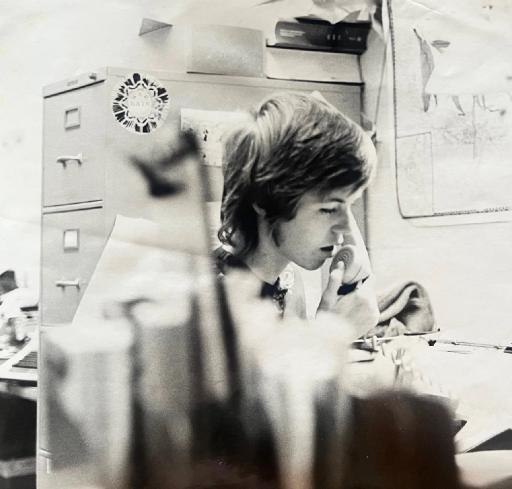
Owings worked as a producer at WRC TV, the NBC station in Washington, D.C., from 1969 to 1971. Courtesy Alison Owings
I eventually quit ABC to become an associate producer of documentaries at NBC’s Washington station, WRC. There, on National Secretaries Day, a woman from personnel steered a cart through the station to give a pink rose in a white vase to every secretary. When I pointed out, in the interest of accuracy, I was not a secretary and thus undeserving of the bloom, she replied, “That’s all right. You’re a woman.” Yet lucky us, we could wear pants.
At CBS, writing for Weekend News became a steady assignment. Saturday’s anchor was Dan Rather, famously tall, dark and handsome, and courtly and appreciative, too. The first Saturday I wrote for him, the closing piece involved an art exhibit within the Sistine Chapel. Knowing that Dan liked to add a comment afterward, I suggested he say if visitors didn’t like the chapel exhibit, they could look up at the ceiling. Our bond was sealed.
Meanwhile, as I wrote for Dan and other anchors, in the back of my mind loomed the person I thought of solely by surname: Cronkite.
Eventually it came to pass. One of his writers went on vacation, and I was assigned to take his place.
For my first day, I had ironed a camera-appropriate blouse, and to calm my nerves, arrived early, before any of the other writers. As on Weekend News, the Evening News writers were briefly shown at their desks before commercial breaks, sometimes typing feverishly. (A CBS spokesperson occasionally had to explain to curious viewers, who called for an explanation, that these were not actors. These were writers.)
I was certainly familiar with Cronkite’s straightforward on-air style and was confident I could write a straightforward sentence. So as the morning wore on, I familiarized myself with news stories I might be writing. Then one of the other news writers strolled in. On his way to his desk, next to mine, he paused, then said in a hiss nobody else could hear, “A woman has no place in a newsroom.”
It was the first snide comment I’d received at CBS. Every other colleague had been friendly and welcoming. My nascent smile frozen, I wordlessly went back to work. I had not lost all confidence, but had lost that component essential in newsrooms, among other places of work: the feeling that we’d help each other out.
Only years later did I admit to myself that being a newswriting woman at that time was emotionally precarious. On a public level, I did not want to mess up and taint all womankind. On a semipublic level, I joined class action sex-discrimination lawsuits. But on a private level, I was never 100 percent convinced I was hired because I was a good, competent writer. And on my first day working for the most trusted man in America, another man hissed at me.
Sometime in the afternoon, after we’d been given our assignments, Walter Cronkite arrived in the newsroom. I believe we shook hands when introduced. He may have wished I was a “How ya doin’, Walter?” type of guy — or any type of guy — but he did not say, “What are you doing in the newsroom?” nor act as if he thought that.
He sat in his anchor chair and immediately got to work. Holding a pen in one hand and a stopwatch in the other, he set to reading, marking and timing our finished scripts. He was, I soon learned, an excellent copy editor. He would slay adjectives and adverbs, or take three seconds from one story, seven from others, to fit in a new story, but never at the expense of perfectly articulated, unhurried delivery.
That night, after he ended the broadcast with the iconic phrase “And that’s the way it is,” I realized he had read all my stories exactly as I had written them. Twenty million viewers heard, through my honed filter, the foreign news of the day. And I could reassure myself that there was indeed a place for a woman, this one, in this newsroom.
AARP essays share a point of view in the author’s voice, drawn from expertise or experience, and do not necessarily reflect the views of AARP.
Post-CBS News, Alison Owings has concentrated on writing books based on oral histories of people in stereotyped populations, including Frauen: German Women Recall the Third Reich, Hey, Waitress!: The USA from the Other Side of the Tray, Indian Voices: Listening to Native Americans and, most recently, Mayor of the Tenderloin: Del Seymour’s Journey From Living on the Streets to Fighting Homelessness in San Francisco.
Remember the Golden Rule, be a good human. We're here to relax and chat, so let's keep it civil and fun. Please, remember to quote the person(s) you are replying to as a courtesy so everyone can follow the conversation. Grossly derogatory comments, blatantly inflammatory comments, excessive trolling, mean-spirited taunting and insults, scamming, spamming, and off topic comments may be removed in compliance with the site's Terms of Service and the Code of Conduct. The moderators have the final word and may remove comments at their judgement (or lack thereof).
Past performance does not guarantee future results. Comment at your own discretion. The owners of the site, the owner of this group, and the moderators are not responsible or liable for any stupid thing you do. You break it, you buy it. No shirt, no shoes, no service. Don't poke the bear. Mind the gap.

Tags
Who is online
68 visitors
No pressure.
Shakespeare knew Walter Cronkite - he even wrote about him:
“He was a man, take him for all in all, I shall not look upon his like again.”
Nor will any of us.