
Why the Democrats Can Move to the Left

By: Ramesh Ponnuru (The American Enterprise Institute)
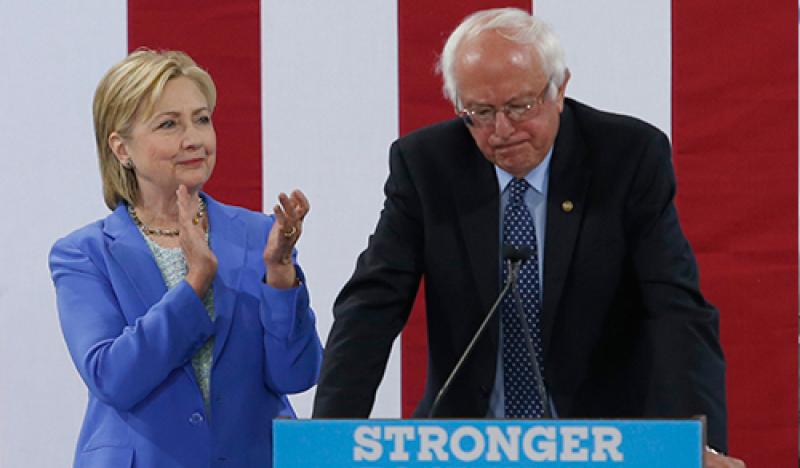

The Democratic Party is no longer an alternative for center-right or center-left voters. It's shear madness to support far-left lunatics just because of Donald Trump.
 S E E D E D C O N T E N T

Democrats are galloping to the left. David Weigel made the point in a Washington Post report on their new party platform: “The Democratic Party shifted further to the left in one election than perhaps since 1972, embracing once-unthinkable stances on carbon pricing, police reform, abortion rights, the minimum wage and the war on drugs.” He could have added Social Security and immigration to his list.
So why has the unthinkable become thinkable? Four reasons come to mind.
Partisan sorting. The Obama years saw the remaining conservative Democrats get wiped out, as Weigel notes. The Democrats are a more uniformly progressive party now. There are fewer conservative Democrats among the party’s elected officials and activists to counsel restraint, and fewer conservative Democratic voters to worry about alienating. The platform reflects these developments.
Demographics. Democrats have grown increasingly convinced that demographic trends augur a lasting progressive majority. Whites are more conservative than nonwhites, married people are more conservative than single people, and church-going Christians are more conservative than everyone else. The percentage of the population that belongs to each of those conservative groups is dwindling, which suggests that conservatism will dwindle, too. These trends give liberals a reason to think that their positions have become less politically risky than they used to be and will be even less risky in the future.
The success of Bill Clinton. Judged by the standards of today’s Democrats, the Clinton administration looks conservative. Clinton signed laws cutting the capital-gains tax, requiring able-bodied welfare recipients to work, making criminal sentences more severe, funding the building of prisons, and defining marriage in federal law as the union of a man and a woman. He said abortion should be “rare,” a sentiment absent from the party’s platform today.
Some progressives damn the compromises of the 1990s. But they should consider that they are able to do so only because those compromises rehabilitated liberalism in the eyes of the public. Welfare reform, in particular, helped to re-legitimize government activism by reassuring middle-class voters that benefits would go to people who work for a living and, in that way, support rather than undermine their values. By playing it safe in a conservative era, the Clintons helped liberalism to survive and grow — and now can run a more confidently liberal party.
Republican haplessness . Republicans have lost the popular vote in five of the last six presidential elections. They have spent much of the Obama administration at war with themselves. This year the party’s voters chose the presidential candidate who polled worst in a general election, and looked least likely to organize and raise funds for a competent national campaign, to be their nominee.
A formidable Republican Party would be able to make the Democrats pay a political price for going too far to the left, and this potential would inhibit the Democrats. Today’s Republicans do not have the Democrats running scared, at least in presidential elections.
Progressive Democrats didn’t get their way on every sentence of the platform: There are still limits to how far left Democrats will go. Liberal commentators have reached a consensus that the welfare reform of 1996 was a catastrophe for the poor. But Democratic politicians remain wary of revisiting the issue. The platform is careful, too, on guns, an issue where public opinion has moved right over the last two decades.
Progressives can fight those battles another day. For now they are celebrating what they have achieved in the latest platform. They have a lot more running room than they used to have, and they are making the most of it.
Ramesh Ponnuru is a nonresident senior fellow at the American Enterprise Institute, where he studies politics and public policy with a particular focus on the future of conservatism. Concurrently, he is the editor of National Review, where he has covered national politics and public policy for 25 years, and a columnist for the Washington Post .
The American Enterprise Institute for Public Policy Research (AEI) is a nonpartisan, nonprofit, 501(c)(3) educational organization and does not take institutional positions on any issues. The views expressed here are those of the author.
Be a good human. Grossly derogatory comments, blatantly inflammatory comments, excessive trolling, mean-spirited taunting and insults, scamming, spamming, and off topic comments may be removed in compliance with the site's Terms of Service and the Code of Conduct. The moderators have the final word.

Tags
Who is online

105 visitors
President Trump and his Krazy Krew are still better choices than what the Democratic Party is offering.
What "far left" policies do you disagree with that multiple democratic congresspersons are putting forth?
This is what is gaining steam on the left. The Nazis were ignored also, until it was too late.
Gemini
Cue the "ignore it until it is a problem" responses.
The only things the Democrats in Congress are putting forward is 'Orange Man Bad' rhetoric. Schumer and Jefferies can only tell us how bad Republicans are. They're only voicing opposition -- not an agenda or alternatives. The message from Congressional Democrats is they'll pursue political theater rather than govern.
Democrats on the street are pushing post-national globalization. That's a variation on the 'one world government' theme. The rank-and-file Democrats are pushing taxes that are as damaging to consumers as tariffs. They're advocating highly targeted government spending for special interests that's being called expansion of the 'safety net'. They are actively pursuing a "brown majority" which is about the geopolitics and economics of the Global South and not about race. The far-left under the Democrat umbrella want to weaken the Constitutional checks on government, create a winner-take-all populist electoral system, advocates for an even more independent autocratic President, and promotes a version of democracy that favors their perceived majority.
So you are pro Trump because of what the democratic polices are, yet you have no idea what the party is supporting? Does this make sense to you?
Who cares? Unless you want to also say the republican policies are a return to slavery and trashing democracy for a theocracy (all of which have been said by a "man on the street" questioning), nobody cares what one off individuals want.
Yet the current republican government is currently violating the government and disregarding judicial orders.
You're confusing 'Democrats are not an alternative' with 'pro Trump'. Since the Democratic candidates were unacceptable there wasn't an alternative to Trump. Yeah, I could waste my vote but that doesn't prevent unacceptable Democratic candidates from obtaining power.
So, the primaries and elections are rigged? Must be if Democrats on the street don't matter. Is that the excuse you are putting forward?
Biden/Harris violated the Constitution and disregarded judicial orders, too. The Biden administration said one thing while doing another. But that's not the threat.
The Democratic movers and shakers wants to abolish Constitutional amendments by judicial decree. They want to reshape elections to obtain power and control over society. They do not hide the fact that they will give priority to special interests. They've already obtained limited non-citizen suffrage with hopes of expansion. They're advocating free movement of people (and money) across our borders.
What are the Democratic movers and shakers stance on Cuba? On imports, energy, education? On globalization, multinationalism, and multiculturalism? What are the Democratic movers and shakers views on the Global South?
If you are promoting Trump over any democrat that did or may in the future run against MAGA, then yes you are pro Trump.
Not even going to hazard a guess where you came up with that...
Cite them.
Again, citations...
So democrats support the Save America act?
Come on! Lots of claims and absolutely no citations. You can do better than that.
You want to limit the amount of cash immigrants can bring over? You are basically claiming that democrats want "open borders", and again you have no citations to support this claim.
Why ask me when you are the one opposed to those stances?
This sentence barely makes sense. One could EASILY say that because Trump is utterly unfit for public office the default vote should go to the Democrat or even a third party. But not Trump. Lets face it, it appears you dont care that Trump is utterly unfit to be in public political life.
You are perceived as being indifferent to his insanity and corruption.
What was the alternative to Trump?
Now that Gemini is available it's much easier to answer the Gish. Here's Gemini's response:
1. "Abolishing Constitutional Amendments by Judicial Decree"
The Grain of Truth
This claim stems from long-standing debates over judicial philosophy—specifically the contrast between conservative Originalism (interpreting the Constitution according to its original public meaning when written) and progressive Living Constitutionalism (viewing the Constitution as a dynamic document whose meaning evolves with societal norms).
Examples & Context
The Second Amendment: Many progressive legal scholars and Democratic leaders argue that the Supreme Court's 2008 decision in D.C. v. Heller—which recognized an individual right to possess firearms unconnected to militia service—was an incorrect reading of the text. Critics argue that appointing judges who favor reinterpreting or narrowing the Second Amendment effectively neutralizes it through judicial ruling rather than a formal constitutional amendment process.
Judicial Reform / Court Expansion: Following conservative appointments to the Supreme Court, some progressive groups and lawmakers advocated for structural court reforms, such as adding seats ("court packing") or imposing term limits, to counter majorities that rule against progressive policies.
Perspectives: Critics view reinterpreting constitutional provisions via the courts as a way to bypass the arduous formal amendment process (Article V). Democrats counter that living constitutionalism ensures rights (such as privacy, marriage equality, and civil rights) are protected in a modern society where original 18th-century framers could not have anticipated today's realities.
2. "Reshaping Elections to Obtain Power and Control"
The Grain of Truth
The Democratic Party actively champions sweeping structural changes to national voting laws, election administration, and representation.
Examples & Context
H.R. 1 / S. 1 (The For the People Act): Democrats introduced comprehensive legislation to set federal standards for elections. Provisions included mandatory automatic voter registration, nationwide same-day voter registration, required early voting and mail-in options, restricting voter roll purges, and replacing state-drawn legislative maps with independent redistricting commissions.
Statehood for D.C. and Puerto Rico: Democrats strongly support granting statehood to Washington, D.C. (and self-determination for Puerto Rico). Because D.C. tilts heavily Democratic, statehood would almost certainly add two Democratic senators and a representative to Congress.
Electoral College Reform: Many Democrats support either abolishing the Electoral College via constitutional amendment or joining the National Popular Vote Interstate Compact—an agreement where states pledge their electoral votes to whichever presidential candidate wins the nationwide popular vote.
3. "Prioritizing Special Interests"
The Grain of Truth
Like both major political parties, the Democratic coalition relies heavily on organized advocacy groups, labor unions, and activist networks that actively lobby for policies favoring their members.
Examples & Context
Organized Labor: Unions (such as the AFL-CIO, SEIU, and teachers' unions like the NEA) are major financial contributors and field organizers for Democratic campaigns. Democrats consistently prioritize labor-backed bills like the PRO Act (Protecting the Right to Organize Act), which strengthens union organizing rights and limits state "right-to-work" laws.
Environmental & Trial Lawyer Associations: Environmental advocacy groups (e.g., Sierra Club, League of Conservation Voters) heavily influence energy platform policies, such as the Green New Deal framework. Similarly, trial lawyers and civil rights organizations frequently align with Democratic positions on tort reform opposition and civil litigation standards.
4. "Obtained Limited Non-Citizen Suffrage with Hopes of Expansion"
The Grain of Truth
Several Democratic-led municipalities have enacted ordinances allowing non-citizens—primarily legal permanent residents (green card holders) or parents of school children—to vote in local or school board elections.
Examples & Context
San Francisco, CA (2016): Voters passed Proposition N, allowing non-citizen parents or legal guardians of children in the city's school district to vote in local Board of Education elections.
New York City (2021): The NYC Council passed a measure granting over 800,000 legal permanent residents and authorized workers the right to vote in municipal elections (for mayor, city council, etc.). However, state courts subsequently struck down the law as unconstitutional under the New York State Constitution.
Maryland and Vermont Towns: Takoma Park, Maryland, has allowed non-citizen local voting since 1992. Cities in Vermont (like Montpelier and Winooski) passed charter amendments enabling non-citizen residents to vote on municipal matters.
5. "Advocating Free Movement of People (and Money) Across Borders"
The Grain of Truth
Progressive platforms often favor pathways to legal status for undocumented immigrants, decriminalization of status issues, and cross-border economic integration.
Examples & Context
Decriminalization Debates (2020 Primaries): During the 2020 Democratic presidential primary debates, several candidates supported repealing Section 1325 of Title 8—the federal law that makes unauthorized border crossing a criminal misdemeanor rather than a civil infraction.
Pathways to Citizenship & Asylum Policies: The official Democratic platform calls for a comprehensive path to citizenship for the estimated 11 million undocumented immigrants in the U.S., expanding asylum processing, restoring programs like DACA (Deferred Action for Childhood Arrivals), and halting physical border wall expansion.
Free Flow of Capital & Remittances: Democrats generally oppose placing heavy taxes or restrictions on wire transfers/remittances sent by immigrant workers to family members abroad, viewing international trade and financial flow as vital for global economic stability.
And that is exactly what happened.
If nothing else most of the left is predictable
Predictable is an understatement.
Congratulations about finally being able to access Gemini, but how about addressing my points with it?
Democrats shift to the left in this past weekend’s platform fight
Your article neglects to mention that the Dave Weigel WP article is from 2016.
Exactly. In 2016 they had room to move to the left. In 2026 they are driving off the left cliff.
I'm do not understand the reason for this comment. The author is stating that the Democratic Party shifted further left in that one election than they had since 1972.
Does it help to understand that the Democratic Party shifted to the far-left in 2016? Is this supposed to be a commendation for Hillary Clinton? Isn't it possible that the Democratic Party's dramatic shift to the left allowed Donald Trump to be considered a better alternative? Is this supposed to highlight that the Hillary Clinton campaign made a Trump Presidency possible?
What's the point of highlighting 2016?
Pre and post Obama Democratic Party bears little resemblance to each other…