
Yep, There's a Decimal Point on That Speed Limit Sign. Here's Why

By: Aaron Rasmussen (Readers Digest)


 S E E D E D C O N T E N T
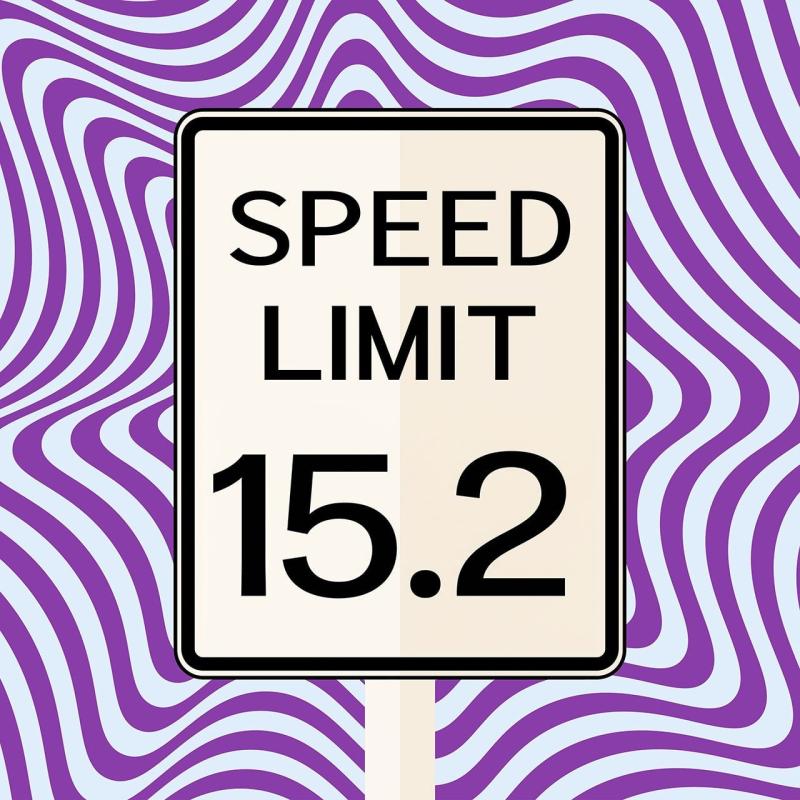
Speed limit signs can either fade into the background or startle us to attention, often depending on how fast we might be going. Familiarity plays a role too. We expect to see 25 mph in a quiet residential neighborhood and 55 or 65 mph on a busy highway. But what if you were driving along and saw 8.2 mph, or 14.4? Most speedometers don't even display tenths of a mile per hour, so how is a driver supposed to follow a rule of the road like that?
It sounds ridiculous, and it is a bit uncommon, but speed limits expressed in decimals definitely do exist. To explain what's going on, Reader's Digest reached out to Michael Knodler, PhD, a professor of civil and environmental engineering at the University of Massachusetts Amherst and the director of the UMass Transportation Center. Read on to find out the purpose behind these unusual speed limits and whether they might soon appear on a road near you.
How long have we had speed limits?
Speed restrictions date all the way back to the days of non-motorized transportation, though they were a little more loosely defined. As far back as 1652, officials in what was then known as New Amsterdam—now New York City—declared that no wagons, carts or sleighs "shall be run, rode or driven at a gallop," according to History.com.
With the arrival and proliferation of the automobile in America in the late 19th century, formal speed limits soon followed. Connecticut is widely credited as the first state to enact an official automobile speed limit in May 1901, setting a maximum speed of 12 mph in cities and 15 mph on country roads. The most important provision? Drivers had to slow down or even stop when encountering horse-drawn vehicles so that they wouldn't startle the horses.
Automobiles continued to improve and become faster as time wore on, but there were no official national speed limits in the United States until much later. In January 1974, President Richard Nixon, responding to the oil crisis and skyrocketing fuel costs, signed legislation that established 55 mph as the maximum speed allowed nationwide. That federal limit stood until 1995, when authority for setting speed limits was returned to states and local jurisdictions.
Today, speed limits vary from place to place. The Federal Highway Administration notes that some common limits include 25 mph in residential or school districts, 55 mph on rural highways and 65 to 70 mph on rural interstate highways. The highest posted speed limit in the country is 85 mph, found on a stretch of Texas State Highway 130.
Why do some speed limit signs have decimal points?
There are two main reasons jurisdictions or property owners might post odd speed limits like this, according to Knodler.
- It stands out. "Seeing a nonstandard limit captures your attention, given its uniqueness," he says.
- It seems important. He also says adding a decimal place "implies a level of specificity that might make it appear really accurate or important."
The idea gained attention when drivers in Appleton, Wisconsin, were recently greeted with a 17.3 mph speed limit at the Outagamie Country Recycling and Solid Waste Facility. According to a Facebook post introducing the new speed limit and sign to the public, safety was the No. 1 reason for the new eye-catching speed limit.
How effective has this been at lowering the number of accidents?
The effectiveness of these types of speed limits remains a bit of a question mark, according to Knodler.
Most research on unique speed limits hasn't focused on those with decimal points, in part because they are not technically supposed to be used on public roads. "The evidence to date would be mostly anecdotal, but it would be easy enough to study if there was interest," he says.
One thing that is clear, however: Any measure that encourages drivers to pay closer attention behind the wheel can be a positive step in the direction of creating safer roads.
Where are you likely to find these quirky signs?
Official statements about decimal speed limits are scarce, but signs with unusual speed limits are often found in semi-private residential developments, private properties and other areas where property owners may install their own traffic signs, even if they don't necessarily comply with roadway standards.
"It's really a bit of a gray area," Knodler says, explaining that the Manual on Uniform Traffic Control Devices is the federal standard and requires speed limits posted on roads that "are inviting of the public"—including some seemingly private areas such as condominium complexes—need to meet certain requirements. They must be based upon an engineering study, be in increments of 5 mph and be displayed on a white regulatory sign with black letters.
So why do these signs continue to appear in places when they don't meet those requirements? "There are plenty of examples of noncompliant traffic control devices everywhere," Knodler says. "I joke that I give my students an assignment every year to go out and find a noncompliant TCD, and it is the easiest assignment because they all get 100%."
Are we going to see more of them across the country?
For now, these signs remain a curiosity more than anything. Official traffic signs are strictly regulated, and the likelihood of widespread adoption is slim. Still, says Knodler, "they are fun, and, as mentioned, attention grabbing."
Sources:
- Michael Knodler, PhD, professor of civil and environmental engineering at the University of Massachusetts Amherst, director of the UMass Transportation Center and director of New England University Transportation Center; email interview, July 2026
- History.com: "Connecticut Enacts First Speed-Limit Law"
- Federal Highway Administration: "Speed Limit Basics"
- Independent : "Decimal Point Added to Speed Limit Sign to Stop Drivers from Going into 'Autopilot'"
- Facebook: "Outagamie County Recycling and Solid Waste New Speed Limit"
Author Aaron Rasmussen Aaron is an accomplished travel and lifestyle writer with decades of experience across digital and print publications. His adventures through more than 50 countries have included navigating Iceland's Ring Road, traversing Peru by luxury train, yachting in the Seychelles, and eating and drinking his way through Italy. His work has been featured in the Wall Street Journal, USA Today, New York , Purist, Travel Channel, HGTV and Grazia USA , among others. When he’s not dreaming up and mapping out itineraries to explore new destinations around the world, Aaron is likely consulting on travel trends or planning extended sabbaticals to live like a local in far-flung cities, as he has done in Bratislava, Slovakia; Mexico City, Mexico; and most recently, Rome, Italy.

Remember the Golden Rule, be a good human. We're here to relax and chat, so let's keep it civil and fun. Please, remember to quote the person(s) you are replying to as a courtesy so everyone can follow the conversation. Grossly derogatory comments, blatantly inflammatory comments, excessive trolling, mean-spirited taunting and insults, scamming, spamming, and off topic comments may be removed in compliance with the site's Terms of Service and the Code of Conduct. The moderators have the final word and may remove comments at their judgement (or lack thereof).
Past performance does not guarantee future results. Comment at your own discretion. The owners of the site, the owner of this group, and the moderators are not responsible or liable for any stupid thing you do. You break it, you buy it. No shirt, no shoes, no service. Don't poke the bear. Mind the gap.

Tags
Who is online
74 visitors
Mach numbers use decimal points in the real world. Warp speeds use decimal points in fiction. So, if you see a decimal point you must be going really fast.
Getting that last 0.4 on a banana bike could be quite a challenge.
Witches on brooms must have really been moving back in the day...
Zoom brooms?
This made me think about what I would do if I were faced with a speed limit sign of 17.4 mph. I believe that if it were only 17 mph I might possibly if it appeared safe to do so drive 20 mph, but the decimal figure would make me think that there is an importance to not exceeding that figure, so I would probably not want to exceed 17 mph.
What might be confusing for American drivers crossing the new Gordie Howe bridge into Canada is the fact that Canadian speed limit signs are designated in metric figures - e.g. 100 kph. If the driver doesn't realize the difference he/she's going to get pulled over for speeding