
Some Republicans Are Finally Realizing They Wrecked the Middle Class

By: Alex Thomas (The New Republic)


Even the political far left is beginning to vaguely understand what MAGA was supposed to be about. Revival of the working class was promised but has yet to be delivered. The ultra-libertarian monetary extremism in the Republican Party pushed 'free market' chicanery to the very limit of disaster. And the resultant 2008 Great Recession sucked the life-blood out of the working class to save the very rich freeloading paper traders that are parasites on the economy. The government adopted measures commonly associated with Communist regimes to save the wealthy elite.
Even The New Republic has given up on the working class. The call for workers to unite reaches fewer ears today than last century. The far left now panders to a middle class in a Neoliberal financialized economy that is being hollowed out. Since President Trump has abandoned the original MAGA goals, the political playing field is wide open to allow the political far left to appropriate and revise MAGA as is their wont.
 S E E D E D C O N T E N T
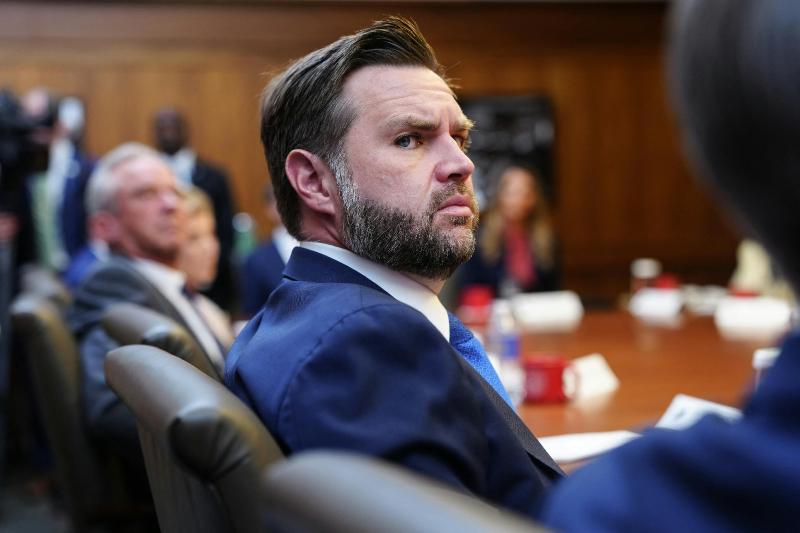
August 11, 2026 -- The headlines following JD Vance's recent appearance on Joe Rogan's podcast were the sort of red meat you'd expect to come out of a Rogan sit-down: Vance admitted the Trump administration botched the Epstein files, he humored Rogan's extraterrestrial fixation, tried a few hacky culture war jabs, and suggested (before directly denying) that Israel is influencing America's behavior in the Iran war. It was all destined to be largely unsurprising stuff—that is, until Rogan made a boilerplate attack on socialism. Vance picked that moment to offer a complaint that decades of Republican economic policy has left Americans suffering and that (most horrifyingly for Vance) the policies of his own party have "created a generation of kids who kind of are attracted to socialism."
Unlike his boss, President Donald Trump, who these days lives almost entirely within the safe confines of his own self-delusions (among them his belief that "the word affordability is a con job"), Vance senses that most of us aren't doing great and that—while the Republican donor class is enjoying the spoils of America's ever-more-pronounced economic inequality—your average American is taking it on the chin. In a striking moment of honesty, Vance made a direct attack on his own party's longstanding supply-side economic doctrine, telling Rogan that "we ran the experiment of ... allowing Wall Street to come in and buy every asset of modern life and turn it into an investable line-goes-up asset." It's this experiment, based on a longtime Republican measurement of economic success, Vance says, that's turning our youths onto socialism.
It's not just Vance. In increasing numbers, Republican politicians are waking up to the reality that their economic policies have screwed just about all of us out of their fabled "American dream." Consider Trump's executive order from January, aimed at keeping investors out of single-family home markets. Senator Bernie Moreno helped make it law in the recent housing bill. It's a sensible policy, but telling American consumers what they can and can't buy, well, that's anathema to the free market economics of the GOP. Or, in a similar moment of realization, Senator Josh Hawley lodged complaints last year that accomplishing the Republican dream of slashing the social safety net in the Big Beautiful Bill was "politically suicidal" and demonstrative of the GOP's longstanding fealty to what Hawley called his party's "old-time religion: corporate giveaways, preferences for capital, and deep cuts to social insurance." Even Marco Rubio during his Senate confirmation hearing last year admitted that "free and unfettered trade at the expense of our national economy has shrunk the middle class and left the working class in crisis" —a remark that sounded eerily similar to the Marxian theory that free trade accelerates inequality.
The particularly inconvenient thing about Republicans realizing they've caught the car at this moment is that they're presently in lockstep behind Donald Trump who, as a dedicated transactionalist, has stacked up a jenga tower of economic policies that are largely short-sighted. Not the sort of ideas you would use to rebuild a party platform that has failed, let alone revive a crumbling economy.
The president's zany economic policies (as much as they can be coherently understood) are best characterized as nationalist, sharp reversals of decades of Republican doctrine. When, in 1987, Ronald Reagan implemented tariffs against Japan over a semiconductor tiff, he complained that "imposing such tariffs or trade barriers and restrictions of any kind are steps that I am loath to take."
When Trump unveiled his widespread tariffs in April 2025, he did so gleefully, cradling an infographic in a Rose Garden ceremony. Trump, already sinking into his self-delusions, saw the tariffs as a quick fix, declaring that "jobs and factories will come roaring back into our country." But reversing half a century of Republican economic blunders isn't as simple as slapping tariffs on the rest of the word.
We are still fighting the semiconductor fight that Reagan was fighting half a century ago, though we've pretty much lost the war. In 1990, we were making around 37 percent of the world's semiconductors; we're now making about 10 percent, according to the Semiconductor Industry Association. Biden tried to reverse this trend with the CHIPS Act, but Trump took a step further to the left, recently doling out $870 million to domestic semiconductor manufacturers in exchange for a government stake in the companies. The acquisition led one policy analyst at the Cato Institute to complain that "Republicans warning that Communists are taking over the Democratic Party might first ask why their own administration is so eager to have the government acquire pieces of private companies."
Cato scholars are exactly the kind of people that are likely to be left bereft in this new era of Republican economics heralded by Vance and others. They're the critics the vice president was referring to on Rogan when he said some accuse him of "being too pro-labor for Republicans." That remark came after another stunning admission from Vance: When asked about AI and how it might reshape the economy, he responded that "what really worries me about AI is the fact that private sector unions have largely disappeared from the United States of America."
Which leads us to the second problem for Republicans, who have managed to catch the proverbial economic car at this moment; it's a familiar one: their billionaire donors. Strong labor unions in the private sector aren't the sort of thing that go over well with the oligarchs who have managed to amass almost all of America's capital and expect to continue their role as the guiding hand of conservative policies.
Contrast Vance's desire for more worker autonomy with the future Elon Musk recently outlined in an Economist interview. Musk said he believes that, after the AI revolution, "work is going to be optional" and that "the treasury should just issue people checks." In Musk's future, there will be an explosion of goods and services to theoretically keep inflation in check. But it stands to reason that if all the goods and services are the products of these AI companies, oligarchs like Musk will also reap the capital produced by those goods and services, private sector unions be damned. Musk imagines a world in which, to quote JD Vance, an industry comes in and turns every aspect of our lives into a "line-goes-up asset."
There's a good argument to be made that Musk is (at least occasionally) delusional in his predictions, but there are two hard truths with which to contend. AI really is coming for the exact sort of private sector jobs that Vance worries are in jeopardy. Additionally, Elon Musk was, in 2024, the largest single-cycle political donor in American history. He was so influential that they gave him an agency within the White House. Now he's poised to throw his money around in a similar fashion this cycle.
Musk's idealized future presents the final problem for Republicans realizing at this moment that their longstanding policies are hurting Americans: The AI future is on the march. Absent some sector-wide uproar or sweeping regulations, it's going to change the economy and drastically reconfigure the role of labor, probably subjugating it even more, and thus driving wealth inequality further into the intolerable zone. This is where the oligarchs and the politicians agree. Musk says that human labor will be irrelevant. Vance told Rogan "the real analogy is the industrial revolution," noting that, the last time this happened, "the inequality in the country got completely out of wack." Taken as a whole, it's a grim sight indeed—we're staring down a new industrial revolution with the industrialists already driving the car, and Republicans are slowly realizing their policies have made this dire future possible.
Alex Thomas has written for Playboy, Air Mail, LitHub, The Daily Beast, and Men’s Health. He writes the weekly blog The Drugs Don’t Work Anymore.
Be a good human. Grossly derogatory comments, blatantly inflammatory comments, excessive trolling, mean-spirited taunting and insults, scamming, spamming, and off topic comments may be removed in compliance with the site's Terms of Service and the Code of Conduct. The moderators have the final word.

Tags
Who is online
104 visitors
Donald Trump has utterly failed as a MAGA President. Trump appears ready to sell MAGA to the highest bidder which only repeats the damned problem that created this mess. Trump has opened the door for the political far-left who seizes upon disgruntled gripes to pander their way into power.
Trump has created a political environment where Communism for the wealthy elite can easily become Communism for the aggrieved elite. And the working class will be left to fend for itself.
I disagree. He is obviously failing at being an even halfway decent American President, but he gave the poorly educated conservative conspiracy theorists MAGA exactly what they wanted.
Do you even know what MAGA wanted? You think MAGA resides in the big cities where the main stream media ventures?
Trump has turned into just another President -- pursuing his own agenda for his own benefit. Trump is no different than any of the other elite who have held office.
They made it clear they're bitterly angry with diversity, equity and inclusion and blamed that for their falling on hard times. They wrongly blamed minorities, Democrats and immigrants for all their problems and hired an arsonist in Donald Trump to burn down a government they believed wasn't working for them. And frankly, it wasn't because why should the government work for stupid, dumb fuck xenophobic white supremacist conservative Christians who ridicule higher education, diversity and inclusion and are an embarrassment to our nation?
Your pet priorities may be coloring your perceptions. The entire country left-right-middle has fallen on hard times. Everybody needs public money. That's not a sign of a robust, healthy economy. That's not a sign of a unified society seeking common goals and objectives.
Maybe that's because minorities receive all the attention. The idea that the 'needs of the many outweigh the needs of the few' has been turned on its head by both social progressives and financial shysters. That's what the hollowing out of society means. We have social minorities and a minority of wealth who suck the air out of any discussion and receive all the attention.
Why should government work solely to redress minority grievance? All political problems and solutions today revolved around money. The middle class is about money. The working class is about opportunity. Somehow the progressive and libertarian shysters have transformed money into a fairy tale of opportunity. That's a lie.
I finally found something to agree with JD Vance on. But this has been building for a long time.
CO PILOT
Evil Geniuses is Kurt Andersen’s forensic history of how America’s economic system was deliberately re‑engineered from the 1970s onward to benefit corporations and the wealthy, producing today’s extreme inequality. The core argument is simple: this wasn’t an accident — it was a coordinated, decades‑long project.
🧩 What the Book Argues (Concise Takeaway)
America once had a broadly fair, regulated, middle‑class‑friendly capitalism. Beginning in the 1970s, a coalition of conservative thinkers, corporate interests, and political operatives systematically dismantled that system — weakening unions, deregulating industries, cutting taxes for the wealthy, and reshaping public opinion — resulting in today’s inequality and stagnation.
🧱 Part I — The America We Used to Have
Period: 1600s–1970s Andersen shows that America historically embraced innovation, modernity, and economic fairness. By the mid‑20th century, the U.S. had:
Strong unions
Antitrust enforcement
Minimum‑wage laws
Child‑labor protections
Social programs like Social Security and Medicare
These created a stable middle class and a capitalism that was “fair, less harsh, and politically sustainable.”
But the cultural upheavals of the 1960s triggered a nostalgic backlash — a longing for a simpler past — which later became politically weaponized.
🔀 Part II — The Turning Point: 1970s
This is where Andersen says the “evil geniuses” begin their project.
Key shifts:
Public trust in business collapses (from 70% in 1968 to 33% in 1970).
Corporations panic about regulation, environmentalism, and consumer activism.
Conservative intellectuals mobilize — Milton Friedman and Lewis Powell become central architects of a new pro‑corporate ideology.
The Powell Memo (1971) becomes a blueprint for building think tanks, legal foundations, media outlets, and lobbying networks.
🏛️ Part III — The 1980s Revolution
Reagan’s election is the moment the long game pays off.
The conservative economic program:
Deregulation
Union‑busting
Massive tax cuts for the wealthy
Corporate mergers and consolidation
A cultural narrative glorifying individualism and demonizing collective action
These changes quietly rewired the economy, often through complex tax and regulatory tweaks that the public barely noticed.
💰 Part IV — Financialization & the New Economy
The 1980s onward saw America transformed into what Andersen calls a “gambler’s economy.”
Finance becomes dominant.
Wages stagnate.
Wealth concentrates at the top.
Middle‑class security erodes.
This is the era where the “evil geniuses” fully succeed: the system now reliably produces inequality.
🧠 Part V — Cultural Manipulation
Andersen argues the economic project was reinforced by cultural engineering:
Media narratives celebrating rugged individualism
Entertainment that glamorizes wealth
Education that downplays collective action
Nostalgia that keeps people looking backward instead of demanding reform
This wasn’t accidental — it helped maintain public acceptance of policies that harmed the middle class.
🚨 Part VI — The Present & Future
By the 2000s–2020s, the consequences are clear:
Extreme inequality
Political polarization
Weakening democratic institutions
A middle class in decline
Andersen warns that automation and AI will worsen inequality unless America dramatically reforms its economic system.
This is what the DSA led Democrats wants to destroy:
Yes, the middle is shrinking. Too many have become wealthy.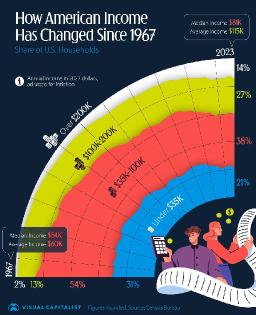
That's not true. Only the top quintile has seen it's share of the national income increase. The other four quintiles capture a smaller share of the national income than they did 60 years ago. The US dollar has lost about 90% of its buying power over the last 60 years. Yes, everyone has more dollars but those dollars have much less value. $100,000 in 1967 would be equivalent to $1 million today.
The same holds for wealth accumulation. The nation's wealth has been migrating to the top quintile over the last 60 years.
co pilot
Today (Credit Card Debt
Average household balance: $11,153
Inflation‑adjusted record high was ~$13,416 in 2007, so today is below that.
1980s (estimated)
Reliable household-level data is sparse, but Federal Reserve surveys show:
Typical household credit card balances were much lower, often $500–$1,500 in nominal dollars.
Inflation-adjusted: roughly $1,300–$3,800 in today’s dollars.
Conclusion: Per household, Americans today carry 3–5× more credit card debt than in the mid‑1980s.
=======================================================================================
As consumer technology and other trendy desireables increased over the years, so did credit card debt. People who cant afford to keep up with the Joneses are enticed into it.
Are they "rich", compared to other places? Not really, they are in debt or on welfare.