
Here’s what happens to the economy when Treasury yields soar like they are now

By: Jeff Cox (CNBC)



 S E E D E D C O N T E N T
Key Points
- Treasury yields surged Wednesday, signaling potential broader impact on the U.S. economy, particularly for consumers.
- Rates along the curve hit highs not seen in years, with implications for longer- and shorter-term borrowing costs.
- The moves came amid heightened expectation that the Fed will approve another rate hike in October.
Soaring Treasury yields aren't just bad for the government and its $40 trillion debt. They also threaten to raise borrowing costs, hitting everyone from homeowners to credit card users, while providing limited help to savers and potential benefits to banks.
Government debt costs leaped higher Wednesday, the product of multiple factors including a fresh report revealing heightened inflation pressures, surging expectations for a Federal Reserve rate hike in October and an auction for 5-year notes showing that Treasury demand was weak. Competition from hyperscaler debt issuance also is seen as an aggravating factor.
Yields responded by jumping more than they have in nearly a year and a half, dating back to April 2025 when President Donald Trump first announced so-called reciprocal tariffs against U.S. trading partners. Recent market liquidity efforts pushed by Treasury Secretary Scott Bessent have had no impact so far, with rates surging higher despite intensified buyback efforts on longer-dated debt.
The 10-year note, a benchmark for mortgages and other longer-term borrowing, saw its yield hit 5.125%, a level not seen since before the global financial crisis. Similarly, the 2-year note, which typically responds to Fed rate expectations and signals rates for home equity, auto loans and other debt, climbed more than 13 basis points past 4.9% as traders priced in a strong possibility that the central bank would follow its hike last week with another in October.
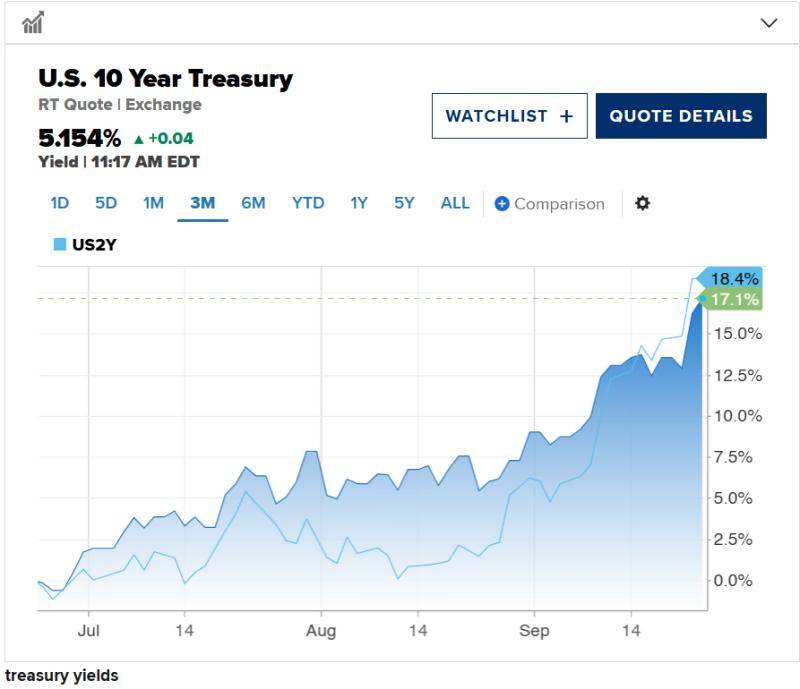
One basis point equals 0.01% and yields move opposite prices.
Such moves generally portend higher borrowing rates that hit the U.S. economy where it hurts the most — consumers, who drive almost 70% of all economic activity and hold nearly $19 trillion in total debt.
While savers will benefit with incrementally higher rates on their bank savings accounts, it's unlikely to offset the pain they'll feel elsewhere, said Dan North, senior economist with Allianz Trade North America.
"The consumer's the most important part of the economy," North said. "They're going from little tiny yields on savings to ever slightly bigger tiny yields on savings. So I don't think that really yet helps the consumer that much. But it sure does crush housing, and it [impacts] on all those personal consumer loans, the credit cards and so forth."

watch nowVIDEO2:5802:58 Main message to take away today is the broadening effect in the economy, says PIMCO's Schneider
Indeed, the interest rate on plain-vanilla savings accounts is around 0.37% and has been on a modest decline since the Fed enacted three quarter-point cuts late in 2025, according to Federal Deposit Insurance Corp. data.
Mortgage rates, though, have been on an entirely different trajectory and are likely to continue rising. A typical 30-year mortgage is now at 7.26%, up more than a quarter percentage point in just the past couple of weeks and nearly a full point over the past year, according to Mortgage News Daily.
Credit card interest rates have been fairly steady over the past few years, but also are unlikely to stay that way if current trends hold up.
How it works
When the Fed hikes, it feeds directly into the prime rate, which is used as a baseline for adjustable-rate credit and most recently was at 7%, after rising a quarter point off last week's Fed move.
Taken together, the factors make it more expensive for consumers to borrow and less likely that they'll seek the loans and credit that fuel a lot of the activity in the $32 trillion U.S. economy.
"You raise the fed funds rate, rates in the short term and effectively all along the curve go up," North said. "If it makes it harder for somebody to buy a car, then there's less demand for cars and there's less demand for auto workers, and the economy slows down. That's sort of basic economics, but that's how it works."
There are some positives from the higher rates.
Aside from whatever gains savers get, banks can benefit. The industry's model is based on a variety of factors that can benefit in times of higher rates. This includes what banks charge their borrowers and the margin these institutions earn, as well as the interest they pay to depositors.
However, even bank stocks were mostly lower Wednesday as dramatically higher yields could slow loan demand and broader economic activity, which otherwise has been solid. The Atlanta Fed is tracking GDP growth of 5.1% for the third quarter, another element that could be factoring into higher yields.
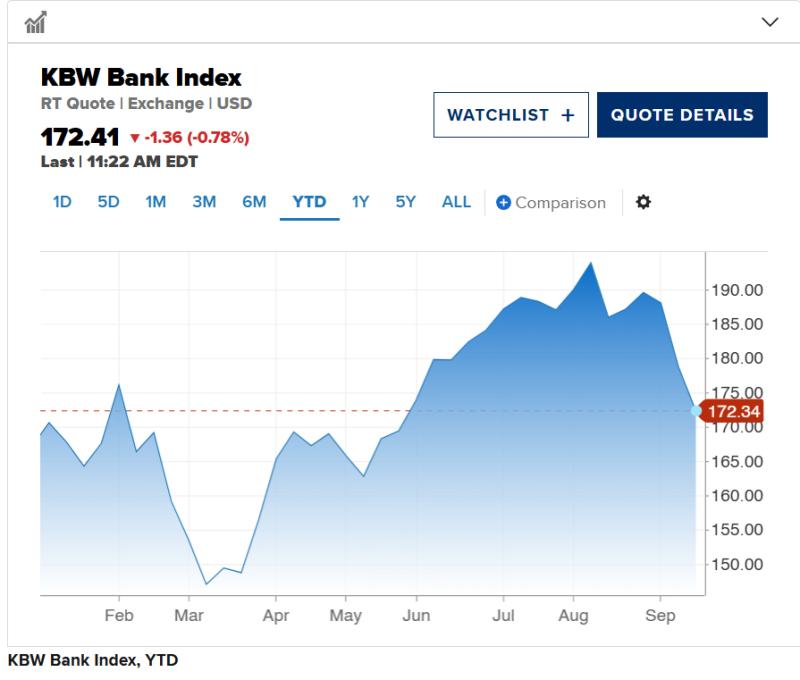
Persistently higher yields, though, pose dangers to that growth picture.
"Smaller and medium enterprises are going to be suffering the worst because they have less ability to borrow," North said. "Less availability of credit makes it more difficult."
Veteran journalist Jeff Cox is the economics editor for CNBC.com where he covers the latest data, the Federal Reserve and how the developments impact financial markets. His stories are routinely among the most-read items on the site each day as he interviews some of the smartest and most well-respected economists and analysts in the financial world. He also is a frequent commentator on NBC News Now and has appeared many times on CNBC broadcast and MSNBC as well as radio outlets across the country.

Be a good human. Grossly derogatory comments, blatantly inflammatory comments, excessive trolling, mean-spirited taunting and insults, scamming, spamming, and off topic comments may be removed in compliance with the site's Terms of Service and the Code of Conduct. The moderators have the final word.

Tags
Who is online


126 visitors
US Treasuries now serve as the primary reserve assets for the banking sector. Under normal conditions, high inflation can increase the risk of financial collapse because of mark-to-market loss of value on Treasury backed reserves. Sec. Scott Bessent's new transactional fiscal policy acts as a hedge against inflation for the banking system by flipping the national debt more quickly. That allows higher coupon rates and yields to supplant any lost revenue from lower credit demand, lessening risk of another financial collapse. Bessent's policies are not intended to protect tax payers or consumers.
Sec. Scott Bessent's hedge fund fiscal strategy protects banking and the financial system. However, that fiscal policy is weakening the Federal Reserve's influence on the economy.
Very important article.
Sadly ignored.
Needs more Trump.
Sadly he doesn't have a clue about what Besemer does or the ramifications.