
Shootout at the O.K. Corral | October 26, 1881

By: (HISTORY)
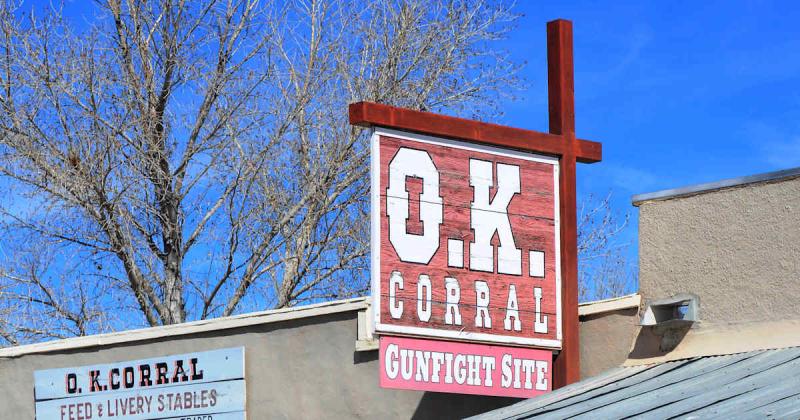


Another newsworthy mass shooting.
 S E E D E D C O N T E N T

On October 26, 1881, the Earp brothers face off against the Clanton-McLaury gang in a legendary shootout at the O.K. Corral in Tombstone, Arizona.
After silver was discovered nearby in 1877, Tombstone quickly grew into one of the richest mining towns in the Southwest. Wyatt Earp, a former Kansas police officer working as a bank security guard, and his brothers, Morgan and Virgil, the town marshal, represented "law and order" in Tombstone, though they also had reputations as being power-hungry and ruthless. The Clantons and McLaurys were cowboys who lived on a ranch outside of town and sidelined as cattle rustlers, thieves and murderers. In October 1881, the struggle between these two groups for control of Tombstone and Cochise County ended in a blaze of gunfire at the O.K. Corral.
On the morning of October 25, Ike Clanton and Tom McLaury came into Tombstone for supplies. Over the next 24 hours, the two men had several violent run-ins with the Earps and their friend Doc Holliday. Around 1:30 p.m. on October 26, Ike's brother Billy rode into town to join them, along with Frank McLaury and Billy Claiborne. The first person they met in the local saloon was Holliday, who was delighted to inform them that their brothers had both been pistol-whipped by the Earps. Frank and Billy immediately left the saloon, vowing revenge.
This Day in History: 10/26/1881 - Shootout at the OK Corral
In this "This Day in History" video clip learn about different events that have occurred on October 26th. Some of the events include the last case of small pox and the first baboon to human heart transplant. Also, the Patriot Act was passed and the Earps had their showdown at the OK Corral
Around 3 p.m., the Earps and Holliday spotted the five members of the Clanton-McLaury gang in a vacant lot behind the OK Corral, at the end of Fremont Street. The famous gunfight that ensued lasted all of 30 seconds, and around 30 shots were fired. Though it's still debated who fired the first shot, most reports say that the shootout began when Virgil Earp pulled out his revolver and shot Billy Clanton point-blank in the chest, while Doc Holliday fired a shotgun blast at Tom McLaury's chest. Though Wyatt Earp wounded Frank McLaury with a shot in the stomach, Frank managed to get off a few shots before collapsing, as did Billy Clanton. When the dust cleared, Billy Clanton and the McLaury brothers were dead, and Virgil and Morgan Earp and Doc Holliday were wounded. Ike Clanton and Claiborne had run for the hills.
Sheriff John Behan of Cochise County, who witnessed the shootout, charged the Earps and Holliday with murder. A month later, however, a Tombstone judge found the men not guilty, ruling that they were "fully justified in committing these homicides." The famous shootout has been immortalized in many movies, including Frontier Marshal (1939), Shootout at the O.K. Corral (1946), Gunfight at the OK Corral (1957), Tombstone (1993) and Wyatt Earp (1994).
6 Things You Should Know About Wyatt Earp
Find out more about this Old West icon, from how he met his friend Doc Holliday to what happened to him after the Tombstone gunfight.

Find out more about this Old West icon, from how he met his friend Doc Holliday to what happened to him after the Tombstone gunfight.
By: Elizabeth Nix
Also on This Day in History
Discover more of the major events, famous births, notable deaths and everything else history-making that happened on October 26th
1774 -- Congress petitions British king to address grievances
On October 26, 1774, the First Continental Congress sends a respectful petition to King George III to inform his majesty that if it had not been for the acts of oppression forced upon the colonies by the British Parliament, the American people would be standing behind British rule. Despite the anger that the American public […]
1775 -- King George III speaks to Parliament of American rebellion
On October 26, 1775, King George III speaks before both houses of the British Parliament to discuss growing concern about the rebellion in America, which he viewed as a traitorous action against himself and Great Britain. He began his speech by reading a "Proclamation of Rebellion" and urged Parliament to move quickly to end the […]
1776 -- Benjamin Franklin sets sail for France
On October 26, 1776, exactly one month to the day after being named an agent of a diplomatic commission by the Continental Congress, Benjamin Franklin sets sail from Philadelphia for France, with which he was to negotiate and secure a formal alliance and treaty. In France, the accomplished Franklin was feted throughout scientific and literary […]
1825 -- Erie Canal opens
The Erie Canal opens, connecting the Great Lakes with the Atlantic Ocean via the Hudson River. Governor DeWitt Clinton of New York, the driving force behind the project, led the opening ceremonies and rode the canal boat Seneca Chief from Buffalo to New York City. Work began on the waterway in 1817. Teams of oxen […]
1864 -- "Bloody Bill" Anderson killed
On October 26, 1864, the notorious Confederate guerrilla leader William "Bloody Bill" Anderson is killed in Missouri in a Union ambush. Born in the late 1830s, Anderson grew up in Missouri and moved to Kansas in the late 1850s. Arriving to settle on his father's land claim east of Council Grove, Anderson was soon enmeshed […]
1917 -- Brazil declares war on Germany
On October 26, 1917, Brazil declares its decision to enter the First World War on the side of the Allied powers. As a major player in the Atlantic trading market, Brazil—an immense country occupying nearly one-half of the entire South American continent—had been increasingly threatened by Germany's policy of unrestricted submarine warfare over the course […]
1942 -- Japanese planes destroy the U.S.S. Hornet
On October 26, 1942, the last U.S. carrier manufactured before America's entry into World War II, the Hornet, is damaged so extensively by Japanese war planes in the Battle of Santa Cruz that it must be abandoned. The battle for Guadalcanal was the first American offensive against the Japanese, an attempt to prevent the Axis […]
1946 -- "Wheel of Fortune" host Pat Sajak is born
On October 26, 1946, Patrick Leonard Sajdak, who will one day be known to millions of game-show fans as the Wheel of Fortune host Pat Sajak, is born in Chicago. Wheel of Fortune, which debuted in 1975, became the longest-running syndicated game show on American television, turning Sajak and his co-host, Vanna White, into pop-culture […]
1984 -- An Ozzy Osbourne fan dies by suicide
Nineteen-year-old John McCollum is found shot to death on his bed in Indio, California. Although it was quickly determined that the fatal wound was self-inflicted, McCollum's parents believed that singer Ozzy Osbourne was actually responsible because their son had been listening to Osbourne's album, Blizzard of Oz, which contains the song, "Suicide Solution," when he […]
1984 -- Infant receives baboon heart
At Loma Linda University Medical Center in Loma Linda, California, Dr. Leonard L. Bailey performs the first baboon-to-human heart transplant, replacing a 14-day-old infant girl's defective heart with the healthy, walnut-sized heart of a young baboon. The infant, known as "Baby Fae," was born with hypoplastic left-heart syndrome, a deformity that is almost always fatal […]
1985 -- Whitney Houston earns her first #1 hit with "Saving All My Love For You"
On October 26, 1985, a rising star named Whitney Houston shot to stardom when her first chart-topping hit, "Saving All My Love For You," hit #1 on the Billboard Hot 100. Houston, the daughter of soul singer Cissy Houston and niece of pop star Dionne Warwick, parlayed her vocal gifts—and the professional nurturing of her […]
1986 -- Red Sox first baseman Bill Buckner lets ground ball roll through his legs
In the wee hours of the morning on October 26, 1986, Red Sox first baseman Bill Buckner lets an easy ground ball dribble between his legs and roll down the right-field line. It was just a routine fielding error, but it was a disaster for the Boston Red Sox: It was the 10th inning of […]
2001 -- George W. Bush signs the Patriot Act
On October 26, 2001, President George W. Bush signs the Patriot Act, an anti-terrorism law drawn up in response to the attacks on the Pentagon and World Trade Center on September 11, 2001. The USA PATRIOT Act, as it is officially known, is an acronym for "Uniting and Strengthening America by Providing Appropriate Tools Required […]
2015 -- Olympic committee announces the creation of refugee team
On October 26, 2015, the International Olympic Committee announces the creation of the first Olympic refugee team, drawing attention to the plight of forcibly displaced people around the world. The declaration, delivered at the United Nations, provided support for athletes displaced by conflict, persecution or human rights violations—and announced a new opportunity to "build a […]

Be a good human. Grossly derogatory comments, blatantly inflammatory comments, excessive trolling, mean-spirited taunting and insults, scamming, spamming, and off topic comments may be removed in compliance with the site's Terms of Service and the Code of Conduct. The moderators have the final word.

Tags
Who is online
86 visitors
Legendary western myth? Or romanticized street violence?
"My Darling Clementine" was the best silver screen depiction of the shootout at the O.K. Coral. They just don't make movies like that anymore.
It might have been the best depiction but it was not the most accurate.
co-pilots says this was the most historically accurate
Wyatt Earp | The O.K. Corral Gunfight | Warner Bros. Rewind
Funny that the current reenactors in Tombstone are the only ones to get it right. Historically the gunfight never took place at the OK Corral, but down the street and to my knowledge no movie or TV depiction has ever got right. I live 45 minutes away from Tombstone and have watched the reenactment multiple times. Every time there is always at least one tourist demanding to know why they are doing it in the wrong place? One or more of the reenactors will explain why and will get a response of "But the movies say it happened that way!".