
Air conditioners could be aiding the spread of COVID-19 indoors, epidemiologists say

By: Stephanie Weaver -- FOX Phoenix
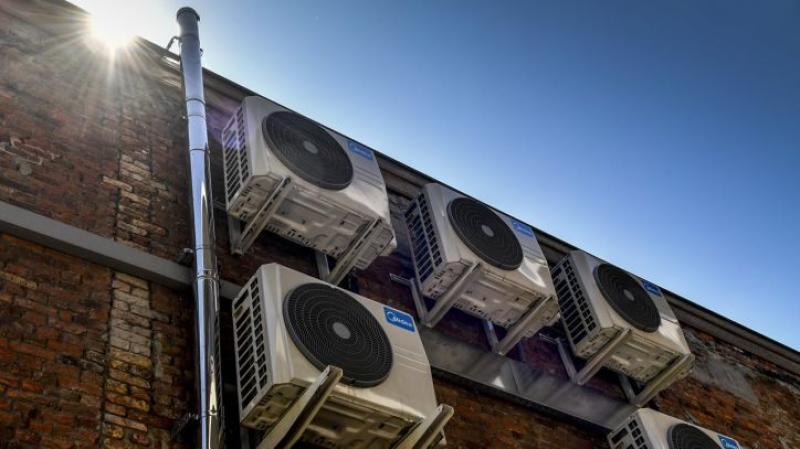


While the focus is on air conditioning, fans will spread the virus indoors, too. Social distancing indoors won't be as effective because air circulation within the enclosed space spreads the virus.
Poorly ventilated spaces doesn't mean lack of air circulation. A well ventilated space replaces air with fresh air from outdoors. But that kinda defeats the purpose of air conditioning. While more effective filters and UV disinfection in the air handling system can remove the virus from the air to some extent, the problem is air circulation within the enclosed space. The air moves around within the space before being drawn into the air conditioning system.
The observations highlights the importance of wearing face coverings indoors. By reducing or preventing release of the virus into the indoor air the virus cannot be spread by air circulation. That reduces the amount of virus being circulated in the enclosed space which also allows the face covering to provide more protection for the wearer.
 S E E D E D C O N T E N T
LOS ANGELES - Amid record-breaking temperatures across the country, people are cranking up their air conditioners to beat the heat. But some researchers are saying that air conditioning in public indoor spaces could actually be causing the coronavirus to spread.
Some experts were hopeful that the summer heat would dissipate the COVID-19 virus and provide a brief period of relief, but Dr. William Hanage, an epidemiologist professor at Harvard University, said that COVID-19 is not significantly affected by the change in the seasons.
"People like me have known that transmission was not going to go away in the heat for some time, months, since the winter. We just didn't know how big the impact would be," Hanage said.
In fact, some experts now believe the heat may be having an exacerbating effect on the spread of the virus, as many people are being driven indoors in order to cool down. Edward Nardell, a professor at Harvard Medical School and an infectious disease expert, suggested Friday that air conditioning use across the southern U.S. may be a factor in spiking COVID-19 cases.
"It is, but not necessarily for the ways you're thinking," Nardell pointed out. "Because of air conditioning and excessive heat, people are indoors and re-breathing each other's air."
Nardell presented data which surveyed places in countries that had the biggest increases in COVID-19 over time. "The places that had the need for most air conditioning, have had the biggest increases in COVID," Nardell said. But Nardell noted that the data could have other correlates, and did not necessarily imply causation.
According to Hanage, the risk of transmission of the novel coronavirus is higher indoors.
A recent study by the University of Maryland (UMD) showed that some air conditioning units could spread the virus, according to Don Milton, a professor of environmental health at UMD. His findings, which were published by the university's School of Public Health, suggested that air conditioning can blow around infected droplets hanging in the air.
"Outbreaks — where you have a bunch of people infected all at once like that — are almost exclusively occurring indoors in poorly ventilated environments," Milton explained.
It's yet another COVID-19 worry, as people try to stay indoors to get away from scorching hot weather. So, what can people do?
Joseph Allen, an assistant professor of exposure assessment science at the Harvard T.H. Chan School of Public Health and director of its Healthy Buildings program, suspects that airborne transmission of COVID-19 is likely, according to a recent interview with The Harvard Gazette.
He said a portable air purifier to filter out airborne particles or a portable humidifier should help. In mechanically ventilated building systems, Allen said almost all of them recirculate some amount of air. The recirculation causes emitting aerosols to be picked up and transported to other areas in a building.
"One way to cut that off when you have a recirculated air supply is to have high-efficiency filters, or certainly upgraded filters from what is typically in a building, which will only capture a small percent of viral particles," Allen said.
Allen said high-efficiency filters do a much better job at limiting transmission from room to room.
If you don't have a central air system, Allen suggested opening up your windows as much as you can. "You want to make sure that if you are recirculating air, that it's being filtered through upgraded filters." He added, "HEPA filters capture 99.97 percent of particles, so upgraded filters can be effective."
But Nardell said nothing is foolproof. "We're always talking probability. So we can lower the probability infection with air disinfection."
Nardel said airborne infection is a problem in public buildings, where someone may have COVID-19. Disinfection techniques include UV lights, room air cleaners and increased ventilation.
Nardell said that ultraviolet lights may also be able to sterilize the air of COVID-19. Ultraviolet, germicidal lamps have been proven effective in protecting against tuberculosis infection and are already in use in some settings to fight SARS-CoV-2, according to Nardell. The lamps shine horizontally, where sterilization is required. Air currents circulate up to the ceiling, where the UV light kills the pathogens.
Evidence has mounted that some cases of COVID-19 occur through airborne transmission. According to Mount Sinai Hospital's Department of Microbiology, airborne transmission refers to situations where residue from droplets remain suspended in the air for long periods of time. These organisms can survive long periods of time outside the body.
"Often, the term 'airborne transmission' creates panic because people imagine these clouds of virus roaming around the streets coming after them. But that's not the way it works," Dr. Linsey Marr, a professor at Virginia Tech with expertise in airborne transmission of viruses and air quality said. "The concern is greatest when you are close to a person who happens to be infected, if they're talking, especially if you're indoors because the virus can build up in the air."
Dr. Linsey Marr, a professor at Virginia Tech with expertise in airborne transmission of viruses and air quality, discusses ways to make offices and schools safer amid the pandemic.
Marr was among 239 scientists from a variety of fields who recently contributed to an open letter calling on the World Health Organization to acknowledge that the coronavirus can spread in the air and urging the WHO to update its official guidance on the subject.
Last week, The World Health Organization updated guidance on airborne droplets correlated to transmission of the coronavirus.
The scientific brief, released on July 9, said that short-range aerosol transmission, particularly in specific indoor locations, "cannot be ruled out."
The WHO said a few experimental studies found that the SARS-CoV-2 virus remains active within aerosols for long periods of time. The virus was within aerosols for up to three hours in one study and 16 hours in another. However, these findings were from experimentally induced aerosols that do not reflect normal human cough conditions, the WHO noted.
Airborne transmission is thought to have been a factor in the spread of COVID-19 at a restaurant in Wuhan, China in January.
In a study published on the website of the U.S. Centers for Disease Control and Prevention, researchers found that the air conditioning system likely passed COVID-19 to 10 people.
Of the 91 people in the restaurant during that time, only those at tables in the way of the air conditioner's airflow contracted the virus, the study reported.
"Airflow direction was consistent with droplet transmission. To prevent the spread of the virus in restaurants, we recommend increasing the distance between tables and improving ventilation," the study said.
Hanage's expectation is that transmission will continue over the summer months unless something is done to stop it.
"This is not over," Hanage said. "It's going to be with us for a really long period of time, and so managing to remember that this is a marathon, not a sprint, and being able to take steps now, which are going to be sustainable, which are going to protect you and your family."

Tags
Who is online
110 visitors
Common sense should be adequate to understand that people are more likely to become infected indoors rather than outdoors. It's the beans and cabbage effect. Taking a family drive after a meal of beans and cabbage isn't a good idea. And there isn't any way to blame the dog for spreading the virus around.
Only if your'e going to planet Mars! Lol
Air sanitation systems like UV light technology are the answer to that although I’ve already been told by one NT know it all that they aren’t effect.
But what the hell do I know. I’ve just been designing and installing HVAC systems for the last 40 or so years.
What's the residence time of air in 50,000 cubic feet? That's a 5,000 sq. ft. floor space with 10 ft. ceiling height. How quickly can a commercial air conditioner draw all that air through a UV disinfection system?
All that enclosed air must circulate through the space to be drawn into the air intake for the air conditioner. And fixtures within the space will interfere with air circulation. So, how long would it take for a commercial air conditioner with a UV system to disinfect the air in that enclosed space?
Depends on a lot. The load profile for the space determines how much CFM is required to do the job. Also each type of space has different ventilation requirements. OR suites for example require more than say a retail space.
And there is no “magic” silver bullet here.
The air still has to get from point “A” (a human breath or contact point) to point “B” (the UV system). Between point a & b one can still be exposed.
Short of bathing the entire SF in effective sanitation, nothing will solve that issue. Especially not masks.
The main purpose of the face covering is to greatly reduce or prevent releasing the virus into the air. If the virus isn't released into the air then the virus won't spread.
A face covering can provide some protection against inhaling the virus. But the eyes and skin are still exposed. So, the best protection is to avoid releasing the virus into the air.
Face coverings are more effective in avoiding releasing the virus into the air than they are at protecting the wearer from virus that is already in the air. The face covering does the same thing as air conditioning filters and UV systems; they prevent spread of the virus by lessening the amount of virus circulated in the air.
People who are not infected should wear face coverings so that people who are infected can be required to wear face coverings and not spread the virus. Reducing the amount of virus released into the air protects everyone.
As noted previously, facecoverings are no magic bullet either.
Not unless they are rated to stop Covid from being ingested or expired. I’ve never argued that they don’t help but imo they give some a false sense of security.
Unless you walk around in a HEPA rated respirator or self contained OBA, Covid can still be ingested and expired.
I think his point was, that one Typhoid Mary in a contained area, constantly emitting the virus reduces the efficiency of any closed system
Even a high air turnover rate will be less than 100% clean until the store closes and the air passes through the system several times.
There is no doubt about the effectiveness of UV, but it can't kill the airborne virus fast enough to guarantee absolute safety for everyone
Never said it would. Read the entire seed.
Mask don’t stop all virus spread either. Both however make perfect sense as protection schemes with this virus.
Comment #2 did not seem to reference this seed, rather something said on a previous seed.
I responded to that comment.
Okay, where did I I say that UV was an absolute solution?
Regardless, I’ve made clear where I stand on this in this article so do you have a point or do you just want to argue?
Oh the irony...
Sorry, I thought it was clear that I agree with you.
Six day old comment? You on a tear today SP?
If this is true, I'm a goner. I can't sleep during the month of July, on the east coast without an A/C and I keep it on 60 degrees.
Are you worried about infecting yourself?
Not really. I was just tested a week ago - it came back negative and Iv'e had the A /C on every night for the last 2 or 3 weeks.
People can become infected while they are being swabbed. Think about it.
People who are not feeling well go to a testing station to find out if they have been infected. So, we know infected individuals have been present at a testing station and have released virus into the air. Testing stations are the opposite of precautions to isolate people who are infected. People are waiting in line to enter an area where the virus has definitely been circulated in the air.
The way testing is being performed really can spread the virus. While recent outbreaks correspond to people seeking cooling indoors, the recent outbreaks also correspond to increased testing. When more infected people are being tested then the testing station, itself, becomes a risk.
Would an ozone generator have any effect?
Yes, that’s another air sanitation process. Problem is the EPA won’t agree because they haven’t tested the efficacy of such systems.
The fact remains if properly designed, installed and operated, such systems will kill most viruses, bacteria’s, molds, etc.
We put a UV system in our air handling equipment several years ago.
Yes but it should not be run while people and pets are present. Even on the lowest settings, it's obvious by the smell that there is an
over abundance of ozone present.
We run ours on low if we are going to be out for a few hours, but not that often.
The ionization and UV light seem to be all my beautiful bride needed to help with seasonal allergies.
On the other hand, I had a pet shop full of fresh and salt water aquariums along with dozens of breeding birds.
I let that old Breeze unit run 24/7 with ozone and ionization to defeat the odors. Could not have operated without it.