
When Mammals Ate Dinosaurs

By: Dr. Alida Bailleul (HeritageDaily - Archaeology News)


Mammals (our very, very distant relatives) lived alongside dinosaurs. Since early mammals were tiny it is difficult to find evidence in the fossil record. For that reason discoveries like this one are rare and exciting.
 S E E D E D C O N T E N T
A research team led by Professor Hans-Ulrich Pfretzschner from the Department of Geosciences at the University of Tubingen discovered bite marks of a mammal the size of a modern shrew on a bone fragment of a sauropod that was approximately 20 meters long and weighed several tons.
The researchers say the mammals were probably eating dinosaur's carcass; this was the only way for such a small animal to eat a large one. This discovery, which provides information on the life and environment of the early mammals, has been published in the journal The Science of Nature.
"The early mammals lived in the shadow of the dinosaurs for more than 160 million years. On average they reached a weight of about one hundred grams," says Felix Augustin from the research team, the first author of the new study. "However, we now know that they nevertheless developed an astonishing biodiversity and occupied a large number of ecological niches."
Alongside the numerous insect-eating ground-dwellers, there were also semi-aquatic, tree-dwelling, digging, and even gliding mammals. This diversity is reflected in their different diets, which researchers can determine indirectly by examining the shape of teeth and jaws. "Direct evidence such as bite marks on bones or stomach contents is very rare," says Augustin. "Furthermore, all the evidence we have to date dates back to the Cretaceous period at the earliest and is at most about 100 million years old. That's why our discovery from about 160 million years ago is so special."
Rich fossil site
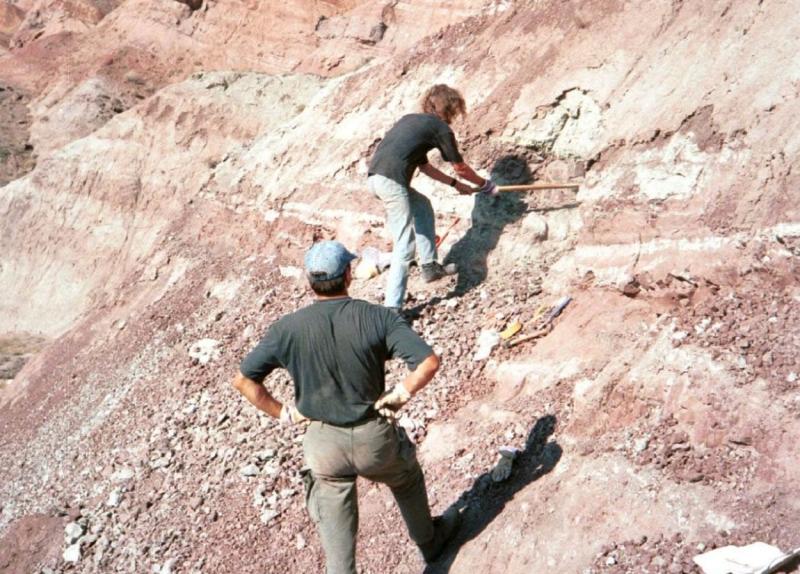
In 2000, researchers of a Chinese-German expedition excavated numerous fossils of vertebrates such as turtles and crocodiles, dinosaurs and mammals from the Jurassic period, the time about 160 million years BCE, from what is now the Junggar Basin in the province of Xinjiang in northwest China.
While re-examining the fossil bones, the team noticed tiny gnaw marks on a fragment of bone, which on closer examination turned out to be bite marks made by early mammals. The researchers working in vertebrate paleontology compared the notches with a large number of similar marks on fossilized and unfossilized bones. "The gnaw marks were very similar to those of today's insect-eating mammals, such as shrews," says Augustin.
Due to the extreme difference in size, the researchers assume that the mammals ate the remains of one animal only. "The marks provide valuable insights into the biology of these early mammals from China, which according to the reconstructions were very small insectivorous or omnivorous animals. We were able to prove for the first time that they were not above eating carrion," says Hans-Ulrich Pfretzschner.
This behavior is also seen in modern insectivores and other small mammals such as rodents. The surrounding rock in the Junggar Basin provided additional information about the environmental conditions at the time and suggest that the northwest of China had rivers and floodplains and a dry, warm climate when these dinosaurs were alive.
Universitaet Tubingen
Header Image Credit : Andreas Matzke

Tags
Who is online
159 visitors
Are we descendants of Jurassic rats?
Looks that way. If it hadn't been for that big space rock, the dino's would most likely still be stomping around, and we wouldn't be here
The dinosaurs, in a way, created the mammals by forcing cold blooded reptiles to shelter during the day and spend more time at night to forage, therefore developing the need to become warm blooded and the need for hair when burrowing underground, then for the protection of the offspring a way to bring nourishment to them without them leaving shelter, mammary glands. To top it all off, to finish the mammals ascension to the top, the extinction of most of the dinosaurs allowing the mammals to live unmolested above ground.
More or less yes
Possums & Opossum are among the oldest mammals ( and marsupials) dating back some 222 million years, more or less.
They are omnivores but prefer carrion to insects and insects to rotten fruit. We have several families in our trees and under our shed.
They are our garbage disposal system and love small bones from chickens and pork ribs.
They will also hunt and control Texas tree rats and mice and snakes.
No surprise that archeologists and researchers have finally ( whew) proven that they were doing the same thing millions of years ago.
I can sleep easier, now. /s
They hunt squirrels????
No, possums have actually shared a tree with our "out back" squirrels.
Texas tree rats ( roof rats ) are literally huge fast and can seemingly climb any surface.
Their goal is your attic, your food and your wallet, lol.
We bait them and use electronic zappers in the rear corners of the property.
When there are possums aplenty we never see mice and about once a week kill a rat.
One of my neighbors went on a mission catching possum and racoon for animal control.
Soon everyone was complaining about dozens of rats in the yards at night and crossing the street in packs.
Once the possums returned, the rats disappeared.
Ohhhhh....glad you clarified that. We have lots of squirrels and at least one possum family (I suspect we have more) and more raccoons than I can plink my bb gun at.
Borrowed from Perrie -
Look how cute that lil guy is!
Indeed they are our Friend. They live here on earth just like we do and all the other wildlife. They do a great deal for us, and we need to be more supportive for them.
Cool article.
Thanks.