
Tenants say a 3-year ban on evictions kept them housed. Landlords say they're drowning in debt | AP News

By: JANIE HAR (AP NEWS)


 S E E D E D C O N T E N T
By JANIE HARJune 26, 2023 GMT
SAN FRANCISCO (AP) — Retiree Pamela Haile has paid property taxes, insurance and other bills on a house she lets out in Oakland, but for more than three years her tenants have paid no rent thanks to one of the longest-lasting eviction bans in the country.
The eviction moratorium in the San Francisco Bay Area city expires next month and Haile can't wait. The 69-year-old estimates she is owed more than $60,000 in back rent, money she doubts she will ever see. Moreover, the tenants have trashed her house and it will cost tens of thousands of dollars to make it habitable, she says.
"It's unbelievable and it's like, how can they have the nerve to just let something like this happen? If this happened to them, how would they feel?" Haile said of her tenants. "Dealing with this whole thing gets me so upset."
Eviction moratoriums were put in place across the U.S. at the start of the pandemic in 2020 to prevent displacement and curb the spread of the coronavirus. Most expired long ago, but not in Oakland or neighboring San Francisco and Berkeley, all places where rents and rates of homelessness are high.
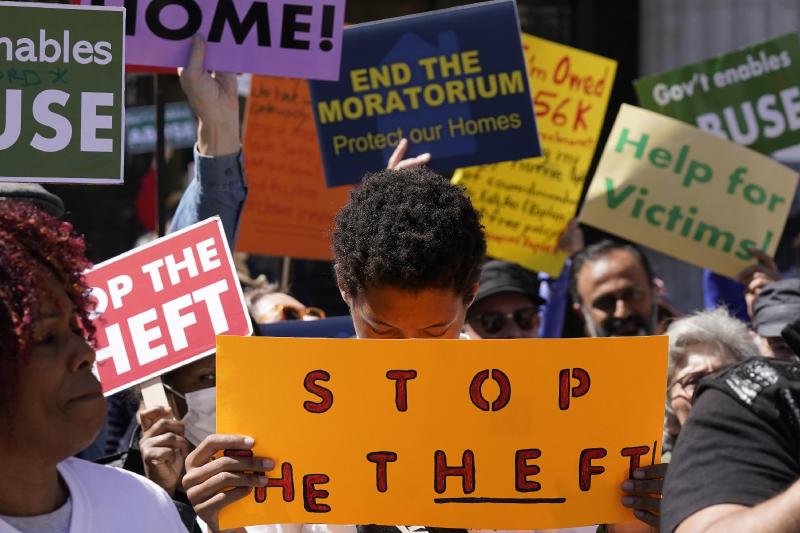
While it's more common to see tenants converging on city halls in California to demand greater protections, in Oakland and surrounding Alameda County small-property landlords staged protests earlier this year demanding an end to the moratoriums.
Many of the landlords were Black, like Haile, or Asian American, and they said the eviction bans had saddled them with debt and foreclosure worries while their tenants, who have jobs, live rent-free.
They scolded elected leaders for allowing tenants to self-certify that their inability to pay was tied to the pandemic. Unlike large corporate landlords, these small-property owners said they didn't have the means to evict, and were eaten up by worry.
"There is nothing natural about being forced to house and have people live in your property for over three years and not pay," said Michelle Hailey, who is also Black and owns a triplex where both her tenants stopped paying. "There is nothing natural, ethical or even humane about that."
Alameda County let its moratorium expire at the end of April. In Oakland it ends July 15. Tenants must start paying rent in August in most cases, but cannot be evicted for back rent if their financial hardship was caused by the pandemic.
Moratorium backers called the bans a lifesaver that kept countless families housed and off the streets. They said low-income residents are still struggling from the pandemic and need protections from ruthless landlords.
Nationwide, eviction filings have come roaring back since the bans ended — to more than 50% higher than the pre-pandemic average in many cities, according to Princeton University's Eviction Lab, which tracks filings in three dozen cities and 10 states.
In California's Alameda County, filings topped 500 in May, compared to 65 in April before the ban ended. That surpassed filings that averaged in the 300s before the pandemic in 2019.
In Oakland, a city rich in Black history, some Black families who migrated from the South during World War II were able to purchase homes, despite redlining and other discriminatory practices by banks and government.
But a recession and subprime mortgage crisis followed by rapidly rising home prices and gentrification pushed out many Black residents, and homelessness escalated.
Carroll Fife, a Black city councilwoman and housing advocate, called for a housing overhaul that focuses on homes for people instead of profit for a few. She acknowledged that some people "took advantage of the moratorium," but says most renters desperately needed the help.
Hailey, the triplex owner, considers herself lucky because she was able to recoup some money through a rent-relief program. The tenants moved out, but she has a stack of bills and can't afford to renovate.
She purchased the property in 1999 after earning big for writing some songs included on the first Destiny's Child album. The artist figured the triplex would provide steady income as well as help fund her retirement.
"So this was my entire plan, and I've just kind of watched it go up in smoke," said Hailey, 59. "We've never had a situation where you would have government-sanctioned freedom to not pay your rent."
Haile doesn't know why the family who rented the house her parents left her stopped paying rent in April 2020. The property management company said they couldn't ask because of the eviction ban.
Reached by The Associated Press, the tenant, Martha Pinzon, said at the advice of a community nonprofit she stopped paying after she lost her hotel housekeeper job during the pandemic-triggered shutdown in March 2020. Even now, she can't afford the $1,875 monthly rent on her pay as a custodian at a homeless shelter.
Pinzon's 19-year-old daughter, Brigitte Cortez, said the moratorium gave her mother "peace of mind" during the pandemic. She said the property management company has for years ignored their requests for repairs.
"We've had a lot of troubles in this house since we've moved in," she said, adding that they are looking for a new place to live.
Haile says the tenants never asked for repairs.
John Williams, 62, hopes that three years of worry and stress are coming to an end.
Williams, who is part of a lawsuit against Oakland and Alameda County over the bans, said his tenant stopped paying the $1,500 monthly rent when the pandemic started. She offered no explanation while operating a storage business out of the apartment and would not cooperate so he could get money from the city's rent-relief program, he said.
As a Black man, Williams had experienced rental discrimination and he thought his Victorian duplex in West Oakland would be a way for him to retire and house others. He started renting to the mom with two kids in 2013.
In late 2020, he tried to sell the house, but she refused to move, and the sale fell through. In late 2021, Williams was so stressed he was hospitalized, placed on disability and could not work. He was forced to move into the unit above his tenant. It no longer felt like his house.
The tenant did not return messages from the AP left at a phone number for a business she operates.
Williams supports the purposes of the eviction ban, but wishes the city had considered landlords like him. He was about to lose his home on May 1, but was saved by a state mortgage-relief program that started accepting applications this year from landlords who reside in their duplexes and triplexes.
He plans to leave the city.
"I don't want to be a home provider in Oakland," he said. "This has been a really hard time."

Tags
Who is online


273 visitors
Sounds like a class action suit may be required to get those who imposed these moratoriums to pay up. In a nut shell, Because they disallowed evictions, they caused the debt, they need to cover the debt.
What happened to all the money Congress approved for these things? Did they authorize the spending and then give it to themselves?
Probably have to ask the state and local GovCo folks where the hell the money got funneled to...................
When the government gives out money everyone puts their hands out.
Undoubtedly we'll find some landlords as well as some tenants that got screwed. Here's an article showing a landlord of covid fund fraud.
There are many articles of people who got screwed and others who committed fraud. Don't make it out to be some grand conspiracy - we already know not everyone gets what they should, and making it easier for the right people to get funds also makes it easier for fraud. It's a balancing act. No plan is foolproof. If landlords are truly owed money they applied for and didn't get they should be made whole.
As the article points out they are free to sue and try to recoup money they feel they are owed. I hope they get it. I've worked for the building owner my office is located as a side hustle. That cured me of ever wanting to be a landlord in any capacity.
You got a better one?
I'm going to assume since both the Feds and the States who gave a shit ton of money to everyone and their neighbors they thought it would work itself out. What the cities were up to, who knows? There were nonprofits in places to help both renters and landlords to get those funds, but this isn't a fair world where EVERYONE is always made whole as I've already pointed out. The landlords could sue the tenants for fraud I suppose, but that doesn't sound like a results oriented plan either. Perhaps they should have been more selective in tenants in the first place? None of this helps anyone now.
The takers are now having to pay rent and their student loans back, I may need to up my flood insurance for all the tears that will be falling.
If the banks and mortgage holders foreclose, the squatters will be out on the street anyway.