
A Scandal That Ended Joe Biden's 1988 Presidential Campaign | Time

By: Olivia B. Waxman (Time)


 S E E D E D C O N T E N T
By Olivia B. Waxman Updated: August 2, 2019 1:20 PM EDT | Originally published: July 30, 2019 4:05 PM EDT
As former Vice President Joe Biden prepares to take the Democratic debate stage on Wednesday, the pressure is on the front runner for the party's 2020 nomination for the presidency — especially after the June debate, after which he admitted he was unprepared for fellow candidate Sen. Kamala Harris to call him out on his past positions on busing.
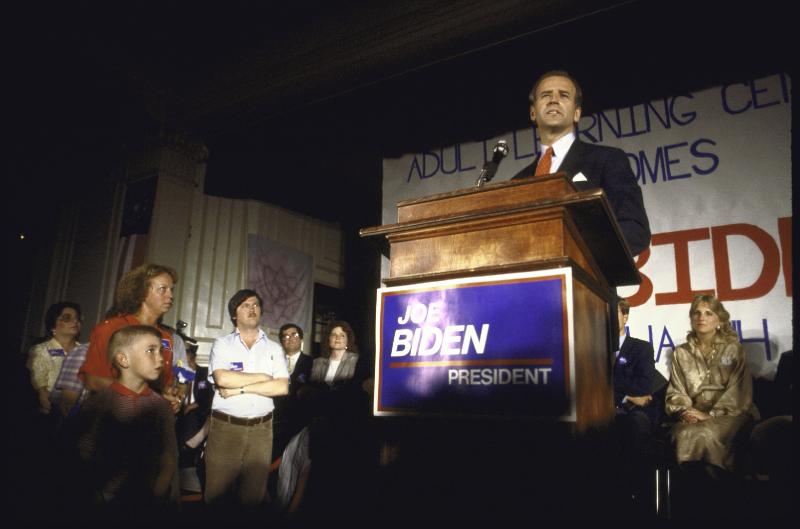
But for at least one veteran political reporter, that moment is just part of a decades-long history that goes all the way back to the first time Biden made an official run for the White House — and to the scandal that ended that campaign.
"Then, as now in fact, Biden is not as fast on his feet as a successful candidate usually is," argues Laurence I. Barrett, a former TIME national political correspondent who profiled Biden during his three-month-long presidential bid in the run-up to the 1988 election.
Biden had been on presidential watch-lists for years by that point. When he was elected to the Senate in 1972, he was already seen as White House material. TIME's walk-up of Election Day that year noted the extraordinary enthusiasm surrounding his Senate campaign, pointing out that he would be old enough to run for president in 1976, if only by 61 days.
He mulled the idea in the years that followed. By the time he did declare his candidacy for the presidency, on June 9, 1987, he had been in the Senate for more than a decade, though his age — now seen by some as a weakness — was still one of his strengths.
"What people don't remember today about Biden in the 1980s is that he was considered by quite a few people as a bright new hope, different from other Democrats," says Barrett.
A supporter holds up a Biden for President button from 1988 in Dover, Del., on March 16, 2019. Bastiaan Slabbers—NurPhoto via Getty Images
President Ronald Reagan had won two presidential elections, and the Democratic field faced a pretty wide-open race. The seven major contenders were nicknamed the Seven Dwarfs. (Biden joked they should be called the seven deadly sins, saying after Gary Hart backed out amid a scandal over an affair that, "We've got an opening for lust.") The lack of a front runner seemed like a great opportunity for Biden.
"The Democrats had taken two shellackings at the hands of Reagan, and there was this thought, not really based on a lot of facts, that the Democrats were too soft, too feminine, too much into interest politics, and Biden was seen by his own people as an antidote to that — good looking and athletic — who would come across as stronger," Barrett says.
Not that the candidate was without his drawbacks: "Biden's mouth is both his greatest asset and his greatest liability," Barrett wrote shortly after Biden announced his candidacy. That analysis would prove enduringly prescient.
The then-44-year-old Senator was great at giving inspiring speeches and people were attracted to his youthful energy, but he could also come off like a "hothead," as he did in his "angry" questioning of Secretary of State George Shultz when the Senate heard testimony about South Africa in 1986. His position in the Senate offered him a chance to show his skill. In particular, as Biden chaired the Judiciary Committee, he hoped to gained more national attention during the uproar over polarizing conservative Supreme Court nominee Robert Bork. Biden, in charge of the confirmation hearings, oversaw what was seen as potentially "the culminating ideological showdown of the Reagan era," as TIME put it back then. "For Chairman Biden, the hearings could provide a spark for his presidential campaign by giving him a chance to show his mettle in front of a national television audience."
But Biden didn't get a chance to shine during the Bork hearings in the way he had hoped.
A few days before they began, video surfaced that spliced together footage of U.K. Labour Party leader Neil Kinnock giving a speech and Biden clearly quoting Kinnock at the Iowa State Fair without attribution. More examples of misattribution came to light, and the plagiarism scandal became more memorable than his leadership during the Bork confirmation hearing. His mouth — or rather, what he failed to say — got him in trouble again.
Here's how TIME described why the fallout was so intense:
[T]he Biden brouhaha illustrates the six deadly requirements for a crippling political scandal.
1) A Pre-Existing Subtext. "The basic rap against Biden," explains Democratic Pollster Geoff Garin, "is that he's a candidate of style, not substance."
2) An Awkward Revelation. The Kinnock kleptomania was particularly damaging to Biden since it underscored the prior concerns that he was a shallow vessel for other people's ideas.
3) A Maladroit Response. Top Aide Tom Donilon claimed that Biden failed to credit Kinnock because "he didn't know what he was saying. He was on autopilot."
4) The Press Piles On. Once textual fidelity became an issue, reporters found earlier cases in which Biden had failed to give proper citation to Humphrey and Robert Kennedy. By themselves these transgressions would not have been worth noting.
5) The Discovery of Youthful Folly. During his first months at Syracuse University Law School, in 1965, Biden failed a course because he wrote a paper that used five pages from a published law-review article without quotation marks or a proper footnote. Since Biden was allowed to make up the course, the revelation was front-page news only because it kept the copycat contretemps alive.
6) An Overwrought Press Conference. With a rambling and disjointed opening statement, Biden failed to reap the benefits of public confession, even though he called himself "stupid" and his actions "a mistake." Part of the problem is that he contradicted himself by also insisting that it was "ludicrous" to attribute every political idea.
The "final blow" for the campaign came when Newsweek unearthed C-SPAN footage of Biden rattling off his academic accomplishments, including saying that he graduated in the top half of his law school, when in fact, he ranked 76th out of 85.
Biden announced he was dropping out of the race on Sept. 24, 1987. (To make things even, Biden later jokingly gave Kinnock some of his speeches to use "with or without attribution" during a January 1988 trip to Europe.) About twenty years later, in his 2008 memoir Promises to Keep: On Life and Politics, he wrote that the plagiarism scandal was his own fault. "When I stopped trying to explain to everybody and thought it through, the blame fell totally on me," he wrote. "Maybe the reporters traveling with me had seen me credit Kinnock over and over, but it was Joe Biden who forgot to credit Kinnock at the State Fair debate."
Barrett helped break the news that the Kinnock attack video had come from the campaign of one of Biden's main opponents, Massachusetts Governor Michael Dukakis. Paul Tully, a top aide to Dukakis, denied, on the record, that the video had come from the campaign, and Barrett says Tully expressed disbelief that the story would run anyway when they saw each other in Iowa. "I told you we were doing this story," Barrett recalls telling Tully. "He looked at me as if I had done something awful." Dukakis at first denied the story when the magazine hit newsstands, but hours later took back his denial. It was a particular embarrassment for the man known as the "straight arrow" candidate because of his "positive campaigning" tactics. Two of his aides stepped down: John Sasso, who leaked the video, and Tully, for lying to TIME.
The public was equally outraged.
Letters to the editor published in TIME offer a glimpse at the public reaction, finding neither Biden nor Dukakis to be honest or trustworthy. "Biden lied in situations in which it was not necessary or relevant," wrote a Los Angeles reader. "I am alarmed that neither candidate viewed these acts as immoral and representative of his character." Another reader was alarmed about a year later when Dukakis rehired Sasso after his campaign started to "tank," literally — a goofy photo of him posing in a military tank was turned into an ad that painted Dukakis as not taking national security issues seriously enough. When the election rolled around, Republican George H.W. Bush won. "Dukakis might have been spared some of [his] mistakes had Sasso been at his elbow," Barrett recalls many thinking.
Biden's short-lived 1988 campaign would end up having long-lasting effect on future political campaigns and political journalism, with Walter Shapiro arguing in a December 1987 TIME essay that it had helped turn political reporters into "character cops" who trade in "paparazzi politics and pop psychology."
And for Biden, there was a silver lining to being driven out of the race: It saved his life. In February of 1988, he had a headache that turned out to be a brain aneurysm. He had surgery, and he had to have surgery again in the spring when a second smaller aneurysm formed. "There is no doubt — the doctors have no doubt — that had I remained in the race, I'd be dead," he told TIME later that fall, at his first event since the aneurysms. He also joked that "The good news is that I can do anything I did before. The bad news is that I can't do anything better."
When he'd had announced his candidacy back in 1987, TIME reported that he had asked his then-teenage son Hunter if he should run. "You should," Hunter said. "If you don't do it now, I couldn't see you doing it some other time."
Hunter Biden, of course, was wrong.
Biden ran for the Democratic nomination again in 2008. He didn't secure the nomination, but went on to serve as Vice President of the United States under Barack Obama. In his eight years in the office, he built up a foreign policy portfolio that included the Paris climate agreement and Iran nuclear deal. Now he hopes his policy portfolios and his high poll numbers, not his past runs for the White House, will define his candidacy.
"The huge difference between now and 1988 is that Biden has much more of a cause now," says Barrett. "In '88 he couldn't really formulate why he was running. He didn't have an ideological cause the way Reagan had a cause. Now we know why he's running. He thinks he's the guy who can defeat Trump."
Write to Olivia B. Waxman at olivia.waxman@time.com.

 Article is LOCKED by author/seeder
Tags
Who is online

177 visitors
It was just a gaffe, caused by his stuttering, as the video demonstrates.
Biden should get out of politics and get into the hair growth business. He's the only man I know whose hairline improved from age 50 to age 85.
So you are defending his incompetence then and defending his incompetence now. AND you expect to be taken seriously?
I was just playing the role of the progressive, who runs out the same tired excuses no matter the evidence in front of their face.
He's obviously not stuttering as he tries to bully the voter with a blizzard of lies.
Makes sense. My apologies.
I should have been more clear. I should have called anyone who criticizes Biden's lies a racist to capture the true progressive spirit.
Racist?
I thought we were all fascists, religious zealots, seditionists out to overthrow the US government./S
Don't tell me Democrats changed the narrative again. They need to create a scorecard so we can keep up with their attempts at bullying.
We've always been racist according to them. I think Sean left out misogynists, xenophobic, and what ever "phobic" they care to invent.
It's hard to keep up up their laundry list of insults. They just go on and on .
I don't think it would be as bad if they even remotely understood the English language and knew how to put a sentence together. But then again, they do support Biden...
They also indoctrinate children by encouraging them to assault Conservatives/Republicans with "play" bricks.
Well, that 1988 video certainly proves that Biden doesn't have a stutter!
That was always such a crazy, dishonest excuse for current inability to speak coherently. Anyone who actually remember Biden before the mental decline set in knows what kind of a speaker he was. He was famous for his long winded orations where he just threw avalanches of words at his audience. This video is a perfect example of how he could just rapidly stack lie upon lie without allowing a chance for anyone else a word edge wise.