
California Spent More Than $600 Million On Environmental Reviews For High-Speed Rail Line That Isn't Built Yet | The Daily Caller

By: Green Foothills (dailycaller)


 S E E D E D C O N T E N T
- California spent more than $600 million on environmental reviews for a high-speed rail project that has not yet been completed, according to documents obtained and reviewed by the Daily Caller News Foundation.
- Approximately 78 miles of the 500 mile-long Los Angeles to San Francisco path have not yet received full environmental approval and clearance, a California High-Speed Rail Authority (CHSRA) official told the DCNF, about 15 years after California voters approved $9 billion in bond financing.
- "With the amount of regulatory paralysis the project confronts, it's no surprise that almost nothing has been accomplished in over 15 years since voters approved it," Edward Ring, senior fellow for the California Policy Center, told the Daily Caller News Foundation.
The state of California has spent more than $600 million on environmental reviews for a high-speed rail project that has not yet been completed, according to documents obtained and reviewed by the Daily Caller News Foundation.
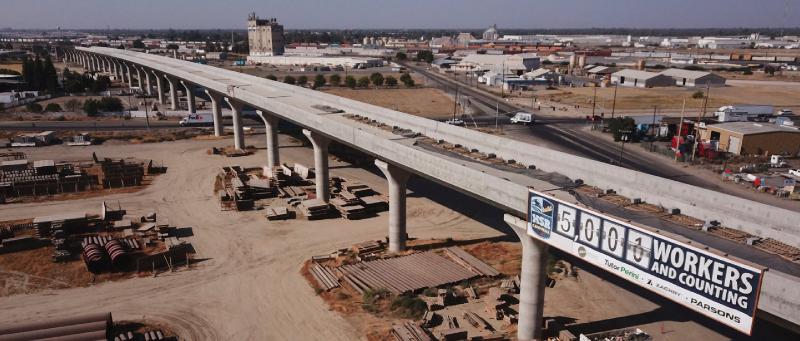
The state shelled out a total of $618,038,924.01 for numerous companies involved in construction to conduct environmental reviews for the state's high-speed railway project, the records show. California voters approved the funding of the undertaking to connect Los Angeles to San Francisco and the Central Valley with high-speed rail in 2008, but it has encountered delays and budget overruns in the 15 years since California voters initially approved issuing bonds to finance the project.
"With the amount of regulatory paralysis the project confronts, it's no surprise that almost nothing has been accomplished in over 15 years since voters approved it," Edward Ring, senior fellow for the California Policy Center, told the DCNF. "The state owes it to the taxpayers to either dramatically streamline the process or cut their losses and cancel the project" because "at the current rate, the project will not be completed in our lifetimes," Ring continued. (RELATED: Here Are 5 Big Reasons California's High-Speed Rail Project Became The 'Train To Nowhere')
The state Legislature created the California High-Speed Rail Authority (CHSRA) in 1996 to begin assessing the project, according to CHSRA. When voters first approved about $9 billion in bond financing for the project in 2008, CHSRA officials assumed that the full railway system would be in place by 2030, according to CHSRA's 2008 business plan for the project.
The project's early proponents reasoned that a major high-speed railway would ease congestion on the state's roadways and help counter climate change, providing $11 billion worth of benefits, according to the 2008 business plan.
An initial capital cost estimate for the entire railway projected that it would cost about $33 billion in 2008, according to the 2008 business plan. The Los Angeles to San Francisco segment of the project now is projected to cost about $128 billion, according to ConstructionDive.
The railway's projected ridership along the densely-populated coastal corridor would help the state to recoup some of the costs, according to the 2008 business plan. The CHSRA plans to forge ahead with the project to completion, a CHSRA spokesperson told the DCNF.
However, the coastal corridor of the railway has not yet received full environmental clearance. About 78 miles of the 500 mile-long Los Angeles to San Francisco path have not yet received full environmental approval and clearance, the CHSRA spokesperson told the DCNF.
The cost and timeline overruns prompted Democratic Gov. Gavin Newsom in 2019 to propose focusing on a pared-down blueprint for the project, which would have a 171-mile segment in the Central Valley be the starting point of the overall project, connecting Bakersfield and Merced, according to the Los Angeles Times. The initial projection for that segment stood at around $22 billion, but that figure has grown to around $35 billion as of March 2023.
The most recent cost estimate for the segment in the Central Valley that Newsom proposed in 2019 is now greater than the CHSRA's 2008 projections of the cost for the entire project.
The railway has already received more than $3.5 billion in federal funds, according to a 2023 CHSRA funding summary. The CHSRA is also pursuing further federal funding via the 2021 bipartisan infrastructure law, as it has submitted applications for $1.3 billion worth of grants from the legislation and expects to apply for more.
The overall project faces several key problems, according to a letter sent to state lawmakers by the California High-Speed Rail Peer Review Group, an independent oversight council for the project. "Project costs, schedules and ridership estimates are uncertain and subject to significant risk of deteriorating, a typical experience for mega-projects," a problem compounded by the fact that "the project is underfunded and its financing is unstable, raising costs and making effective management difficult if not impossible," the letter states.
The HSRA is committed to its "aggressive goal" to connect Merced to Bakersfield, two cities in the less-densely populated Central Valley, by 2030, the CHSRA spokesperson told the DCNF. There is a built-in risk period of three years to the timeline to account for uncertainties in the permitting and construction processes, meaning that the smaller segment may not be ready until 2033, according to the CHSRA spokesperson.
Connecting those two Central Valley communities will require considerable work in the coming years to meet the 2030 target, including "the extensions north and south to Merced and Bakersfield, track, systems, and trainset procurement and testing and certification of the same, as well as completing our stations," the CHSRA spokesperson said.
"There are no plans to end the project, as we have obligations to our federal partners via the billions in grants they've allocated, as well as to the millions of Californians living here and who mandated this project," the CHSRA spokesperson added.
Additionally, there is some concern that its construction could negatively impact wildlife in the railway's path. The project's alignment through Coyote Valley and the Pacheco Pass could put some animals, such as mountain lions, at further risk because the project will likely fragment their habitat further, according to a 2020 report by Green Foothills, a California-based environmental group.
Additionally, the project may not immediately assist the state in achieving its climate goals, according to a 2021 report by Marc Joffe, senior policy analyst for the Reason Foundation. The project would need to operate for 71 years at medium ridership levels to offset the greenhouse gas emissions generated by its own construction, according to a University of California, Berkeley study published in 2010.
The CHSRA calls suggestions that high-speed rail does nothing to decrease greenhouse gas emissions now and that California could make better investments in its transportation infrastructure to meet the state's climate goals are myths, according to its website.
The California Environmental Quality Act (CEQA) is one of the driving factors behind the cost overruns and is "a magnet for litigation," Ring explained to the DCNF.
"The state legislature has repeatedly expanded the scope of this 50 year old law to the point where even small projects require thousands of pages of reporting and take years to complete," Ring told the DCNF about CEQA. The law, "along with the Global Warming Solutions Act of 2006 and subsequent add-on legislation, demand absurd levels of analysis and predictions, right down to how many molecules of [carbon dioxide] each phase of the project will generate or offset, from initial construction to decades in the future," he continued, adding that "countless local, regional, and state agencies are monitoring the project, each of them with regulations that frequently change or are expanded, and often are in conflict with each other."
It is important "to consider the cost of not delivering California high-speed rail," the CHSRA spokesperson said. California's existing highway system and airports are in a "capacity crisis," the spokesperson asserted.
All content created by the Daily Caller News Foundation, an independent and nonpartisan newswire service, is available without charge to any legitimate news publisher that can provide a large audience. All republished articles must include our logo, our reporter's byline and their DCNF affiliation. For any questions about our guidelines or partnering with us, please contact licensing@dailycallernewsfoundation.org.
No Trump or fascist nonsense.
Memes must be topical.

 Article is LOCKED by author/seeder
Tags
Who is online
237 visitors
"The state legislature has repeatedly expanded the scope of this 50 year old law to the point where even small projects require thousands of pages of reporting and take years to complete," Ring told the DCNF about CEQA. The law, "along with the Global Warming Solutions Act of 2006 and subsequent add-on legislation, demand absurd levels of analysis and predictions, right down to how many molecules of [carbon dioxide] each phase of the project will generate or offset, from initial construction to decades in the future," he continued, adding that "countless local, regional, and state agencies are monitoring the project, each of them with regulations that frequently change or are expanded, and often are in conflict with each other."
Biggest boondoggle in the history of the Universe.
This ill-conceived and poorly executed project will never have the ridership to pay for itself
It’s hard, I think, to exaggerate what an absolute clusterfuck this project is. People voted for this boondoggle because the proposal sounds like a great idea. It’s supposed to be high speed rail connecting the major urban centers of the state, from San Diego to LA to San Francisco.
Maybe it takes a little longer than an airplane would, but airports waste so much time, you figure it balances out.
But the shit is taking forever, and it is costing multiples of what was promised. You wouldn’t think it would be hard to lay down a bunch of railroad track. That’s certainly what voters assumed. After all, we built railroads that spanned the continent in a handful of years - and that was in the 19th century! Today, other countries can pump out thousands of miles of track faster than we can talk about it. It’s embarrassing.
The only part of this project they’re actually trying to build goes from Bakersfield to Merced, which - if you’re unfamiliar with California’s Central Valley - is like tying a rope between the rectums of two cows. No one wants to be in either place, and the smell here is no metaphor. Those towns actually smell like cow’s ass.
Why build that section? Because it’s actually the easiest ground on which to put tracks. It’s basically flat, with no obstructions. To get to SF, they have to go through hills. To get to LA, they have to go through an actual mountain range. I predict that will take another millennium.
Compare what Japan has accomplished with its bullet trains. (I was riding them a few weeks ago.) Super technology that travels up to 200 mph (smooth) and is impeccably on time.
Why are we so inept at doing something that resource-constrained Japan can do at the highest level of excellence?
ANSWER (in part): the Japanese culture is one of national pride, respect and cooperation for the common good.
We’re not, but between corruption and over-regulation, we’re choking on our own poisons.
That is what I was saying. Of course we can technically accomplish this, but when we consider the big picture (the entire system which includes individual politics and greed) ... we are inept.
Demonstrably.
A lot of different political conditions between the two countries.