
In Mideast, Taliban victory seen as lesson in waning U.S. power

By: Hams Rabah (MSN)

Who didn't see this coming?
 S E E D E D C O N T E N T
By Hams Rabah
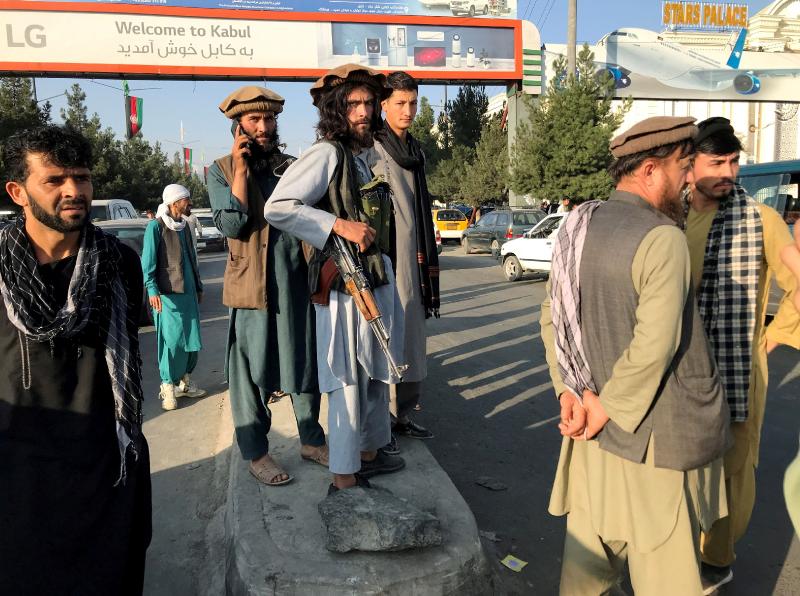
© Reuters/Stringer . A member of Taliban stands outside Hamid Karzai International Airport in Kabul
AMMAN (Reuters) - Across the Middle East, the Taliban's rapid seizure of power in Afghanistan has been seen by some as a signal that players in the region can no longer depend on diminishing U.S. power.
While the Taliban's ability to retake ground from foreign forces was welcomed by anti-Western factions, the group's advance has also triggered concerns that the country could once more become a haven for Arab militants.
Fighting to expel foreign forces since being overthrown in 2001, the Taliban seized Kabul on Sunday after a lightning offensive as U.S.-led Western forces withdrew.
In the Middle East, where the United States has long been the dominant outside power although its involvement has receded since it drew down forces in Iraq, events in Afghanistan could prompt states to forge new or parallel alliances, analysts said.
"What happened in Afghanistan reinforces the conviction of numerous Arab regimes that the U.S. role in the Arab and Islamic world ... is regressing," said Mohammad Abu Rumman, a Jordanian analyst and former minister.
"It is time to reduce dependence on Washington in the strategic realm," Emirati analyst Abdulkhaleq Abdulla wrote in The National.
Western policy and military interventions have sparked resistance movements for decades in the Middle East, and some welcomed the retreat of foreign forces.
The Houthi movement in Yemen and Lebanon's Hezbollah, both aligned with Iran, made statements drawing attention to what they called U.S. failure and humiliation.
Hezbollah said the American withdrawal should serve as a lesson to U.S.-aligned groups in Lebanon not to depend on Washington as an ally.
"In order not to fight on behalf of anyone, he (U.S. President Joe Biden) accepted bearing a historic and humiliating defeat in Afghanistan," Hezbollah leader Sayyed Hassan Nasrallah said during a Tuesday night sermon.
Hamas, the Palestinian militant group that controls the Gaza Strip, congratulated the Taliban and the Afghan people. Gazans were pleased about the Taliban's advance, which offered encouragement to Palestinians living under Israeli occupation, said Mohamed Dadar, a 28-year-old in Gaza City.
'AGGRESSIVE INVADERS'
Sheikh Ahmed Bin Hamad al-Khalili, the Grand Mufti of the Gulf State of Oman, which has a longstanding policy of neutrality, welcomed the victory over "aggressor invaders".
However, reactions were tempered by concern over resurgent militancy in Afghanistan, where before 2001 many Arab fighters were trained under Taliban rule for insurgencies back home.
"We are scared of their return," said 23-year-old Jordanian Taqi Abdelsamad, citing past jihadist violence in Syria and Iraq.
Several groups aligned with al-Qaeda have welcomed the Taliban's success.
The Taliban's capture of Kabul could accelerate a trend of jihadists heading for Afghanistan, said Jordanian analyst Abu Rumman, who is an expert on Islamist groups.
"This could encourage in my estimation the morale of thousands of jihadists who crumbled after Daesh (Islamic State) disintegrated, so they believe that things are not so bad."
However, he added that the Taliban would treat newly arriving jihadists with caution because of a peace deal that led the withdrawal of U.S. forces in Afghanistan.
Others expressed dismay at the return to power of a group with a hardline religious agenda.
"We should all unite to prevent this from happening because it is unacceptable for this to happen to the rights of women and anyone in the Arab and Islamic world," said Sarah Nawas, a student in the Syrian capital, Damascus.
A Taliban spokesman has suggested that the group will impose laws more softly than during their harsh 1996-2001 rule.
In Iraq, the Taliban's advance brought back painful memories for some of the seizure of swathes of Iraqi territory by Islamic State in 2014.
"I really sympathize with them (the Afghan people) because I have been through this situation before," said Khalid al-Rawi, a musician from Mosul, Islamic State's Iraqi stronghold before it was driven out in 2017.
(Reporting by Hams Rabah, Muath Freij, Fadi Shana, Arafat Barbakh, Nuha Sharaf, Tom Perry, Aziz El Yaakoubi, Yamam al Shaar, Mahmoud Hassano, Sayed Sheasha, Khalid al-Mousily, Charlotte Bruneau, Maher Nazeh; Writing by Aidan Lewis; Editing by Giles Elgood)

Just great. As if PotUS wasn't displaying enough weakness.
I don’t think I’d go that far. No one was going to turn Afghanistan into some bastion of justice and democracy. If someone was depending on that, that sounds like an unreasonable expectation. Unless America wants to turn into a modern day Rome and just become an Empire, we’re not going to control a place like that for a long time.
Don’t piss us off, though, because the planes and bombs can be back by lunchtime.
Granted. But Americans, at least those with any concept of reality and in power, knew that Afghanistan was never going to be a successful nation building endeavor. It was nothing more than a keyhole into the region. It provided America the ability to more closely monitor the 'comings and goings' of our adversaries in an up close and personal setting.
We very easily could have maintained exactly what we had there. Provide air support via Bagram and a small contingent of operators to 'keep an eye' on the terrorists.
We've maintained a military presence in a number of nations around the world for well over 50 years. Initially it was to 1-ensure the vanquished did not rebuild militarily and 2- provide them with the assistance to rebuild and fend off potential aggressors. We succeeded very well at that. We also have a military presence in over 100 nations today. That assistance provides direct action when necessary and indirect assistance through logistical, intelligence, and training capabilities. America is very good at what it does when given the political will and support to succeed. Unfortunately, the current administration has no will or worse yet is being controlled by outside forces to the detriment of America.
I think that’s a fair observation. I mean even though I don’t like the idea of being in some quagmire on the other side of the world, we weren’t that deep at this point. It appears that we didn’t need to be. We only had a few thousand people there the last few years, and my understanding is that it wasn’t like the kind of combat we had seen for so long - that our people were more like advisors and support. And, while I don’t want any Americans hurt or killed, I don’t think any have died there in about a year and a half. We probably could have stayed there without too much of an ongoing effort, and it would have meant a measure of security for allies in the region.
We have troops in Syria and Iraq for basically the same thing as we did in Afghanistan. Biden seems to be in no hurry to pull out there.
I don't trust China Joe.
Could it be a plot to open a slot? LOL
No one does. But at times, it is necessary for the security of this country. As I noted, we have forces all over the world.
I feel very confident noting that were the 38,000 men and women we current have stationed in South Korea not there, the south would have been attacked and overrun since the "truce" was established. Some people simply don't understand the idea that American security and safety isn't relegated to the shores of the east and west coasts nor the land borders on the north and south. It's a global platform.
The situation today is even worse than it was 50 years ago. At that time, we faced off against nations using traditional ideas and concepts with armies, navies and air forces. Today, we and the world for that matter are faced with an entirely different type of threat that is asymmetrical in nature and often hidden from view until it strikes. Without eyes and ears and immediate response ability, those forces can be even more dangerous than the traditional nation threats we recognize.
But Trump is no longer in office, the 'kompromat' no longer matters. Thankfully we have a rational President in the oval office now regardless of whether he chose one of two evils and is now being attacked for it. Of course this is a great opportunity for the sycophants of the former wannabe dictator to attack their Fuhrers successor and make baseless accusations and lies against him in their bitter impotent rage.
Unfortunately. Unless you've been hiding under a rock for the last few years, there never was any Trump collusion or any other fallacies of the left, other than in the bulging eyes head of Adam Schiff.
I'm simply amazed at what is dribbling out of the ether from the Hunter Biden "stolen" laptops and the videos of him and his friendly local hooker complaining about the 'gazillions' of dollars he makes and implicating 'the big guy' who he supports.
Same crap, another day. Rinse, repeat. How long did it take the US military to remove the Taliban government in Afghanistan? Weeks? Days?
The United States spent twenty years in Afghanistan doing nation building; not fighting a war. That was expedient because the military needed a staging area to hunt Al Qaeda and Osama bin Laden. The United States did not give up the hunt. We got him. And we took away bin Laden's martyrdom.
The actual war in Afghanistan was extremely short. The United States took Afghanistan as quickly as the Taliban have retaken Kabul. The United States does not need Afghanistan. The United States has never wanted Afghanistan as a colony. But threaten the United States again and watch what happens.
It's not the "country" of Afghanistan that we wanted. It was the strategic location and abilities it provided us.
We could very easily have maintained the 'status quo' of the last couple of years by permitting the contractors ability to maintain the Afghan "air force" air craft which in turn was the support we had trained the ground fighters to depend on, much like we train our own fighters to do.
What has transpired is a national disgrace.
Yes. But the United States only wanted that strategic location to hunt Al Qaeda.
There likely was some expectation within the military that Afghanistan could serve as a staging area to hold Iran in check and possibly Pakistan. And maybe as a check on China's threats against Tibet and potential conflicts with India. But the logistics was a nightmare for those purposes. As a staging area to balance geopolitical power in the region, Afghanistan was pretty worthless.