
The great failure of the climate models



 S E E D E D C O N T E N T
by Patrick Michaels and Caleb Stewart Rossiter
| August 25, 2019 12:00 AM
Computer models of the climate are at the heart of calls to ban the cheap, reliable energy that powers our thriving economy and promotes healthier, longer lives. For decades, these models have projected dramatic warming from small, fossil-fueled increases in atmospheric concentrations of carbon dioxide, with catastrophic consequences.
Yet, the real-world data aren’t cooperating. They show only slight warming, mostly at night and in winter . According to the United Nations' Intergovernmental Panel on Climate Change, there has been no systematic increase in the frequency of extreme weather events, and the ongoing rise in sea level that began with the end of the ice age continues with no great increase in magnitude. The constancy of land-based records is obvious in data from the National Oceanic and Atmospheric Administration.
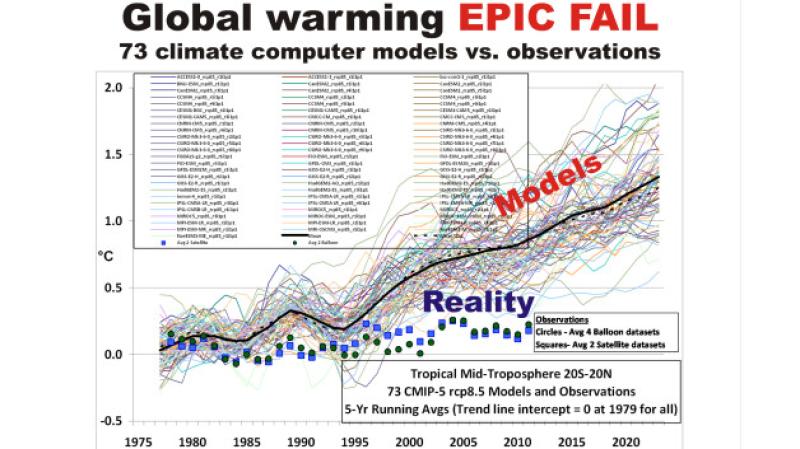
Should we trust these computer models of doom? Let’s find out by comparing the actual temperatures since 1979 with what the 32 families of climate models used in the latest U.N. report on climate science predicted they would be.
Atmospheric scientist John Christy developed a global temperature record of the lower atmosphere using highly accurate satellite soundings. NASA honored him for this achievement, and he was an author for a previous edition of the U.N. report. He told a House Science Committee hearing in March 2017 that the U.N. climate models have failed badly.
Christy compared the average model projections since 1979 to the most reliable observations — those made by satellites and weather balloons over the vast tropics. The result? In the upper levels of the lower atmosphere, the models predicted seven times as much warming as has been observed. Overprediction also occurred at all other levels. Christy recently concluded that, on average, the projected heating by the models is three times what has been observed.
This is a critical error. Getting the tropical climate right is essential to understanding climate worldwide. Most of the atmospheric moisture originates in the tropical ocean, and the difference between surface and upper atmospheric temperature determines how much of the moisture rises into the atmosphere. That’s important. Most of earth’s agriculture is dependent upon the transfer of moisture from the tropics to temperate regions.
Christy is not looking at surface temperatures, as measured by thermometers at weather stations. Instead, he is looking at temperatures measured from calibrated thermistors carried by weather balloons and data from satellites. Why didn’t he simply look down here, where we all live? Because the records of the surface temperatures have been badly compromised.
Globally averaged thermometers show two periods of warming since 1900: a half-degree from natural causes in the first half of the 20th century, before there was an increase in industrial carbon dioxide that was enough to produce it, and another half-degree in the last quarter of the century.
The latest U.N. science compendium asserts that the latter half-degree is at least half manmade. But the thermometer records showed that the warming stopped from 2000 to 2014. Until they didn’t. In two of the four global surface series, data were adjusted in two ways that wiped out the “pause” that had been observed.
The first adjustment changed how the temperature of the ocean surface is calculated, by replacing satellite data with drifting buoys and temperatures in ships’ water intake. The size of the ship determines how deep the intake tube is, and steel ships warm up tremendously under sunny, hot conditions. The buoy temperatures, which are measured by precise electronic thermistors, were adjusted upwards to match the questionable ship data. Given that the buoy network became more extensive during the pause, that’s guaranteed to put some artificial warming in the data.
The second big adjustment was over the Arctic Ocean, where there aren’t any weather stations. In this revision, temperatures were estimated from nearby land stations. This runs afoul of basic physics.
Even in warm summers, there’s plenty of ice over much of the Arctic Ocean. Now , for example, when the sea ice is nearing its annual minimum, it still extends part way down Greenland’s east coast. As long as the ice-water mix is well-stirred (like a glass of ice water), the surface temperature stays at the freezing point until all the ice melts. So, extending land readings over the Arctic Ocean adds nonexistent warming to the record.
Further, both global and United States data have been frequently adjusted. There is nothing scientifically wrong with adjusting data to correct for changes in the way temperatures are observed and for changes in the thermometers. But each serial adjustment has tended to make the early years colder, which increases the warming trend. That’s wildly improbable.
In addition, thermometers are housed in standardized instrument shelters, which are to be kept a specified shade of white. Shelters in poorer countries are not repainted as often, and darker stations absorb more of the sun’s energy. It’s no surprise that poor tropical countries show the largest warming from this effect.
All this is to say that the weather balloon and satellite temperatures used in Christy’s testimony are the best data we have, and they show that the U.N.’s climate models just aren’t ready for prime time.
Patrick Michaels was a research professor of Environmental Sciences at the University of Virginia for 30 years and is the author of the upcoming book Scientocracy. Caleb Stewart Rossiter taught climate statistics and mathematical modeling at American University. They are currently with the CO2 Coalition in Arlington, Virginia.
Tags
Who is online
250 visitors
This guy's work has a long track record of needing to be checked and corrected. Here's an article from 2 months later, in May 2017:
Read the explanations in the rest of the article here.
And if being a bad researcher isn't bad enough, Trump recently tapped him for the EPA (because of course he did):
AGW denial is a crime against humanity.
Holocaust denial is a crime in some countries - because it is always a direct prelude to anti-Semitism.
AGW denial should be prosecuted on the grounds that it leads to murdering the planet.
There are clearly a lot of variables in how we measure climate data and a lot of disagreement about what data actually matters. It seems like it would be healthier and more fair if people on all sides of the debate discussed it with an open mind while still having a genuine concern for our environment. Right now, the whole thing seems very dogmatic.
Not among the experts.
Yes, among the experts. This article mentions that much data has been collected using different methods and that has had to be revised multiple times. It also points out that there are many different climate models. I don't think you would disagree with those facts, but if you do, I invite you prove me wrong.
Anyway, those are examples of variation and disagreement among experts. You may not find it significant, but it exists all the same.
Have a nice life.
Hey!
I wished Tacos a nice life.
[delete]
Seriously???
You let pass an assimilation of the entire left to Adolph Hitler... but I get a ticket for not wishing a nice life to someone?
Seriously??
wow........