
The Real Conflict is Not Racial or Sexual, It’s Between Ascendant Rich Elites and The Rest Of Us


 S E E D E D C O N T E N T
Despite the media’s obsession on gender, race and sexual orientation, the real and determining divide in America and other advanced countries lies in the growing conflict between the ascendant upper class and the vast, and increasingly embattled, middle and working classes.
We’ve seen this fight before. The current conflict fundamentally reprises the end of the French feudal era, where the Third Estate, made up of the commoners, challenged the hegemony of the First Estate and Second, made up of the church and aristocracy.
These dynamics are unsettling our politics to the core. Both the gentry left, funded largely by Wall Street and Silicon Valley, and the libertarian right, have been slow to recognize that they are, in de Tocqueville’s term, “sitting on a volcano ready to explode.” The middle class everywhere in the world, notes a recent OECD report , is under assault, and shrinking in most places while prospects for upward mobility for the working class also declines.
The anger of the Third Estate, both the growing property-less Serf class as well as the beleaguered Yeomanry, has produced the growth of populist, parties both right and left in Europe, and the election of Donald Trump in 2016. In the U.S., this includes not simply the gradual, and sometimes jarring, transformation of the GOP into a vehicle for populist rage, but also the rise on the Democratic side of politicians such as Sens. Bernie Sanders and Elizabeth Warren, each of whom have made class politics their signature issue.
The Rise of Neo-Feudalism
Today’s neo-feudalism recalls the social order that existed before the democratic revolutions of the 17th and 18th Century, with our two ascendant estates filling the roles of the former dominant classes. The First Estate, once the province of the Catholic Church, has morphed into what Samuel Coleridge in the 1830s called “the Clerisy,” a group that extends beyond organized religion to the universities, media, cultural tastemakers and upper echelons of the bureaucracy. The role of the Second Estate is now being played by a rising Oligarchy, notably in tech but also Wall Street, that is consolidating control of most of the economy.
Together these two classes have waxed while the Third Estate has declined. This essentially reversed the enormous gains made by the middle and even the working class over the past 50 years. The top 1% in America captured just 4.9 percent of total U.S. income growth in 1945-1973, but since then the country’s richest classes has gobbled up an astonishing 58.7% of all new wealth in the U.S., and 41.8 percent of total income growth during 2009-2015 alone.
In this period, the Oligarchy has benefited from the financialization of the economy and the refusal of the political class in both parties to maintain competitive markets. As a result, American industry has become increasingly concentrated. For example, the five largest banks now account for close to 50 percent of all banking assets, up from barely 30 percent just 20 years ago.
The concentration numbers in tech are even more frightening. Once a highly competitive industry, it is now among the most concentrated . Like the barbarian chieftains who seized land after the fall of Rome, a handful of companies — Facebook , Google , Apple, Microsoft and Amazon — have gained total control over a host of markets, from social media to search, the software operating systems, cloud computing and e-commerce. In many key markets such as search, these companies enjoy market shares reaching to eighty or ninety percent.
As they push into fields such as entertainment, space travel, finance and autonomous vehicles, they have become, as technology analyst Izabella Kaminska notes, the modern-day “free market” equivalents of the Soviet planners who operated Gosplan, allocating billions for their own subjective priorities. Libertarians might point out that these tech giants are still privately held firms but they actually represent , as one analyst put it, “a new form of monopoly power made possible by the ‘network effect’ of those platforms through which everyone must pass to conduct the business of life.”
The role of the Clerisy
The new feudalism, like the original, is not based simply around the force of arms, or in this case what Marx called “the cash nexus.” Like the church in Medieval times, the Clerisy sees itself as anointed to direct human society, a modern version of what historian Marc Bloch called the “oligarchy of priests and monks whose task it was to propitiate heaven.” This modern-day version of the old First Estate sets down the ideological tone in the schools, the mass media, culture and the arts. There’s also a Clerisy of sorts on the right, and what’s left of the center, but this remains largely, except for Fox, an insignificant remnant.
Like their predecessors, today’s Clerisy embraces an orthodoxy, albeit secular, on a host of issues from race and gender to the environment. Universities have become increasingly dogmatic in their worldview. One study of 51 top colleges found the proportion of liberals to conservatives as much as 70:1, and usually at least 8:1. At elite liberal arts schools like Wellesley, Swarthmore and Williams, the proportion reaches 120:1.
Similar attitudes can be seen in virtually all other culturally dominant institutions, starting with Hollywood. Over 99 percent of all major entertainment executives’ donations went to Democrats in 2018, even though roughly half the population would prefer they keep their politics more to themselves.
The increasing concentration of media in ever fewer centers — London, New York, Washington, San Francisco — and the decline of the local press has accentuated the elite Clerisy’s domination. With most reporters well to the left, journalism, as a 2019 Rand report reveals, is steadily moving from a fact-based model to one that is dominated by predictable opinion. This, Rand suggests has led to what they called “truth decay.”
The new geography of feudalism
The new feudalism increasingly defines geography not only in America but across much of the world. The great bastion of both the Oligarchy and high reaches of the Clerisy lies in the great cities, notably New York, London, Paris, Beijing, Shanghai, Tokyo, San Francisco, Los Angeles and Seattle. These are all among the most expensive places to live in the world and play a dominant role in the global media.
Yet these cities are not the progressive, egalitarian places evoked by great urbanists like the late Jane Jacobs, but more closely resemble the “gated” cities of the Middle Ages, and their equivalents in places as diverse as China and Japan. American cities now have higher levels of inequality, notes one recent study , than Mexico. In fact, the largest gaps ( between the bottom and top quintiles of median incomes are in the heartland of progressive opinion, such as in the metropolitan areas of San Francisco, New York, San Jose, and Los Angeles.
In some of the most favored blue cities, such as Seattle , Portland and San Francisco , not only is the middle class disappearing, but there has been something equivalent of “ethnic cleansing” amidst rising high levels of inequality, homelessness and social disorder. Long-standing minority communities like the Albina neighborhood in Portland are disappearing as 10,000 of the 38,000 residents have been pushed out of the historic African-American section. In San Francisco, the black population has dropped from 18% in the 1970s to single digits and what remains, notes Harry Alford , National Black Chamber of Commerce president, “are predominantly living under the poverty level and is being pushed out to extinction.”
This exclusive and exclusionary urbanity contrasts with the historic role of cities. The initial rise of the Third Estate was tied intimately to the “ freedom of the city .” But with the diminishing prospects for blue-collar industries, as well as high housing costs, many minorities and immigrants are increasingly migrating away from multi-culturally correct regions like Chicago , New York, Los Angeles and San Francisco for less regulated, generally less “woke” places like Phoenix, Dallas-Ft. Worth, Houston, Atlanta and Las Vegas.

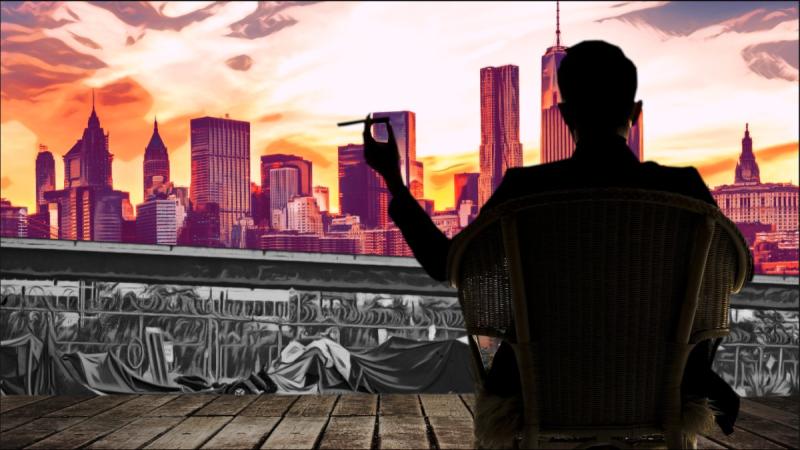
Man smokes over the ruins. Grae Stafford-Daily Caller News Foundation.
Yet even as the middle-class populations flee, poverty remains deeply entrenched in our big cities, with a rate roughly twice that of the suburbs. The much-celebrated urban renaissance has been largely enjoyed by the upper echelons but not the working classes. In the city of Philadelphia , for example, the “center city” income rose, but citywide between 2000 and 2014, for every district that, like downtown, gained in income, two suffered income declines. Similarly, research shows that the number of high poverty (greater than 30 percent below the poverty line) neighborhoods in the U.S. has tripled since 1970 from 1,100 to 3,100.
Undermining the Third Estate
The impact of the rising Clerisy and Oligarchs poses a direct threat to the future of the Third Estate. On the economic side, relentless consolidation and financialization has devastated Main Street. In the great boom of the 1980s, small firms and start-ups powered the economy, but more recently the rates of entrepreneurship have dropped as mega-mergers, chains and on-line giants slowly reduced the scope of opportunities. Perhaps most disturbing of all has been the decline in new formations among younger people.
This phenomenon is most evident in the tech world. Today is not a great time to start a tech company unless you are in the charmed circle of elite firms with access to venture and private equity funds. The old garage start-up culture of Silicon Valley is slowly dying, as large firms gobble up or crush competitors. Indeed, since the rise of the tech economy in the 1990s, the overall degree of industry concentration has grown by 75 percent.
Like the peasant farmer or artisan in the feudal era, the entrepreneur not embraced by the big venture firms lives largely at the sufferance of the tech overlords. As one online publisher notes on his firm’s status with Google:
If you’re a Star Trek fan, you’ll understand the analogy. It’s a bit like being assimilated by the Borg. You get cool new powers. But having been assimilated, if your implants were ever removed, you’d certainly die. That basically captures our relationship to Google.
The Clerisy’s War on the Middle Class
For generations, the Clerisy has steadfastly opposed the growth of suburbia, driven in large part by the aesthetic concerns –the conviction that single-family homes are fundamentally anti-social– and, increasingly, by often dubious assertions on their environmental toxicity. In places like California, the United Kingdom, Australia and Canada, government policies discourage peripheral construction where homeownership rates tend to be higher, in favor of dense, largely rental housing.
This marks a dramatic turnaround. During the middle of the 20th Century, ownership rates in the United States leaped from 44 percent in 1940 to 63 percent in the late 1970s. Yet in the new generation, this prospect is fading. In the United States, homeownership among post-college millennials (aged 25-34) has dropped from 45.4 percent in 2000 to 37.0 percent in 2016, a drop of 18 percent from the 1970s, according to Census Bureau data . In contrast, their parents and grandparents witnessed a dramatic rise of homeownership from 44 percent in 1940 to 63 percent 30 years later.
But the Clerisy’s war on middle- and working-class aspiration goes well beyond housing. Climate change policies already enacted in California and Germany have driven millions into “energy poverty.” If adopted, many of the latest proposals for such things as the Green New Deal all but guarantee the rapid reduction of millions of highly productive and often well-paying energy, aerospace, automobile and logistics jobs.
Political implications
The war of the Estates is likely to shape our political landscape for decades to come. Parts of the Third Estate –those working with their hands or operating small businesses– increasingly flock to the GOP, according to a recent CityLab report. Trump also has a case to make with these workers, as real wages for blue-collar workers are now rising for the first time in decades. Unemployment is near record lows not only for whites but also Latinos and African-Americans. Of course, if the economy weakens, he may lose some of this support.
But the emergence of neo-feudalism also lays the foundation for a larger, more potent and radicalized left. As opportunities for upward mobility shrink, a new generation, indoctrinated in leftist ideology sometimes from grade school and ever more predictably in undergraduate and graduate school, tilts heavily to the left, embracing what is essentially an updated socialist program of massive redistribution, central direction of the economy and racial redress.
In France’s most recent presidential election, the former Trotskyite Jean-Luc Melenchon won the under-24 vote, beating the “youthful” Emmanuel Macron by almost two to one. Similarly in the United Kingdom, the birthplace of modern capitalism, the Labour Party , under the neo- Marxist Jeremy Corbyn , won over 60 percent of the vote among voters under 40, compared to just 23 percent for the Conservatives. Similar trends can be seen across Europe, where the Red and Green Party enjoys wide youth support.
The shift to hard-left politics also extends to the United States– historically not a fertile area for Marxist thinking. In the 2016 primaries , the openly socialist Bernie Sanders easily outpolled Hillary Clinton and Donald Trump combined. A 2016 poll by the Communism Memorial Foundation found that 44 percent of American millennials favored socialism while another 14 percent chose fascism or communism. By 2024, these millennials will be by far the country’s biggest voting bloc .
In the current run-up to the Democratic nomination these young voters overwhelming tilt toward Sanders and his slightly less radical colleague Warren, while former Vice President Joe Biden retains the support of older Democrats. The common themes of the “new” Left, with such things as guaranteed annual incomes, rent control, housing subsidies, and free college might prove irresistible to a generation that has little hope of owning a home, could remain childless, and might never earn enough money to invest in much of anything.
At the end, the war of the estates raises the prospect of rising autocracy, even under formally democratic forms. In his assessment in “Democracy in America ,” Alexis de Tocqueville suggests a new form of tyranny — in many ways more insidious than that of the monarchical state — that grants favors and entertainments to its citizens but expects little in obligation. Rather than expect people to become adults, he warns, a democratic state can be used to keep its members in “perpetual childhood” and “would degrade men rather than tormenting them.”
With the erosion of the middle class, and with it dreams of upward mobility, we already see more extreme, less liberally minded class politics. A nation of clerics, billionaires and serfs is not conducive to the democratic experiment; only by mobilizing the Third Estate can we hope that our republican institutions will survive intact even in the near future.
Mr. Kotkin is the Presidential Fellow in Urban Futures at Chapman University and the executive director of the Center for Opportunity Urbanism. His next book, “The Coming Of Neo-Feudalism,” will be out this spring.
Tags
Who is online
230 visitors
The Real Conflict Is Not Racial Or Sexual, It’s Between Ascendant Rich Elites And The Rest Of Us
It seems there's a lot more of this sort of thing lately-- some self-proclaimed "expert" (or "experts", plural) deciding what "our" conflict is.Our "problem".is.
Which means, by extension, deciding for me what my "real problem" (or "real conflict") is.
Well, I'm not wealthy-- nor am I extremely poor financially.
But the fact that there are some wealth (and some extremely wealthy) people doesn't bother me in the least.
Although that does seem to be a problem for some folks-- the ones that let other decide for them what their problems & conflicts should be.
The Real Conflict Is Not Racial Or Sexual, It’s Between Ascendant Rich Elites And The Rest Of Us
The fact that there are some wealth (and some extremely wealthy) people doesn't bother me in the least. Although that does seem to be a problem for some folks-- the ones that let other decide for them what their problems & conflicts should be.
I'm pretty content with my lot in life. (I take responsibility for the fact that I created it the way it is).
To cut to the chase: IMO there's a reason that Envy was included in the list of Seven deadly Sins.
'Nuff said!
Thanks for cutting and pasting from the article listed above, I am sure no one noticed it.
Yep, the middle class is disappearing, but that's what happens when you constantly give massive tax breaks to the 1% and screw the middle class. Raygun did it, both bush's did and trump has done it. When you constantly elevate one class of people over everyone else, yes, the middle class and the working poor get screwed. I can't even remember the last republican president to actually propose AND deliver middle class tax cuts. Trump said he was working on a 10% tax cut for the middle class just days before the midterms, but as soon as the midterms were over, he never mentioned it again. And on that, why would he propose those cuts in the first place? I mean he said he gave tax cuts to the middle class............oh wait, he didn't. His proposal of tax cuts for the middle class only proves that he knew the other cuts were not for the middle class. Ergo, he lied............AGAIN.
President Obama actually cut taxes for the middle class. Trump? Not so much.
You don't cause or solve inequality with the tax code.
You cause and solve inequality with the educational system.
Without support from the family side, the educational system can only do so much. I was just talking to a friend about another friend's 31 year old son who has "failed to launch" - but when I think about the example he's getting from his parents, it's not hard to see why he's failed to launch. You see this generational poverty, or generational lack of ... ambition isn't the right word ... quite often.
Partially true. It's hard to send kids to college if the cost of tuition is through the roof, that the parents cannot afford. It's getting to the point where only the rich can send kids to a good college.
Easing the burden via taxes I will admit is not a fix all, but it does help.
Pretty completely true. People who can earn money and understand what to do with it are going to prosper.
I'm not talking about college. I'm talking about public schools that rubber stamp kids who can't read, write or add. They have zero chance of competing in the modern economy, but the schools don't care because that's somebody else's problem.
We have consistently and ceaselessly lowered standards, especially for poor kids and double especially for minority kids and then we stand in amazement when they can't earn a living.
It doesn't help for shit. You don't help the weak by handicapping the strong. It's nonsense. The idea that we "fix" inequality from the top is among the more ridiculous of all the liberal beliefs.
It's like pretending that playing basketball on a 9' goal eliminates height advantage. It doesn't.
There's always been a "Parenting" problem when it comes to education !
"Parents" don't seem to worry about what is being taught, and if it's for the betterment of their kid, but MORE how well the School is "Babysitting" their kids.