
Adam Schiff’s Capacious Definition of Bribery Was Tried in 1787

By: Jonathan Turley

 S E E D E D C O N T E N T
Below is my column in the Wall Street Journal on case that may be looming in the background of tomorrow’s opening hearing in the House Judiciary Committee on the impeachment of President Donald J. Trump.
I have been called to testify at the hearing. With only a few days to prepare, I will be completing my testimony today and I will hopefully post it before leaving for the hearing in the morning. This is a daunting but not unfamiliar challenge as an academic. It has been 20 years since I testified at the Clinton impeachment hearing with other constitutional and historical experts on this same question. It has been 10 years since I served as the last lead counsel (with Dan Schwartz) in the impeachment trial of Judge Thomas Porteous. The hearing will begin at 10:00 am in the Longworth House Office Building.
Here is the column:
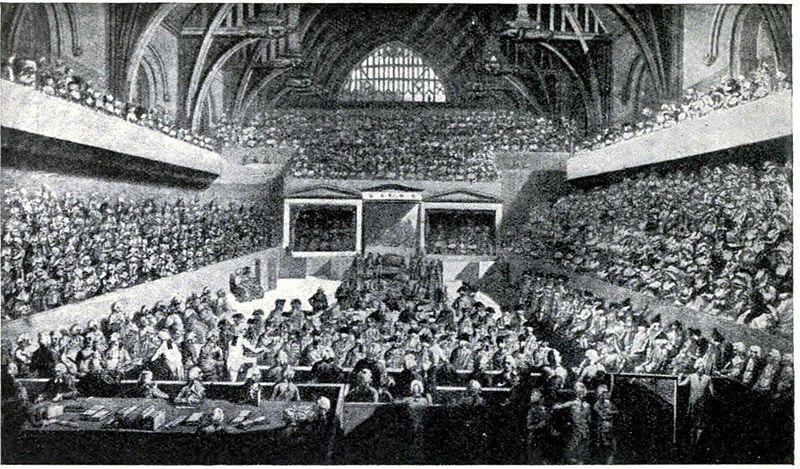
In the push for a December impeachment vote, House Democrats appear poised to make history. It will be the shortest investigation producing the thinnest record of wrongdoing for the narrowest impeachment in history. There is, however, a precedent for the Democrats’ expansive interpretations of bribery and impeachment: the trial of Warren Hastings, 230 years ago in Britain. But Hastings’ tale is a cautionary one that nobody should aim to repeat.
House Speaker Nancy Pelosi says she has “corroborated evidence of bribery.” House Intelligence Committee Chairman Adam Schiff agrees, explaining that, “As the founders understood bribery, it was not as we understand it in law today. It was much broader. It connoted the breach of the public trust in a way where you’re offering official acts for some personal or political reason, not in the nation’s interest.”
Mr. Schiff’s sudden transformation into an originalist may be short-lived. The Framers did not, in fact, view bribery as some overarching concept of corruption. At the Constitutional Convention, George Mason objected to listing only “treason” and “bribery” as impeachable offenses because they were too narrow and limited. He suggested a broader term, “maladministration,” citing the still-unfolding Hastings case, which was based on interpretations of bribery and corruption that would soon be exposed as dubious.

Warren Hastings
Warren Hastings was Britain’s governor-general in India, a realm rife with corruption and bribery. The East India Company held tremendous power in the subcontinent and was accused of perpetuating the corruption for its own ends. Hastings had sought greater control over Indian governance, and his actions became controversial in Britain, where Parliament was bitterly divided. Hastings’s greatest detractor was the statesman Edmund Burke, who pilloried him as the “captain-general of iniquity” and a “spider of Hell.” Even today’s overheated rhetoric pales in comparison with Burke’s denouncing Hastings as a “ravenous vulture devouring the carcasses of the dead.” Burke would lead the impeachment of Hastings, who was arrested in 1787 by Parliament’s sergeant-at-arms.
Hastings was charged by the impeachment committee with bribery and other forms of abuse of power. The case dragged on for seven years before Hastings was acquitted on every article of impeachment. Even though Hastings did have some dodgy personal financial dealings, his impeachment today is widely viewed as an injustice, and Burke was ultimately censured for his intemperate rhetoric.

Edmund Burke
While Hastings had not yet stood trial in London, in Philadelphia Mason spoke of the Hastings impeachment with approval. He wanted the U.S. Constitution to include a similarly broad scope for impeachable offenses, covering everything that could “subvert the Constitution.”
Mason failed. The Framers rejected terms ranging from “corruption,” obtaining office by improper means, betraying one’s trust to a foreign power, “negligence,” “perfidy,” “peculation” and “oppression.” All these were rejected along with “maladministration” and kept off the Constitution’s list of impeachable offenses.

James Madison
Notably, perfidy means dishonesty and peculation means self-dealing — two common allegations in today’s Trump hearings. The Framers dropped these terms, however, as too broad and undefined. Indeed, in arguing against the inclusion of maladministration, Madison remarked that “so vague a term will be equivalent to a tenure during the pleasure of the Senate,” an outcome repugnant to him. Mason then substituted “high Crimes and Misdemeanors,” which was approved.
Since then, politicians have often sought to adopt expansive interpretations to make impeachment easier. When I served as lead defense counsel in the Senate impeachment trial of federal Judge Thomas Porteous, the lead House manager sought to convict my client on the novel theory that even conduct before taking office could be impeachable. That impeachment manager was Adam Schiff.
There is much that is worthy of investigation in the Ukraine scandal, and it is true that impeachment doesn’t require a crime. But the Framers expressly warned against lowering the impeachment standard to a mere discretionary option for any party that happens to control the Senate. That’s what interpreting bribery to include any action viewed as “offering public acts for some personal or political purposes” would do.
All politicians are self-dealers who use their offices to advance themselves politically. That doesn’t make their acts criminal or impeachable. Just ask Warren Hastings.

Jonathan Turley ( @JonathanTurley ) is the chair of public interest law at George Washington University and served as the last lead counsel in a Senate impeachment trial in defense of Judge Thomas Porteous. He has testified with other constitutional experts in the Clinton impeachment.
 Article is LOCKED by author/seeder
Tags
Who is online

301 visitors
"The Judiciary Committee hearing will include legal experts as witnesses and is titled, "The Impeachment Inquiry into President Donald J. Trump: Constitutional Grounds for Presidential Impeachment,” as Democrats decide whether to draft articles of impeachment."
One of the three Constitutional experts the House Judiciary Committee intends to use is Jonathan Turley.
I've always liked watching Turley's interviews. Although he's a Democrat, he honestly affirmed today that he didn't vote for Trump. He's the only one on the lawyer panel who hasn't attacked Trump on some level and has made his comments and observations about impeachment based upon constitutional law, not personal opinion.
It's a shame that the Judiciary Democrats are too afraid to ask him questions and solely stick with their three angry, anti-Trump witnesses on the panel.
He made his case well today in stark contrast to the three self-righteous liberal law professors (two of whom are Clinton/Obama donors) who gave the nation a glimpse of academic group think in action. Watching Turley in his down to earth style I thought for a minute it was Jimmy Stewart in one of those uplifting movies of "truth to power" in Washington DC.
This whole process is now about what the future will look like. Are all future presidents at risk of frivolous impeachment?
While it's true that, in law, precedent has great bearing and weight to any/all legal arguments and decisions. But, I believe Adam Schiff is really reaching 'cross the pond to attempt to utilized the case of Hastings as a precedent for the impeachment of President Trump. Different country, different laws, different standards and different times.
Schiff should note, if he is indeed going to attempt to utilized the Hastings incident, that after seven years, Hastings was acquitted of all charges - something that could very well occur in the sham impeachment hearings that the Dem's/Libs are pushing.
You might not like something the president has done, but that is not a reason to impeach him.
It's not as if there have been no repercussions for Trump, nor that there could be others in the future. He has been criticized for the Ukraine affair repeatedly by the news media and members of Congress. Either chamber could choose to censure him or produce some other official condemnation of his actions. These words, though they cannot directly remove him from office, have an impact on public perception of the president leading into his reelection campaign. That may even be the primary motivation for the timing of these procedures.
It doesn't have to be that the response to every presidential action we don't like is impeachment and removal from office. Criticism of Trump does, arguably, have an impact on him. Ukraine may actually be a good example of this, if you buy into the Democratic narrative of events. The claim has been that Trump was holding up aid to Ukraine pending their compliance with his demands. Then the public found out about those demands, complained, and the funds were released without the payment of special favors from Ukraine. Problem solved! Our system works.
Meanwhile Congress is distracted and delayed by impeachment. Their own rules require Congress to focus on impeachment, once it has begun to the exclusion of other business. This is not only dividing the country, but it's preventing the doing of other important work.
Rather than look for a reason to oust the president, Congress should be looking for ways to make government function better. Impeachment of the type we are seeing isn't any more productive or desirable than constant recall elections would be for members of Congress.
And yet another one in a very long line of defenses by the 'Cult of the Stormy Who'.
This president should have disclosed every conversation and agreements made to Putin at Helsinki. Failure or unwillingness to do so, this president would be physically removed from office. This did not happen. Why?
Absolutely not. We wouldn't have foreign policy if foreign leaders were afraid that one on one conversations would be made public!
That has never been a requirement of any president.
Jerry Nadler has slammed shut all the exits with Constitutional academics. Democrats don't have any choice now. The Democratic House must vote and adopt articles of impeachment or bear the brunt of backlash from the Democratic base. Conscientious objection by any House Democrats would be traitorous toward the party and, by partisan projection, traitorous toward the country.
Using the point of the bayonet to impose a partisan point of view onto the pubic is an inherent corrupting influence of majority rule and democracy. The idea that might makes right was discredited centuries ago when the United States was founded as a Constitutional Republic. And the Constitution has been under attack from the beginning by those claiming a mandate by the majority.