
Authoritarian Overreach Is Unnecessary to Fight the Pandemic

By: ANDREW C. MCCARTHY

 S E E D E D C O N T E N T
There are worse things that can happen than a pandemic.
‘A n overreach by our police officers.” Yeah, I’ll say.
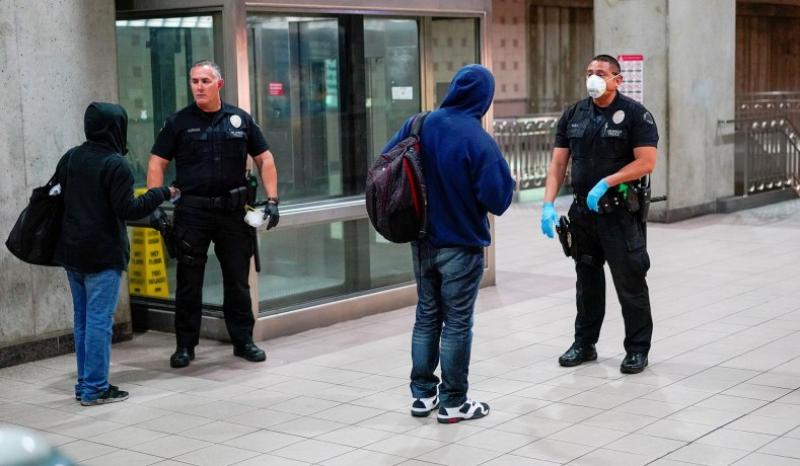
“Overreach” was the concession that the police department in Brighton, Colo., grudgingly offered regarding their arrest of Matt Mooney, a 33-year-old former state trooper. Mooney was handcuffed in front of his six-year-old daughter . His “crime”? Playing tee-ball with her on an empty field. Cops on the scene capriciously decided that this transgressed the state’s social-distancing restrictions.
The incident would be madness under any circumstances. But it wasn’t even true as alleged. Under the rules — which are executive edicts, not criminal laws enacted by the people’s legislative representatives — the fine print said the park was not closed to groups of fewer than five . Mooney, his wife, and their toddler were social distancing. Indeed, they were farther apart on the empty softball field than at home. It was the police who sloughed off social-distancing: physically handling him, cuffing him without wearing protective gear as unworn masks dangled from their belts, sticking this insolent criminal in the back of a squad car as they sought guidance from headquarters — because what cop wouldn’t need guidance on this one, right?
The dragnet was called off and Mooney was released after a few minutes. The state is really sorry. And its officials would love to tell us more but, you see, an internal investigation is underway so they can’t be expected to comment — just to shelter in place, hoping this lunacy slides down the memory hole but quick.
And who’s to say it won’t?
In Chicago, police broke up a dangerous gang . . . of congregants at St. Odisho Church, daring to conduct funeral rites during a Sunday service.
That probably won’t be happening in New York City. Gotham’s ineffable Marxist mayor, Bill de Blasio ( a.k.a. Warren Wilhelm Jr. ), took time out from flouting his own social-distancing dictates to admonish the peons that churches would be seized and permanently shuttered if worshipers defied his shutdown orders.
With Pope Francis declaiming that the coronavirus just might be “nature’s response” to humanity’s apathy toward the “partial catastrophes” of climate change (I don’t think that was quite ex cathedra ), his kindred spirits — that would be leftists, not Christians — are feeling their oats.
To take a telling example, there is, as ever, San Francisco. Last year, its denizens elected as their district attorney Chesa Boudin , the son and foster son of Weather Underground terrorists. Not far has the apple fallen from the tree. The City by the Bay is doing its best to empty the prisons of gangbangers and dope dealers — since any excuse to combat the “institutional racism” of the criminal-justice system will do. But that didn’t stop the duly cowed police from issuing a citation — the first for violating the city’s “stay at home” diktat — to Ronald Konopaski, an 86-year-old anti-abortion activist who had the temerity to protest outside a Planned Parenthood clinic.
The Jacobins are having their moment, courtesy of a pandemic . . . or, better, of the panic and chaos of a crisis that must never go to waste .
It is a time of emergency orders, unilaterally issued with ever less compunction by state and local executives. A time when the president offhandedly causes panic by floating the notion of issuing intrastate quarantines. This, even as Democrats — the same Democrats who five minutes ago were impeaching the president for his purportedly dictatorial proclivities — urge him to assume dictatorial powers over a private economy already ravaged by government.
In this time of the virus, the cavalier decrees of Bernie Bro statists would make George III blush. It is a time when we legal beagles are peppered with constitutional queries. What are our rights? How compelling is government’s interest in countering the spread of infectious disease? Does the Supreme Court’s “strict scrutiny” jurisprudence quantify the deference individual liberty owes to public security?
Interesting questions . . . for a law-school exam. But they’re the wrong questions for the here and now.
The Constitution is a solemn pact. It codifies the relationship between the people and the governmental system they have created — not the other way around. Before we ever get to the legal niceties, there is the fundamental issue of government’s political legitimacy. Do officials remember who the sovereign is? (Hint: It is not they.) Are those who so portentously remind us that they are in “government service ” mindful of what a servant is, and of who the master is?
It is the history of the United States that courts do not enter the fray while executive officials are grappling with a crisis — war, natural catastrophe, plagues. The constitutional issues attendant to the inevitable police-power excesses will not be settled until after the crisis has subsided.
But the legal dispositions are secondary. As a practical matter, the nation’s federal, state, and municipal governments, deploying all their police agencies, could not conceivably enforce quarantines, social-distancing, and interstate travel restrictions against 330 million Americans absent the vast public’s assent.
At a certain point, a free people — nearly 17 million of whom have now filed unemployment claims in an economy that was booming just a month ago — comes to realize that the de Blasios are pleaders, not rulers. Common sense emerges in the clarity of lives torn asunder by willful acts of elected officials and faceless bureaucrats. Our DNA reminds us that governments derive their just powers only from the consent of the governed.
There is a lot going on that no one has consented to. The law is beside the point. The state and its police need the public’s cooperation. They won’t get it by coercion. If they can’t get cooperation because they’ve forfeited their legitimacy by capricious, politicized enforcement . . . well, there are worse things that can happen than a pandemic.
The preservation of a free society requires ordered liberty. The government can never forget that the objective is not order for its own sake, or for the sake of “progressive” social transformation. The point of order is the flourishing of freedom.

Andrew C. McCarthy is a former federal prosecutor and a Contributor at National Review Online. From 1993 through 1996, while an Assistant United States Attorney for the Southern District of New York, he led the prosecution against the jihad organization of Sheik Omar Abdel Rahman, in which a dozen Islamic militants were convicted of conducting a war of urban terrorism against the United States that included the 1993 World Trade Center bombing and a plot to bomb New York City landmarks. Mr. McCarthy also made major contributions to the prosecutions of the bombers of the United States embassies in Kenya and Tanzania, and the Millennium plot attack Los Angeles International Airport.
Following the September 11 attacks, Mr. McCarthy supervised the U.S. Attorney's Anti-Terrorism Command Post in New York City, coordinating investigative and preventive efforts with numerous federal and state law enforcement and intelligence agencies. From 1999 through 2003, he was the Chief Assistant U.S. Attorney for the Southern District's satellite office, responsible for federal law enforcement in six counties north of New York City.
Mr. McCarthy is the recipient of numerous awards, including the Justice Department's highest honors: the Attorney General's Exceptional Service Award (1996) and Distinguished Service Award (1988). He has served as a Special Assistant to the Deputy Secretary of Defense, and as an Associate Independent Counsel in the investigation of a former cabinet official. He has also been an Adjunct Professor of Law both at the Fordham University School of Law and at New York Law School.
He writes extensively on a variety of legal, social and political issues for National Review and Commentary, among other publications, as well as providing commentary for various television and radio broadcasts.
(freshfiction.com/author.php?id=18689)
Who is online

318 visitors