
An interview with President Trump: ‘The real hate is the hate from the other side’

By: Mark A. Thiessen

A great article about and interview of a great man, our American President, Donald J. Trump. A great read from the Washington Post for once.
 S E E D E D C O N T E N T
As I walked in to the Oval Office, President Trump was going over new polls — some internal, some not — showing him tied or leading Joe Biden in key swing states. “Pennsylvania tied. Florida, up one. Wisconsin, up one . Texas, up five. Arizona, Trump 49, Biden 45 ; North Carolina, Trump up three . And then Montana: Trump up a lot — 52-38 ,” he said.
While some in the Republican Party may be panicking over other polls showing an uphill climb for reelection, the president remains confident. “I haven’t really even started to campaign yet,” he said, adding: “Now, campaigning’s a little bit tough because of the coronavirus. This thing, what China did to us, is just unbelievable. We were sailing, it was unstoppable. And then, this happened. And it’s shame, but now [we’ve] got to go back to work. But I think we’re doing really well.”
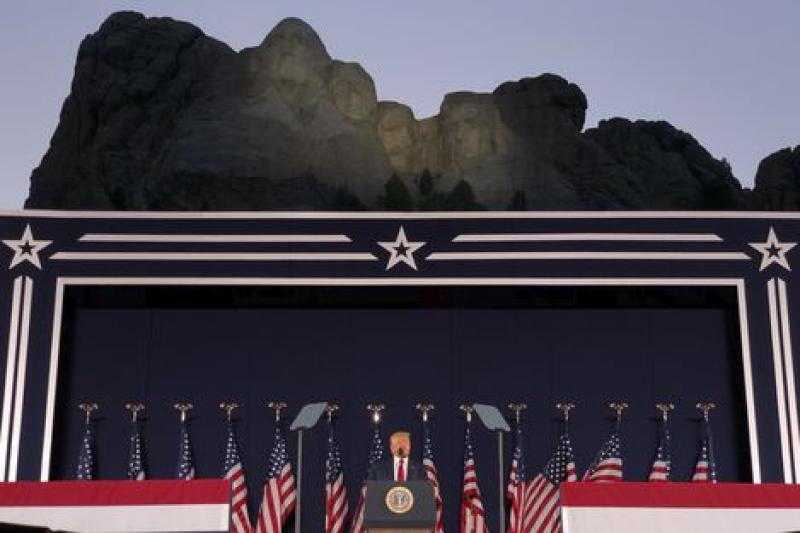
Our conversation turned to negative media coverage of his outstanding speech at Mount Rushmore on July 3. The speech, he said, “was actually not dark, it was the opposite of dark.” “What’s dark is the other side. . . . They’re trying to take everything down. And I think they’re crazy, but I also think they’re evil. There’s an evilness to it. And I can’t believe that there’s not more pushback. I mean, I push back. But people who are on the other side of the issue, are like lambs being led to slaughter. They’re like lambs being led to slaughter. They’re going to get slaughtered if they don’t push back.
During his speech, Trump praised Abraham Lincoln for winning the Civil War and issuing the Emancipation Proclamation , and called slavery an “evil institution.” So why is Trump so adamant about defending Confederate memorials? “Oh, I’m not,” the president says. “But I am adamant about defending the past. It’s part of our history. They’re taking down everything. They’re taking down history, they’re taking down so much, Marc. They’re taking down everything and they call it ‘cancel culture.’ I don’t think it’s a beautiful term, but it’s actually very descriptive. . . . They want to cancel everything. They want to cancel the good and the bad. They started off by canceling things that were controversial, and I actually said years ago. . . . ‘Well, does that mean that George Washington and Thomas Jefferson are next?’ And it turns out that they are next. . . . I was sort of half-joking, and people are now saying ‘Trump was right.’ These people are crazy. They’ve gone stone-cold crazy.”
I am adamant about defending the past. It’s part of our history. They’re taking down everything. They’re taking down history, they’re taking down so much.
President Trump
The president’s critics in the media conflate his criticism of mobs tearing down statues with criticism of the broader racial justice movement. So, I asked him point blank: Do you support the peaceful protests? “Peaceful protests for racial justice? Absolutely. Peaceful protests, period. Absolutely. I support peaceful protests,” he said. What he does not support is mob violence and cancel culture. “You had people that were far-left radical maniacs, they were anarchists, and they were agitators, and you also had other people that were there and they didn’t know what they were doing. They got caught up in the whole thing.”
He believes his tough response has tamped down the violence. “In Minneapolis, after a number of days of watching that fiasco, I demanded that the National Guard be sent in,” he said. “And as soon as they were in — I don’t know if you remember — they showed up, they lined up in the street, they walked through like butter being cut by a knife, and it all ended. It was over.”
Trump also contends that the Black Lives Matter movement preaches violence against the police. “You take a look at the people running it, they’re Marxists, they’re people that you don’t want,” he said. “And yet, they become almost like this wonderful group of people. And you look at what happened with the riots, and you look at all of the things that have happened, I think it’s a very, very divisive group. And I’m not the only one to feel that way. Now, a lot of people don’t want to talk about it because they haven’t got the guts to talk about it. But they feel it. The [National Basketball Association] now is putting big ‘Black Lives Matter’ on the courts. It’s mainstream, but the people running it are not mainstream.”
I pointed out that millions of Americans have marched peacefully since the killing of George Floyd on Memorial Day, and that most are not for the cancel culture or violence against police, but they want racial justice. “I do too,” Trump interrupted.
Trump also says he has no love for the Confederacy. “I’m against it. It was my opponent. I was born in New York, I’m against it. . . . I am a Yankee. But I also believe in free speech, and I believe in history. You can’t erase history. If you erase it, you’re going to repeat it.” The president’s concern, he said, is that if you give in to the cancel culture, where does it end? “You take out the Confederate? Okay, good. Then they’re going to take out all opposition to the Confederates. I mean, they don’t want George Washington. . . . I’ve seen them rip down statues [of] abolitionists. It will never stop.”
What about the military posts and bases named for Confederate generals? We don’t have bases named for Benedict Arnold , who was part of our history, because he was a traitor. These Confederate generals were the Benedict Arnolds of their day. “I consider that a very different thing,” Trump said. “The interesting thing, the bases were named after, long after the war. And they were named as a reconciliation to bring our country together. And then, all of a sudden, they cancel them out. Now, I’m not defending or judging any of the names because most of the names — you know Fort Bragg, but nobody knows who General Bragg is. But we won two world wars from these forts. We won two world wars. Is anyone just a little superstitious? We had great success and great luck from all of these places. And now we’re going to all of a sudden change the name? And who are we going to name them after?”
Nobody knows who General Bragg is. But we won two world wars from these forts. We won two world wars. Is anyone just a little superstitious?
President Trump
What about naming them for some of the American heroes Trump named during his remarks at Mount Rushmore? “I would, but I’m not sure that you could get them,” he said. “It won’t be accepted.” Besides, he added, “I think it’s a slippery slope. You’re going to take the name off and then who are we going to name it after? You’re going to end up with a fight, you’re not just going to put a name on it.”
But if he could control it, would he rename them? “If I could control it . . .” He paused and thought for a moment, then said, “I believe in history. To me, this was Fort Bragg named after somebody as a reconciliation matter. I mean he was a general, he was a tough general, he’s very tough, but this was done for reconciliation. These bases were named to bring the South because it was tremendous animosity from the many years to bring the South . . .” But, I interjected, that’s been accomplished, so the names are not needed anymore. “Yeah, but you could also say then did they go back on the deal?” Besides, the president said, “it’s not going to be easy to find somebody that. . . . I mean, what we’re saying is let’s find somebody who’s universally loved. There is no such person. . . . You couldn’t even name the base [for] George Washington.”
This is a mistake. If Trump directed the Army to rename bases for the Founding Fathers, he would be striking a blow against the cancel culture, not giving in to it. The left argues that both the Confederacy and the Union were built on slavery. Trump would be in a stronger position to defend the Union if he renamed the bases — and forced his opponents to protest that naming military installations after Washington and Jefferson was inappropriate.
But Trump is absolutely right to fight back against the cancel culture. And and his message will resonate more than many in Washington realize. “It takes guts to say what I say,” he said on Wednesday. “I mean, I understand, I could do it a lot easier, but it would be the wrong thing to do. I could say I’m against everything — ‘I’m against everything, I’m totally in favor of all of the hate.’ — The real hate is not the hate from me. The real hate is the hate from the other side on many of the things that we talk about.”
“Maybe I’m a voice in the wilderness,” he said, “but most people agree with me. And many won’t say it, and they might not even say it in a poll, but I think they’ll say it in an election.”

President Trump at the White House on Thursday. (Jabin Botsford/The Washington Post)
Asked whether he had launched the attack, Trump replied: “Correct.”
Trump said that, in 2016, President Barack Obama “knew before the election that Russia was playing around. Or, he was told. Whether or not it was so or not, who knows? And he said nothing. And the reason he said nothing was that he didn’t want to touch it because he thought [Hillary Clinton] was winning because he read phony polls. So, he thought she was going to win. And we had the silent majority that said, ‘No, we like Trump.’ ”
Unlike Obama, Trump says, he acted on the intelligence he was given about Russia’s election interference by striking its cyber capabilities.
“Look, we stopped it,” the president said.
The cyberattack was previously reported in The Post, but Trump had never officially confirmed it until now. Senior U.S. officials also confirmed for me that the strike occurred and was effective, taking the Internet Research Agency offline.
Trump had elevated U.S. Cyber Command to the status of a unified command in 2017 and gave it new authorities to conduct offensive cyberoperations in 2018. The cyberattack appears to have been the first that was designed to frustrate Moscow’s attempts to interfere with a U.S. election.
Russian interference in the 2018 midterm elections was serious and pervasive. In February 2018, then-Director of National Intelligence Daniel Coats testified before the Senate Intelligence Committee that “the United States is under attack,” and that Russia had been emboldened in 2018 by the success of its previous influence operations, for which the United States had imposed no price. During the hearing, Democrats accused the Trump administration of failing to prepare to protect the 2018 vote. “We’ve had more than a year to get our act together and address the threat posed by Russia and implement a strategy to deter future attacks. But we still do not have a plan,” the committee’s top Democrat, Sen. Mark R. Warner (Va.), told the intelligence chiefs .
Well, it turns out Trump did have a plan. In March 2018, during a White House news conference, Trump was asked about possible Russian election interference. “We won’t allow that to happen,” Trump said . “We’ll counteract whatever they do. We’ll counteract it very strongly.” And unlike his predecessor in 2016, he did so, using America’s offensive cyber capabilities in an unprecedented way against Russia’s interference operations.
During our interview, Trump said the cyberattack was part of a broader policy of confronting Russia throughout the world. “Nobody has been tougher on Russia than I have,” he said. The president offered a litany of actions he has taken to counteract Russia. “I could give you 30 different things,” he said. “I sent [Ukraine] a massive number of antitank busters. I sent them military equipment and Obama sent them nothing. That’s against Russia,” he says. “I made us the number one oil-producing country in the world. It wasn’t even close. I made us number one — that’s bad for Russia.”
The president also cited his pressure on Germany to cancel the Nord Stream 2 natural-gas pipeline from Russia and avoid becoming even more dependent on Moscow than it already is. “Germany is paying billions of dollars, billions to Russia,” Trump says. “And we’re supposed to protect Germany from Russia. How does that work?”
But his “biggest” move of all to counter Russia, Trump said, has been his restoration of America’s military: “I rebuilt our military. We now have the newest military we’ve ever had. . . . That’s not good for Russia either. You understand?”
Trump has used that military against Russia, and not just in cyberspace. The New York Times reported that U.S. forces killed several hundred Russian mercenaries during a February 2018 firefight in eastern Syria.
Talking about his efforts to counter Russia, the president also pointed to his success in persuading NATO members to increase their contributions to the transatlantic alliance. “I raised $140 billion from NATO countries going up to $400 billion [over three years], and what’s the purpose of NATO? Russia.”
Trump said that, thanks to his efforts, eight NATO allies are now meeting their NATO commitment to spend 2 percent of gross domestic product on defense. “And by the way, 2 percent is too little,” he said. “I had some that were paying almost nothing, and now they’re paying. And they asked me the big question: Would you leave if — and I said, ‘Yeah, I would leave.’ And if you don’t give that answer, they’re not going to pay.”
But does the president want to exit NATO? “No, I don’t want to leave,” Trump said. “But I want them to pay their fair share.”
Trump recently announced that he is withdrawing nearly 10,000 U.S. troops from Germany. He told me that some of the troops will be going to Poland. “Two different locations, including Poland. I’m also bringing some back home. I’m bringing about half back home and half are going to different places that deserve it.”
The president said that even though “every week, we put more sanctions on Russia,” he and Russian President Vladimir Putin “actually have a very good relationship.” The two leaders are “trying to work out a nuclear arms treaty that’s going to be a significant one. . . . There is no more important thing that we can do than nuclear arms control.”
I asked him about Russian support for the Taliban. Regardless of whether Russia actually paid bounties to kill U.S. troops, as has been reported , Russia is supporting the Taliban, which is killing Americans. Shouldn’t Moscow be punished? “I think Russia, the last thing they want is to get involved with Afghanistan,” Trump said. “Okay? The last thing they want. They were there for a long time. The Soviet Union became Russia because of Afghanistan, because they got beaten so badly in Afghanistan.” With U.S. troops withdrawing (“We’re almost out”), the president said, his attitude is that if Russia wants to go back into Afghanistan, “Enjoy yourselves.”
I asked Trump why he is so determined to withdraw completely from Afghanistan and Syria, as opposed to leaving a small counterterrorism force to train and enable local fighters and help them fight our enemies for us? Why the determination to get to zero? Trump didn’t reply directly, saying: “I’m certainly not a globalist. And I don’t think there’s anything wrong with saying that. I think globalists are not in vogue right now. Because when we were globalists, we were losing with everybody.”
On the subject of China, Trump said that Chinese cyberoperations against the United States exceed those of the Russians, but it receives less attention because “Democrats and their donors and others, frankly, are all making a lot of money with China until I come along. Until the China flu came along, the China virus came along, until this happened, we were beating them so badly. It was incredible. That’s why people say, ‘Do you think it was an accident?’ It was gross incompetence or something happened, but one thing they did, they let it escape the country. That’s one thing they did. And it was a big change in many different ways, including political.”
The president said that Senate Minority Leader Charles E. Schumer (D-N.Y.) and House Speaker Nancy Pelosi (D-Calif.) have made his dealings with China more difficult. “If I make a deal and it’s a phenomenal deal, let’s say a trade deal with China, Schumer and Pelosi will say, ‘It’s a terrible deal.’ They won’t have ever seen the deal. If I say, ‘No, you don’t understand. China’s giving us everything, they’re giving us everything, and we can buy Beijing for one dollar,’ they’ll say, ‘It’s a terrible deal.’ Anything you do is a terrible deal.”
The “automatic” opposition, he said, is “standard political. But it’s so bad for the country.”
Does Trump think it would change during a second term? Would Democrats be forced to cooperate if voters give him another four years? “The only way it’s going to, we have to keep on winning. It was starting to change until we got hit with the China virus. It was starting to change. They were starting to come around toward the end. And then this happened. This changed things. And now they think they have a chance.”
Nonetheless, Trump remains confident about November, thanks to “the greatest base in the history of politics. . . . Have you been watching the boats in Florida, all over the country? Thousands of boats every weekend. They have thousands of boats, and cycles, you know the bikers for Trump? They had a line last week, it went miles long, bikers for Trump, and they have the flags and the whole thing.”
“I love the country,” Trump said, “and so, despite all of the things I have to do, I just feel I have to do it right.” Here is something he did right. While Trump is accused of not taking Russian interference seriously, he did more than Obama ever did to combat it.
Tags
Who is online

122 visitors