
The values of a Conservative

By: Bryan Griffin

The secular progressive cancel culture and its mainstream and social media allies have hated against and lied about conservatives and have gotten away with their libelous smears for too long. It is the conservative movement that is caring and compassionate and is the defender of individual freedom, religious liberty, and economic opportunity.
 S E E D E D C O N T E N T
(Getty)
Op-ed views and opinions expressed are solely those of the author.
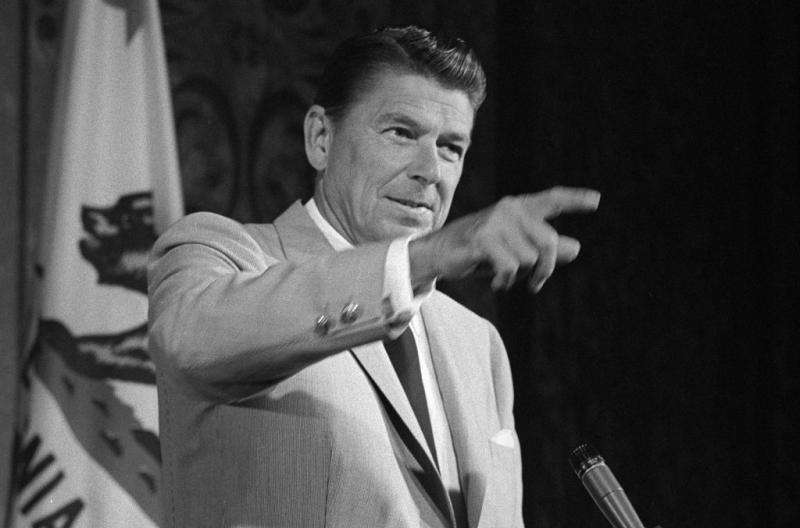
In 1964, future President Ronald Reagan was addressing a crowd of conservatives about the upcoming presidential election. He had recently switched out of the Democratic Party, and this speech would launch him into national prominence. He told these conservatives :
“[A]nytime you and I question the schemes of the do-gooders, we’re denounced as being against their humanitarian goals. They say we’re always ‘against’ things—we’re never ‘for’ anything.”
Then and now, we’ve been mischaracterized. Opponents on the left have framed the political divide as follows: disagreeing with the left’s political agenda is akin to holding a desire not to fix or address any issue that the left champions.
“One of the most pervasive political visions of our time is the vision of liberals as compassionate and conservatives as less caring,” writes Thomas Sowell, one of the greatest conservative minds of our lifetime.
They say conservatives don’t care about the poor because they don’t support this or that large social program.
They say conservatives don’t want people to have access to healthcare because they don’t support its socialization.
They say conservatives hate the environment because we won’t grow regulations to protect it.
They say we accept racism, they say we aren’t for equality, they say we stand against progress.
This could not be more wrong.
A lot of conservative pundits and politicians miss opportunities to call these falsehoods out because they feel they shouldn’t have to. Many conservatives still hope that the other side sees shared common goals between them.
Yet the body of critique of conservative ideology does not start from a place of mutual respect or benefit of the doubt.
Baseless social media soundbites about conservatives have now bled into mainstream media discourse and even the talking points of elected Democrats. Conservatives are the anti-, the phobic, the heartless.
Conservatives should not miss the opportunity to speak truth to that lie. Reject it and denounce it.
Disagree with us on how it is achieved, but conservatives care for the poor, abhor racism and sexism, want affordable healthcare for all, and want to preserve the environment, despite what this meme or that cardboard sign says.
In fact, the conservative ideology is one that specifically seeks the best for everyone.
These noble motives motivate our fight.
Because we care for the poor, conservatives fight to build strong economies on the foundation of economic liberty necessary for the country to foster a job-friendly, growth-friendly marketplace. A conservative sees a rising tide lifting all boats. We believe that growing wealth is the answer to providing for those in need, not redistributing it.
Because we want to see healthcare affordable, we fight to keep it in the marketplace and out of the hands of government.
Because we want to see the environment protected, we fight to protect it through innovation and consumer appeal rather than bulky and inefficient government regulation.
Because we abhor racism and sexism we fight for society to remain individualistic, where the value of a person comes from God or from within and not a group that they identify with or a government that is big enough to decide who matters.
We are guided by history on this. “The facts of life are conservative,” said Margaret Thatcher.
Big government is racist. Big government is sexist. Big government is more than institutionalized favoritism, it eventually becomes codified oppression. The Soviet gulags and Nazi concentration camps of the past; the Chinese Uighur camps and Libyan slave trade of today are all born out of a government too big.
Conservatives don’t believe in growing the size or role of government to fix every problem. This doesn’t mean we are the ideology of “no.”
Some on the left would love for the country to believe in a false binary of two options for progress: either have the government solve a problem or don’t solve it at all. The left sees government as the solution to the problem. Conservatives see the government as the source of our problems. Our “nos” to government growth are “yeses” to solutions that come from the marketplace, the community, and the family. These are the only sources of lasting, open-sourced, voluntary solutions for society.
The government, to a conservative, is a tool of last resort. Once the government gets involved, it doesn’t stop no matter how poorly it performs. Once the government grows, it never shrinks.
Conservative ideology will always lose if we allow the other side to name us, frame us, and shame us.
Conservative politicians aren’t the party of “no.” They’re the party of “grow.” Grow opportunity and grow the economy. Protect the delicate grounds of freedom and liberty as it can easily be washed away. Improve possibilities through innovation. Let each individual and family harvest the bounty of their work, and as a means of last resort the government can exist to serve the needs of a free and active electorate.
Sometimes, these things have to be reaffirmed. Speak out against the caricature of conservatives painted in the gloomy dregs of the internet.
Both conservatives and liberals can seek to do good as an ends and disagree upon the means. Again, Thatcher’s words ring true, a banner for limited government conservatives:
“I am in politics because of the conflict between good and evil, and I believe that in the end good will triumph.”
Tags
Who is online

127 visitors
Today's so-called conservatives are actually anarchists. Anarchists are far worse than socialists. At least socialists make a half-hearted attempt to protect the social contract and govern for the benefit of the greatest number rather than the fewest.
Ayn Rand was no conservative; Rand was an anarchist. Liberty ain't freedom. And conservatism isn't about winning, it's about protecting the game.
The role of government is to protect the social contract that allows a civilized society to function. The government is supposed to impose itself on those who threaten the social contract; that's the purpose of government. The government is supposed to break up monopolies, prevent the emergence of oligarchies, punish racketeering, stop market manipulation by syndicates, fight profiteering, and eliminate obstacles for the opportunity of competition. The role of government is to protect the game without favoritism toward any of the players.
Cheats, fraudsters, flimflam artists, swindlers, and snake oil peddlers always complain that the government is too intrusive. Don't allow those threatening the social contract to call themselves conservative.
Ayn Rand on anarchism.
"Anarchy, as a political concept, is a naive floating abstraction: . . . a society without an organized government would be at the mercy of the first criminal who came along and who would precipitate it into the chaos of gang warfare. But the possibility of human immorality is not the only objection to anarchy: even a society whose every member were fully rational and faultlessly moral, could not function in a state of anarchy; it is the need of objective laws and of an arbiter for honest disagreements among men that necessitates the establishment of a government." Ayn Rand from her essay The nature of Government
Yet, Ayn Rand advocated for the concept of objectivism where the moral purpose of life is pursuit of one's own happiness. Rand was a proponent for unrestrained freedom which is nothing more than anarchy.
Unrestrained freedom is not liberty. And the role of government is not to remove restraints on freedom. The purpose of government in the United States is to protect liberty which requires imposing restraints on freedoms that threaten the social contract. Crime and violence are rather obvious abuses of freedom that threatens the social contract. But unrestrained pursuit of happiness also threatens the social contract and is no less an abuse of freedom.
Ayn Rand was a proponent of anarchy. Like Ronald Reagan, Ayn Rand mouthed the words but practiced anarchy.