
In Case You Missed It, December 28th, 2020




Is the Distribution of Vaccines the Biggest Trump Screw Up Yet?
A Christmas gift: Cherokee Nation stores heritage seeds in Svalbard Global Seed Vault
The Resistance: In the President’s Relentless War on Climate Science, They Fought Back
Proof versus Evidence
The New York Times Hasn’t Heard About China’s Vaccines
Roberta McCain: A Military Matriarch With a Sense of Adventure
Katherine Johnson: The NASA ‘Computer’ Who Launched a Man into Space and Women Into STEM
China Has the World’s Largest Economy: Get Over It
A brief history of Brexit – all 2,000 years of it
The secret of Jacinda Ardern’s success lies in her conservatism

Is the Distribution of Vaccines the Biggest Trump Screw Up Yet?
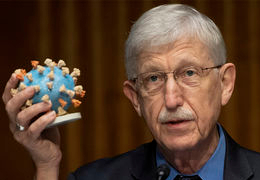
By comparison, we manage to get over 170 million flu shots in people’s arms every year, without any heroic efforts by the government and the military. Most of those doses are given over roughly a four-month period, which means a bit less than 1.5 million a day. That puts our flu shot delivery system ahead of Donald Trump’s warp speed. What the f**k?
Last week I wrote a piece asking why we didn’t have 400 million doses of vaccines on hand by the start of December. Of course production takes time, and we didn’t know back in the summer which vaccines would prove effective, but so what?
We could have started mass production of every vaccine that entered Phase 3 trials. If some of them proved to be ineffective, we would have wasted some money, but the cost would be trivial. The per shot cost of a vaccine is in the range of $2-$4. This means if we had to throw 200 million vaccines in the toilet, we would have wasted $800 million dollars, using the higher end estimate. That is less than 20 percent of the two-year cost of Donald Trump’s three martini lunch tax break and less than 1 percent of the size of the double-dip tax break, allowing companies to write off expenses that were reimbursed under the paycheck protection program.
Along with massive production of vaccines, they should have been pre-positioned to allow for faster distribution. We should have had major warehouses located around the country so that as soon as the FDA green-lighted a vaccine, it could quickly be delivered to hospitals and clinics in every corner of the country.
The basic point here is that we have two distinct processes. One is the manufacture and distribution of the vaccines. The other is the determination that they are safe and effective. These can go on simultaneously.
We should have been prepared to start inoculating millions of people the day a vaccine was approved. This is a massive policy failure, or as Donald Trump would say, #MAGA!.
Bonus :
Operation Warp Speed Set To Miss Initial COVID Vaccine Distribution Goal
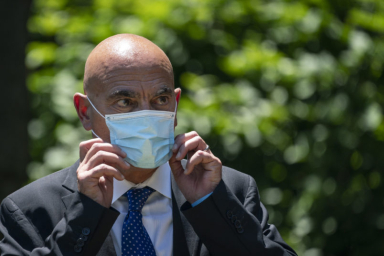
Moncef Slaoui, the former head of GlaxoSmithKlines
vaccines division, listens as U.S. President Donald
Trump delivers remarks about coronavirus vaccine development
Drew Angerer/Getty Images
Trump administration officials had promised to vaccinate 20 million Americans by the end of 2020, meaning that 40 million doses would be distributed by Jan. 1.
But Gen. Gustave Perna, chief operating officer of the Trump administration’s effort to accelerate vaccine development, said that the government would only have allocated 20 million doses by Jan 1. — far fewer than promised.
“We have allocated 15.5 million doses of vaccine and we are on track to allocate another 4.5 to 5 million next week, which will bring us to 20 million doses of vaccine allocated to America before the end of the year,” Perna said in a Dec. 23 briefing with reporters. “We’ll finish those deliveries in the first week of January.”
Perna’s remarks suggest that the Trump administration will not complete delivery of half of its projected estimate of vaccine until the first week of January. State and local governments will then oversee the vaccine’s distribution.
Michael Pratt, chief communications officer for Operation Warp Speed, told TPM in a statement that distribution falls to the states and that the effort will “allocate 20 million doses for first vaccinations by the end of December 2020, with distribution of the first 20 million doses spanning into the first week of January as states place orders for them.”
“These doses are being distributed at states’ direction to the American people as quickly as they are available and releasable, and the rapid availability and distribution of so many doses – with 20 million doses expected to be allocated for distribution just 18 days after the first vaccine was granted emergency use authorization – is a testament to the success of Operation Warp Speed,” the statement reads.
It’s a stunning retrenchment in ambition and scale for the effort, which has achieved unprecedented success in accelerating vaccine development but is running into delays in getting the shots into people’s arms.
And it comes as Trump administration officials have boasted of mass vaccine availability on a timeframe that medical supply chain experts say is unrealistic.
In November, Health and Human Services Secretary Alex Azar said that 40 million doses of the vaccine would be available by the end of December — “enough to vaccinate about 20 million of our most vulnerable Americans.”
Since then, Azar and other top Trump administration officials have reiterated that estimate while also hyping an unrealistic timeline for widespread availability of the vaccine.
Azar has said that the vaccine could be as widely available as the flu shot by February, while HHS Assistant Secretary for Health Adm. Brett Giroir has said that the majority of the population could be vaccinated by late spring.
These promises set up expectations that are impossible for the incoming Biden administration to meet. Lower-level Operation Warp Speed officials have contradicted the rosy timeline put forward by top officials.
Moncef Slaoui, head of Operation Warp Speed, made similar remarks to Perna at the Dec. 23 briefing, defining down the Trump administration’s initial commitment
On Dec. 2, Slaoui said that he was “confident” the government would be able to vaccinate 20 million Americans by Dec. 31 — a task requiring 40 million doses.
“And end of February, we will have potentially immunized a 100 million people, which is really more or less the size of the significant at-risk population, the elderly, the health-care workers, the first line workers, people with comorbidity,” he added.
But on Dec. 23 — less than three weeks later — Slaoui said that “the commitment that we can make is to make vaccine doses available.”
He added that “that commitment is met,” but that getting “shots in arms” had been “slower than we thought it would be.”
“That objective is not met,” Slaoui said.
Cracks have shown both in Operation Warp Speed’s ability to deliver the weekly cadence of vaccine that the Trump administration has promised to the states and in the capability of overstretched state and local public health departments to quickly inject the shots.
The first week of distribution saw states complain that their allocations had been cut and Pfizer, the manufacturer of one of the two vaccines currently available, claim that it had millions of doses sitting in its warehouse waiting for distribution orders.
Separately, state health officials have said that absent additional funding, they will lack the capacity to quickly distribute the shot itself — particularly when it comes to mass vaccinations scheduled for the spring and summer.
President Trump signed relief legislation on Sunday that allocated at least $4.5 billion to state and local public health departments to distribute the vaccine. That will help states meet vaccine demand, though some experts say the lack of funding until this week — combined with the time it will take to distribute the money allocated by Congress — has already caused delays.
Perna, the Operation Warp Speed general, said that some issues had been due to quality control checks on the vaccine shipments.
“We have had to adjust our timelines,” Perna said.
A Christmas gift: Cherokee Nation stores heritage seeds in Svalbard Global Seed Vault

“As Cherokees, one of our beliefs is that as long as we have our Cherokee plants, the Cherokees will remain. Cherokees cannot be Cherokees without their native plants,” said Pat Gwin, Cherokee Nation senior director of environmental resources.
The Cherokee Nation is the first North American tribe to deposit seeds at Svalbard for storage. In 2015, Andean tribes in South America deposited 750 potato seed varieties.
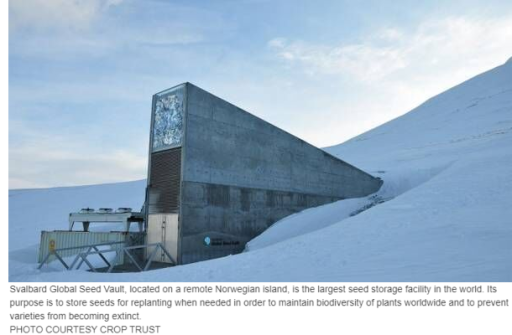
Svalbard is the largest protected seed storage facility in the world and currently holds 992,039 different seed varieties. The vault can store 4.5 million seed packets and has plenty of room for more seed deposits.
Svalbard stands on a remote Norwegian island 800 miles from the North Pole and is built in an abandoned Arctic coal mine where the seeds are stored at 0 degrees. Its purpose is to protect Earth’s unique genetic seed material so that crops will not become extinct due to adverse weather conditions or other disasters. It is the ultimate failsafe storage facility to help maintain plant biodiversity worldwide.
Chuck Hoskin Jr., principal Cherokee chief, was contacted by the Trust in 2019 and asked if the tribe would like to store some of its heritage seeds at Svalbard. The tribe agreed and began the process of deciding which seeds were most important for preservation.
In 2006, when tribal elders realized their heritage crops needed to be preserved for future generations, the Cherokee Nation started the Cherokee Heirloom and Native Plants Gardens in Tahlequah, Okla. From the gardens, seeds are stored in a tribal seed bank. Seeds are also shared each year with tribal members who plant them in their own gardens.
Although the Cherokee reservation is in Oklahoma, their ancestral homelands were in Alabama, Georgia, North Carolina and Tennessee. In 1838, after passage of the Indian Relocation Act by Congress, the U.S. military forced the Cherokees, along with members of the other “Five Civilized Tribes” – Creek, Chickasaw, Choctaw and Seminole – to leave their homelands in the southeast. Tribal members traveled by foot to reservations located in “Indian Territory” which would later become the states of Oklahoma, Kansas, Nebraska and part of Iowa. About a quarter of the Cherokees died during this long walk called the “Trail of Tears.”
Many of the Cherokee’s native plants grown in their homelands in the southeast were lost when the tribe relocated. When tribal elders began their heritage gardens and seed bank, Gwin spent several years tracking down the tribe’s lost crops from their southeast homeland. Twenty-four varieties of “lost crops” were brought back and planted in the gardens, along with other heritage food crops. Medicinal and inedibleplants, such as river cane used to weave baskets, are also grown in the garden.
Each February, the Cherokee tribe offers tribal members seeds from the garden. This gives tribal members the opportunity to continue their ancestor’s gardening traditions and to learn proper methods for growing these heirloom plants successfully.
“It is important that we continue to distribute seeds to our tribal members each year,” said Feather Smith, a cultural biologist for the Cherokee Nation. “This program helps educate our youth about the Cherokee culture. As the seeds are planted, stories about our Cherokee history can be shared.”
“Plants in the Heirloom and Native Plants Gardens are rare cultivars not commercially available. They represent centuries of Cherokee culture and agricultural history,” noted Hoskin.
“It is an honor to have a piece of our culture preserved forever at Svalbard. Generations from now, our stored Cherokee seeds will still hold our history and will always be a part of the Cherokee Nation.”
Honoring their heritage and cultural identity through growing and preserving their native plants helps keep the Cherokee Nation strong.
Happy gardening.
The Resistance: In the President’s Relentless War on Climate Science, They Fought Back
The scientists' efforts were often unseen and sometimes unsuccessful. But over four years,
they mounted a guerilla defense that kept pressure on the Trump Administration.
Every time the word “climate” was deleted from the name of his program at the Environmental Protection Agency, Dan Costa stuck it back in.
Chris Frey fought back in the unlikely setting of a hotel conference room, where he and 20 other members of an EPA science review panel dismissed by the Trump administration met to do their job anyway, later publishing their views in a prestigious medical journal.
And as Jeff Alson was walking out the door of the EPA in frustration after a 40-year career at the agency, he gave pep talks to the younger engineers about why they had to stay on.
“I told them what I’m going to do for you is go out and tell the truth, so that the public knows that this rollback is not being done by EPA staff, it is being done by other people in the government,” Alson said.
These are snapshots of the resistance. Although their names are little known and their efforts often went unseen, they defied the relentless campaign President Donald Trump and his administration waged against mainstream science during the four years of his presidency—particularly the scientific consensus on climate change.
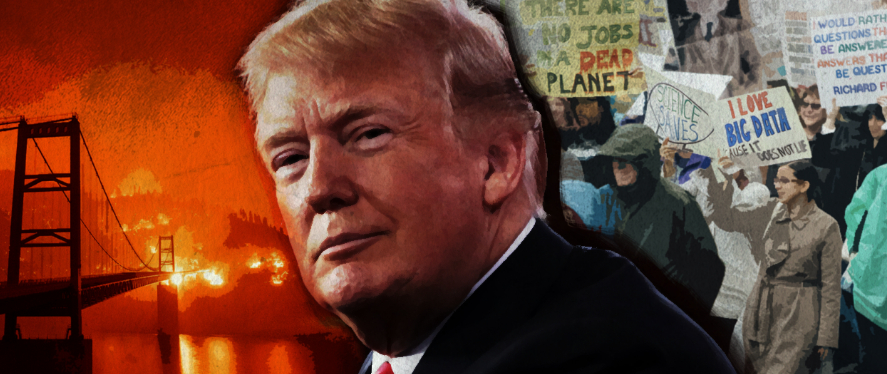
The outcome of this war is yet to be written. Trump has rolled back more than 100 environmental regulations, loosening restrictions on fossil fuel development when the science points ever more urgently to the need to stop the reliance on energy sources that produce greenhouse gas emissions. In California earlier this year, the president summarized his administration’s attitude toward scientific expertise: “I don’t think the science knows,” he said, as the state’s worst wildfire season on record raged all around him.
But the Trump administration’s drive to dismiss and deny climate science has made only partial headway. In what may be a sign of the robustness of both the science and the U.S. institutions that support it, scientists inside and outside the federal agencies fought back.
When Trump and his team sidelined or silenced government experts, the scientists spoke out. When the administration eliminated or radically reshaped panels of outside advisers, scientists made sure their advice got on the record anyway. Fringe theories were relegated to footnotes or ignored, despite the administration’s efforts to elevate them. Mainstream views—including that greenhouse gases pose a danger to human health and the environment—largely prevailed.
It is unclear whether continued distrust in science will prove to be Trump’s lasting legacy, a hindrance to President-elect Joe Biden’s plan to put the nation on course to net-zero carbon emissions by mid-century.
In the final weeks of 2020, as it became clear (though perhaps not to the president himself) that Trump’s tenure was drawing to a close, his administration was attempting to lock disdain for science into federal decision-making, installing climate contrarians in influential positions and finalizing rules to hamper environmental protection for years to come.
But the scientists who stood their ground on climate say they see hope in Biden’s victory, and in a president-elect whose campaign included the most ambitious climate platform ever advanced by a major party’s presidential nominee, and was waged amid the worst public health crisis in a century.
“There’s a recognition in the American public that the nation didn’t pay attention to the science, and we are paying the price for it now,” said Chris Zarba, one of hundreds of EPA scientists who resigned or retired early in the Trump administration. “As a result, there may be an opportunity for a renewed appreciation for science by the American public, and the pandemic and the Biden administration may be able to make that point very powerfully.”
If so, the ground troops that paved the way for that resurgence included Zarba and other EPA staffers, alumni, and advisers—and even some of the Trump administration’s own appointees—who engaged in a four-year, multi-front guerilla defense of environmental science.
Small Protests Kept the Pressure On
In his 2016 campaign, Trump derided climate science as an expensive “hoax” and promised to reduce the EPA “to little tidbits .” Based on such pronouncements, his presidency was seen as a threat in the science community from early on. Yet few foresaw how complete the administration’s rollback of climate policy would be, or the devastation that would result from its sidelining of federal scientists and embrace of fringe theories about the coronavirus pandemic.
“No previous administration in the modern era has so willfully, brazenly, and comprehensively based its decision-making on ignorance,” said Geoffrey Supran, a science history fellow at Harvard University.
Lab-coated demonstrators registered their objections in March 2017, in a nationwide March for Science that Supran helped organize. Yet the most important protests during the Trump administration took place not in the streets but behind the scenes, in hearing rooms, in paper trails, in quietly placed phone calls.
Dan Costa did not set out to be part of this underground resistance against the Trump administration. Director of the Air, Climate and Energy Research Program at EPA’s campus in Research Triangle Park, North Carolina, when Trump was elected, Costa put together briefing material for the incoming administration, just as he had done in the four previous presidential turnovers he had witnessed in his 34 years at the agency. “Every administration brings in a different philosophy, not just a political philosophy, but also a kind of modus operandi—how they get things done,” he said. “We’ve been through a lot of these transitions before. I thought we’d figure it out.”
But when the day came for the Trump transition team to arrive at the agency (“when people bring out the coffee and cookies,” as Costa put it), no one showed up.
What seemed at first like disregard soon looked more like outright hostility. In June 2017, The New England Journal of Medicine published groundbreaking air pollution research —one of the largest epidemiological studies ever conducted—funded in part by Costa’s program. In an analysis of the health records of 60 million Medicare recipients, the Harvard researchers showed that tens of thousands of premature deaths were linked to exposure to fine particulate matter, or PM 2.5, the pollution from combustion, even at levels that met the national standard.
The study had great significance for climate, because it underscored the risks of fossil fuels, and great significance for the EPA, because the agency was in the midst of a legally required review of the adequacy of the PM 2.5 standard.
So Costa was stunned to read an attack on the study by an EPA staffer in a story in The Washington Times. An unnamed Trump administration spokesman from EPA’s public affairs office was quoted as saying that the conclusions of the research were not “supported by direct evidence.” The spokesman said, falsely, that the study had failed to take into account risk factors such as smoking, obesity and income, or the possibility that people had died in car crashes—all of which had been addressed by researchers, both in the study design, which factored out more than 100 confounding variables, and in multiple quality checks, called sensitivity analyses.
Most disturbing of all to Costa, the spokesman suggested that the Harvard researchers were hiding something. “The authors should release the data to better inform the public of the merits of its conclusions,” the spokesman said. But the data was already publicly available from Medicare, the EPA, NASA and the National Oceanic and Atmospheric Administration.
“It was just completely bogus,” Costa said of the Trump administration’s response. Knowing he was nearing retirement, Costa told his supervisor he was willing “to take the bullet” and speak out in the study’s defense, contradicting the administration’s party line. But his boss advised him not to rock the boat, and Costa agreed, not wanting to make life harder for his colleagues.
He hung on at the agency until the end of Trump’s first year, getting his group started on research into the pulmonary effects of wildfire, a topic he felt would not draw the ire of Trump’s political team, since the link to favored industries like coal was indirect. He watched his colleagues hunker down, too.
“All during this period, particularly on the climate side, there was a growing sort of self-censorship,” Costa said. “You change the words. You don’t have ‘climate’ up front. You talk about ‘environmental changes,’ or ‘evolving environmental concerns.'”
None of the Trump administration political appointees said anything to Costa directly, but when they sent him budget documents for review, they removed the word “climate” from his program’s name. He reinserted it, doing so again and again until he retired from the agency in January 2018. The administration promptly renamed the program the “Air and Energy Research Program.”
Although the Trump administration won the naming battle, once Costa left the agency, he began speaking out. He joined a newly-formed group of EPA alumni, the Environmental Protection Network, who came together to share their inside knowledge with the press, with health and environmental advocacy organizations, and with politicians on Capitol Hill. Costa began working with the American Thoracic Society on a proposal for increased funding for research into the health effects of wildfire. And he testified before Congress on the public health effects of climate change, and his view that the Trump administration was derailing the mission that had guided EPA since it was established 50 years ago.
“I knew I could speak out freely once out, and did so,” Costa said. “I felt I had a unique perspective, coming from hard science and being part of the science leadership with daily policy interactions.”
Trump EPA Administrator Andrew Wheeler has dismissed the criticisms of “that politically active group of former EPA staffers that just attack everything.”
But Costa said he thinks the activist network, which now numbers 500 EPA alumni, “kept the pressure on EPA, brought some critical things into the open, and set the stage for a rebuild, perhaps rebirth, of EPA as it enters the next 50 years of its existence.”
Costa was one of more than 1,600 federal scientists who left the federal government in the first two years of the Trump administration, according to calculations The Washington Post made earlier this year—a 1.5 percent drop compared with an 8 percent increase in the number of government scientists under President Barack Obama.
The pressure on climate scientists was not just at EPA, it was across the federal government. At the Interior Department, scientific studies on the health effects of mountaintop removal mining and the safety of offshore drilling were canceled, and scientists in the U.S. Geological Survey’s Climate and Land Use Change Research Program were dispersed. At the Agriculture Department, dozens of studies on climate change were buried and offices relocated, prompting top agency climate scientists to quit. At the Energy Department, more than 40 studies on the benefits of renewable energy were blocked from publication by agency officials.
But at no agency was the strain more severe than at the EPA, under Trump’s first administrator, Scott Pruitt, a former Oklahoma attorney general who had sued the agency more than a dozen times, and then his successor, Wheeler, a former coal industry lobbyist. Although Congress never went along with the massive budget cuts Trump proposed for the agency, staffing at EPA fell by nearly 10 percent in a single year, to about 14,200, its lowest level in 33 years.
“These are people who had spent their lives establishing the scientific foundations for those regulations, or had worked to craft sensible regulations and put them in place,” said John Holdren, co-director of the Science, Technology and Public Policy Program at Harvard, who served as Obama’s top science adviser. “They were then forced to watch it all destroyed, pell-mell.”
Christine Todd Whitman, the former New Jersey governor who served as President George W. Bush’s first EPA Administrator, had experience in clashing with the White House over climate change. But she said there was nothing like the Trump administration’s effort to manipulate how science was conducted. “There were certainly people who questioned science within the Bush administration,” she said. “But there wasn’t a war on science. This has been an outright war on the EPA, a physical effort to strangle the agency.”
‘They Basically Cooked the Books’
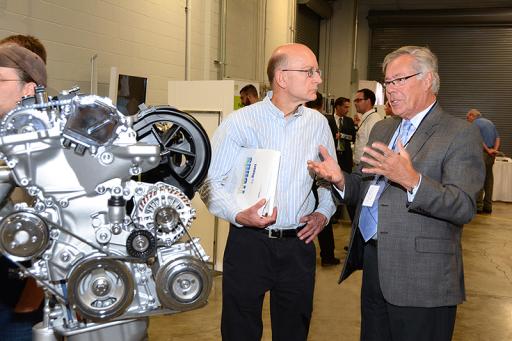
Jeff Alson discusses energy efficiency advances
with an auto industry representative at a 2014
technology showcase at EPA’s National Vehicle
Fuel Economy Laboratory in Ann Arbor, Michigan.
EPA
The two agency teams had worked hand-in-hand on the nation’s first greenhouse gas standards for automobiles under Obama. “We had worked together every month, most of the time every week, and sometimes every day when we had deadlines coming up,” Alson recalled recently. “We knew the names of their spouses and how many kids they had and where they went on vacation.” Now, the fuel economy group wouldn’t return the phone calls of EPA’s engineers.
The Transportation Department analysts finally unveiled their work to Alson’s dumbstruck team at EPA via a video conference call in January 2018. The cost-benefit analysis they had previously worked on together was replaced with new numbers that shrunk the benefits of reducing carbon dioxide and other air pollutants, and added new costs, like increased car crashes, noise and congestion. Instead of the government’s previous conclusion that the clean car standards would bring $100 billion in net benefits to the economy, the new analysis concluded they would result in $200 billion in net costs.
Alson, 63, had worked on dozens of cost-benefit analyses, but he had never seen such a dramatic reversal.
“I concluded that they had been told what the answers had to be if they were going to roll back the standards. They had to show the public that they were way too expensive, which they did by basically cooking the books,” Alson said. “When I saw how dishonest the whole analysis was in those early stages, that’s when I decided I wanted to get out of there. I thought maybe I can do more good on the outside.”
Alson, like Costa, left the agency and joined the EPA alumni in the Environmental Protection Network. He began speaking out and with 40 other former EPA engineers, scientists, policy analysts, attorneys and managers, filed formal comments on the proposed fuel economy rollback. A prominent economist whose work the Trump administration had heavily cited in its proposal, Antonio Bento of the University of Southern California, published a peer-reviewed critique in the journal Science, detailing everything that the Trump team had gotten wrong.
“Inconsistent with basic economic principles,” Bento and his co-authors concluded about the Trump analysis, the most striking flaw being an assumption that looser standards would result in 6 million fewer cars on roads in the United States.
The public critiques by engineering and economics experts put the Trump administration in a bind. With the threat of litigation against its rollback looming, it had no choice but to address the flaws in its cost-benefit analysis in the final version of the “Safe Affordable Fuel-Efficient (SAFE) Vehicles Rule” published on March 31 of this year. But those corrections forced the agencies to concede that the rollback could be expensive, imposing as much as $22 billion in additional fuel bills and other costs on the economy. And that unfavorable cost-benefit analysis left the Trump rollback vulnerable in the courts, where it has been challenged by multiple states and health and environmental groups.
“They wanted to take money from our pockets and give it to the oil companies, because that’s basically what you’re doing if you make people buy cars that are less fuel efficient,” said Alson, who said a driving force behind his speaking out was to defend the reputation of the EPA.
“We did everything we could to try to do the best standards that we could so the American public would benefit,” he said.
As he was retiring, Alson said, he encouraged the young engineers on staff to continue their work, despite the setbacks of the Trump administration.
“Don’t lose faith in EPA,” he said he told them. “Because if we’re going to save the planet, people have to still have faith that the U.S. Environmental Protection Agency can do the job.”
In the End, They Were Scientists First
At the same time that the Trump administration was losing expertise from within the government, it was seeking to limit input from outside experts in environmental science. This helped Trump’s team quell some of the scientific arguments against its rollbacks of environmental protection. But opposition made it onto the record anyway, sometimes with the help of the administration’s own appointees.
EPA’s science advisory boards had long been a target for the ire of the fossil fuel industry and its allies, who sought to overturn environmental regulations. Courts had frequently upheld rules based on the EPA’s reliance on advice from scientific experts. Soon after taking office, the Trump administration set out to gain maximum control over the kind of advice the EPA would get.
“Process matters,” said EPA Administrator Pruitt, at a gathering at the agency in October 2017, with two of EPA’s harshest critics seated in the front row, then-Rep. Lamar Smith (R-Texas) and Sen. James Inhofe (R-Okla.). Taking up an idea that Smith and Inhofe had championed in Congress, Pruitt announced that scientists who had received EPA grants would be banned from serving on the agency’s science advisory boards, asserting that it was a conflict of interest.
“Joshua says to the people of Israel, ‘Choose this day who you are going to serve,'” said Pruitt, once a deacon in his Southern Baptist church back in Oklahoma. “I would say this is sort of like the ‘Joshua principle.'”
Because the EPA is one of the largest sources of U.S. environmental research funding outside of industry, the effect of the ban was to remove most of the scientists whose work was funded not by industry but by grants from the federal government.
“It was just a smokescreen to give some legitimacy to the idea of kicking real experts off,” said Chris Frey, an environmental engineer at North Carolina State University, who had served on numerous EPA advisory boards.
Three federal courts ruled this year that Pruitt’s directive was illegal. But it had already had a dramatic impact. There was no similar conflict-of-interest rule barring industry-funded scientists from serving. As a result, by the start of 2018, the make-up of EPA’s advisory boards had shifted away from academics and toward industry consultants, with the overall number of outside advisers at EPA and other environmental science agencies at its lowest level since 1997. When Wheeler—a former Senate staffer for Inhofe—replaced Pruitt as agency administrator, he continued paring that number down.
Nowhere was the impact more striking than on EPA’s seven-member Clean Air Scientific Advisory Committee (CASAC), which had a large role in reviewing the adequacy of the current air quality standard on fine particulate matter. Pruitt and Wheeler had both taken steps to speed up the review, moving the timeline up by two years so that the process would be complete by the end of Trump’s first term in office.
The new chairman of the CASAC, Denver statistician Louis Anthony Cox, a consultant for the American Petroleum Institute and other industry groups, had long argued that there should be a much higher burden of proof for concluding that pollution was harmful to health. Cox dominated the discussion at the committee’s meetings. Meanwhile Wheeler disbanded the 20-member committee of pollution experts that was supposed to advise CASAC on particulate matter. The CASAC had no experts of its own on epidemiology or other relevant fields of study.
A 2,000-page assessment by EPA’s in-house scientists had concluded that tens of thousands of lives could be saved by tightening the PM 2.5 standards. But Cox, citing contrarian science, blasted the assessment and questioned whether PM 2.5 should be considered a cause of death at all.
Some committee members agreed, others disagreed, and the result was that the committee’s advice to the agency was divided. Wheeler, in finalizing a decision earlier this month to keep the PM 2.5 standard as it was, cited the divergent views as evidence that the science was uncertain. And he dismissed from consideration emerging science indicating that PM 2.5 pollution increased the risk of Covid-19 mortality.
Wheeler has said that EPA’s reviews of the air quality standards were taking longer than the law allowed, and that “the process had gotten out of control.” And he maintained that all the changes he and Pruitt enacted were necessary to streamline the process, and still conduct a “thorough review of the science.”
But while Trump’s team could stack the deck against tightening the fine particulate standard, it could not block scientific critiques from entering the public record, put there by the activism of former EPA science advisors who had been pushed out. In an extraordinary move, the 20 members of the disbanded PM 2.5 science review panel held their own two-day meeting in an Arlington, Virginia hotel conference room last fall, with support from the Union of Concerned Scientists.
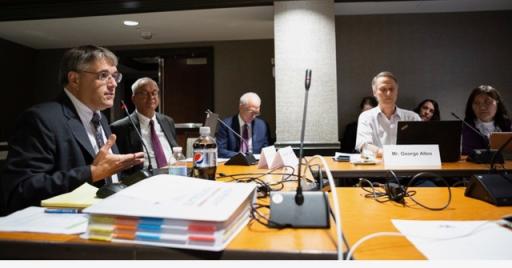
The panel unanimously recommended that the PM 2.5 air quality standard be strengthened. They submitted the recommendation to the administrative record and published their findings last summer in an opinion column in The New England Journal of Medicine. “The epidemiologic evidence is consistent across studies with diverse designs, populations, pollutant mixtures, locations and statistical approaches,” Frey and his colleagues wrote.
Assisting Frey in organizing and running the meeting was Zarba, an environmental scientist who had spent the last 18 of his 38 years at the EPA as director of the agency’s outside advisory boards.
Zarba had developed a deep appreciation for the work of the advisers, many of whom waived the honorarium that the agency pays for their work.
“I know of no place where so few people can have such a huge impact on the effectiveness and the credibility of the Environmental Protection Agency as on the science advisory boards,” Zarba said. “The attacks on what EPA does coming from every direction are so frequent and so aggressive that you need the SAB to push back.”
He added that it was easy for industry and others affected by regulation to criticize EPA decisions, he said, but the SAB process normally forced those critics to make their case with data, before experts who understood the science.
When Pruitt instituted his “Joshua principle,” though, Zarba was given the job of firing those experts. And Pruitt made clear he was going to make his own decisions in replacing them, Zarba said; in a departure from previous practice, Pruitt wanted no briefing from EPA staff on the expertise needed on the committee or on the qualifications of the applicants. The only thing that Zarba could do was make sure that the outside world knew what was happening.
“I think there’s a little bit of an advantage when you know you can retire at any time,” Zarba said. “I could fight some fights and push back a little bit harder.”
Because the boards were covered by the Federal Advisory Committee Act, and their proceedings were required to be public, Zarba was cleared to communicate with the press.
“So I was able to work with the press to help them get up to speed before some things were actually pushed out to the public,” Zarba said. “I would let them know, ‘I’m going to fire these scientists next week, at noon on Tuesday. And if you want to get quotes from them, you could start working it now, but you just can’t print anything until Wednesday.”
It wasn’t the job that Zarba was used to. “It was very stressful,” he said. In January 2018, he retired and joined the Environmental Protection Network, to advocate for a restoration of the EPA science advisory boards.
To the surprise of some, the EPA’s largest body of outside experts, its chartered Science Advisory Board, became a persistent critic of many of the Trump administration’s decisions. This was the case even though Pruitt and Wheeler had appointed the majority of the board’s members, including its only climate scientist, the prominent contrarian John Christy. For example, the board blasted the Trump rollback of fuel economy standards as lacking in scientific basis, in a report that relegated Christy’s outlier view—that fuel economy standards would have no effect on climate change—to a footnote. Christy “was able to gain little traction with more than a few other members of the board,” said Steven Hamburg, the chief scientist of the Environmental Defense Fund, who sat on the board until his term ended in September 2019.
Whether because of the advisory board’s size—it had 44 members—or the dynamic that emerged as the group began to scrutinize the Trump rollback proposals closely, the ultimate advice from the board turned out to be mainstream.
“The magic, which I didn’t see coming, is that on the SAB, the identity of members as scientists has been dominant for almost everyone,” said Hamburg. “The number of extremists on the panel is not that great—there are a few, there’s no doubt about it—but they are pretty isolated on the board.”
Because the law requires that the SAB’s work be open to the public, the Trump EPA wasn’t able to keep the critical SAB reports under a lid, even though the agency delayed their publication and delayed the board from meeting for several months. And although Wheeler last year issued a new directive intended to limit the regulatory decisions the advisory board reviewed, he was persuaded to scale back the plan by the SAB’s then-chairman, Michael Honeycutt, director of the toxicology division of the Texas Commission on Environmental Quality. That ensured that decisions on which EPA proposal the board would review would be made in public, by a sub-committee of the board.
Environmental advocates who balked when Honeycutt, an opponent of stronger air quality standards in Texas, was made chairman of the SAB, now credit his leadership with bringing important scientific questions about the Trump EPA’s proposal to light.
“I can understand why people would be concerned, but I hope that the board demonstrated that we did the best job we could,” Honeycutt said recently.
“I know I felt whenever you sign up to be on the board, you take your day hat off, and you put your SAB hat on,” he said. “And I know people from industry and people from environmental groups and people from academia—we all did that. We all sort of put aside what I’ll call our professional bias, just to look at things as a scientist and just took the job very seriously.”
The Science Proved Durable
The pushback from scientists both inside and outside the agency frustrated the administration and others who opposed action on global warming. Trump took the big step early on of announcing an exit from the Paris climate accord, and he never wavered from his climate denial. But his administration did not succeed in making a significant dent in the science.
In fact, the science won over converts. Jim Bridenstine, the former Oklahoma Congressman and climate denier who Trump appointed to lead NASA, said he had experienced an evolution in his thinking after several months at the agency. By 2018, he was telling Congress he now accepted the science that human activity was driving global warming.
Meanwhile, Trump’s own political advisers shot down an idea floated by climate deniers as a way to shine a spotlight on contrarian science: staging an administration-sponsored “red team-blue team” debate on climate change. The advisers feared negative political fallout from such a forum, first championed by Pruitt and later by William Happer, a prominent climate science denier and physicist who served for a year on Trump’s National Security Council.
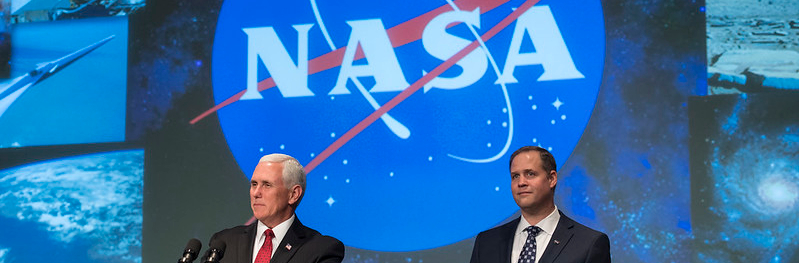
Vice President Mike Pence speaks prior to the swearing-in of Jim Bridenstine as the 13th NASA Administrator.
NASA/Joel Kowsky
Equally disappointing to foes of climate action, Trump’s EPA officials never moved to rescind the agency’s 2009 “endangerment finding,” that greenhouse gases pose a danger to human health and the environment. In a landmark decision two years earlier, the Supreme Court had ruled that the emissions met the definition of pollutants under the Clean Air Act, opening the way for the EPA to act.
“They did not even mount a serious challenge to that,” said one senior EPA scientist, who asked not to be named because he was not cleared by the administration to speak on the issue. “I think that’s an under-appreciated fact that should really stand out. That even this administration, which was so clearly against climate action, and which had a lot of people yelling at them to take back the endangerment finding, did not take that on. I think they knew they would lose.”
In November 2018, despite the administration’s attempts to subvert the effort, the federal government issued its Fourth National Climate Assessment, delivering the most blunt warning yet from scientists on the threat of global warming in the United States.
Thirteen federal agencies and more than 300 scientists from within and outside the government worked on the report, which is required by law. There were attempts by Trump political appointees to weaken the findings, but the extensive public review process and the determination of the government scientists on the steering committee, some of whom would later be removed from their role in the assessment, ensured that the work was delivered intact.
Although the final volume of the assessment was released over Thanksgiving weekend in 2018 (in an effort to “bury” its findings, Happer said), the report sounded a call for action. Its detailed look at the threats in different regions of the country were highlighted by local media from Tampa to Des Moines to Seattle. And over the following two years, record wildfires in the West and tropical storms in the East lent credence to the report’s dire warnings.
A Final Assault
The next National Climate Assessment now has become one focus of a wide-ranging effort by the Trump administration and its allies to make a final mark on climate science. They are seeking to inject doubt into the assessment, due out in 2023, and to put limits on the use of science in future government decision-making, especially research showing the harmful health effects of fossil fuels.
The opening salvo of this anti-climate science drive came just a few weeks before the election, when the White House pushed for the appointment of two prominent climate science deniers and a former Trump campaign official to top positions at NOAA. After the election in November, the contrarian scientists, David Legates and Ryan Maue, were put in charge of the Fifth National Climate Assessment, which was just getting underway with a call for authors.
Myron Ebell of the conservative Competitive Enterprise Institute, who served as Trump’s chief environmental transition adviser but has been disappointed in his failure to dismantle climate science, said he is hopeful that Legates’ appointment will have a lasting impact.
Although the Biden administration would probably be able to replace Legates and reverse any decisions he made, Trump’s allies hope the impression that competing views on climate science deserve equal consideration will stick. In any case, Ebell said, contrarian scientists who are removed by Biden administration officials could join together produce their own assessment.
“They’d have a good case to make that ‘the government isn’t letting us do this, but we’re going to do it ourselves,'” said Ebell, “and we’re going to present it as an alternate report.'”
In other words, the Trump administration is readying an alternate science that will bear Trump’s implicit stamp of approval, just as Biden is attempting to launch aggressive action on climate change.
Biden allies are expressing confidence—in public, anyway—that the checks built into the process will ensure the integrity of the climate assessment.
The Trump administration is also working in its last weeks to finalize a slew of new rules that benefit the fossil fuel industry, many of them designed to limit the use of science in federal decision-making.
On Dec. 9, Wheeler finalized an overhaul of EPA’s cost-benefit process that makes it harder to justify air pollution rules, especially the regulation of carbon dioxide.
And the EPA administrator is aiming to cap his tenure by finalizing a proposal—which in some form has been on the fossil fuel industry’s wish list for years—to limit the agency’s use of any science that is based on individualized health data. Wheeler called it a “transparency” measure, characterizing the ordinary health confidentiality protections around that data as a nefarious form of secrecy.
But in an outpouring of nearly 1 million comments on the proposal, the nation’s leading public health, science and academic institutions warned that it would hobble the EPA, barring the agency from relying on the most powerful studies on the health risks of pollution.
And in a remarkable protest, Thomas Sinks, the EPA career scientist assigned the job of shepherding the “transparency” rule, filed an opinion letter with the agency objecting to the proposal just before he retired in September, a move first reported by The New York Times.
Sinks, an epidemiologist with 35 years of government experience, wrote that if finalized, the rule “will compromise the scientific integrity of our scientists, the validity of our rulemaking, and possibly the health of the American People.”
One protest from a retiring scientist may not be enough to stop the proposal; the Trump administration has pushed past the resistance on nearly every front to enact its agenda. But the voices of insiders and former insiders resound like no others in the war that has been waged over U.S. environmental protection for the last four years.
They have punctured the facade that the Trump administration is acting on behalf of a unified government and illuminated the obscure corners of its battle plan. They have revealed how Trump’s presidency has loosened restraints on the dominant industries of the past, while ignoring the scientific imperative to build a different future.
The Biden administration now has pledged to take up that mandate, following the difficult path that in many ways has been laid bare by the underground combatants of the Trump years. To confront climate change, Biden and his team will need to build back not just an economy, but trust—in government, in science and in our capacity for change.

One misunderstanding involves considering these words to be interchangeable: synonyms that can be swapped around as equal alternatives just to reduce the repetition in a paragraph. That is incorrect.
A different error is to consider ‘proof’ to be a version of evidence but at a higher standard. That is also incorrect.
The fact is, they apply within different realms.
Proofs should be absolutely correct, like in geometry. The statement that the square on the hypotenuse is equal to the sum of the squares on the other two sides of a right angle triangle is indisputable; beyond challenge.
But what do you notice about it?
All the information is just thought. It depends on useful but imaginary conventions: that it’s possible to have perfectly straight lines, which have length but no width and which can proceed in an unwavering direction from a point on a flat plane. None of that is real.
In fact, the universe is entirely quantised. Made of dots. Things can only be connected up by joining the dots in a stepwise fashion. And nothing can be unidimensional – all the quanta have three dimensions, four if you include time – they all had a beginning and have a limited duration. There is no evidence for infinity.
Where is this provable world?
Inside our heads. Nowhere else. It’s the Conceptual Realm. In our brains. Where we link ideas together. Where we construct beliefs…
You can formulate arguments to prove your god. But arguments are also in this purely Conceptual Realm. They are just thoughts – ideas that have had their dots joined. And these linkages may turn out to be false – like the design concept for a perpetual motion machine or the notion that the sun goes round the Earth…
Arguments can be presented without evidence – like Trump’s laughable attempts to alter the result of the recent election in the courts.
However, arguments may be based on evidence, the sun does appear to go round the planet, but more evidence came in, forcing a new understanding. What brought about this change? New observations , thanks to the invention of the telescope.
Observations trump arguments. (Pun not intended.)
Yes, evidence is not conclusive. We can’t have absolute evidence because we can’t examine all the situations in the entire universe.
However, evidence can be weighty, especially if corroborated from different independent sources.
If you want your god to be real, you’re going to have to show that it exists in the Natural Realm . Unless, that is, you are content for it to remain in the realm of mere conceptualizations, along with Humpty Dumpty, and my favorite god, Unkulunkulu…
This is why you have to provide evidence for your god .
What is evidence?
Shareable repeatable observations. You’re going to have to produce observations of Unkulunkulu…
Got any?
The New York Times Hasn’t Heard About China’s Vaccines

China has already made commitments to supply hundreds of millions of doses to Brazil, Morocco, Indonesia and other developing countries . While it would be best if every country with manufacturing capacity could produce any vaccine, without regard to intellectual property rules, it is bizarre that a piece on access to vaccines in the developing world would fail to mention the vaccines developed by China.
Roberta McCain: A Military Matriarch With a Sense of Adventure
by Cindy Mc Cain
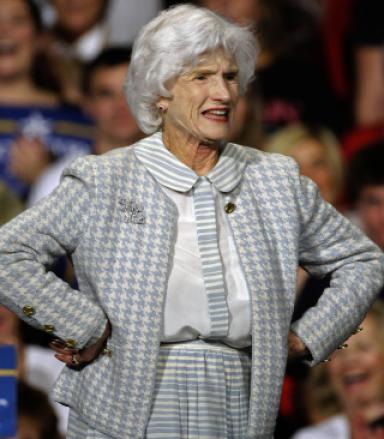
Roberta was born on February 7, 1912, to Archibald and Myrtle Wright in Muskogee, Oklahoma, where Archie enjoyed a colorful reputation for gambling and bootlegging. He was purported to have won in a card game the tract of land where he would strike oil. After the bonanza, he moved the family to Los Angeles, and retired at the age of 40 to devote his time to the care, education and entertainment of his children. He escorted his daughters to dances and recitals, and led them on excursions around the country to visit various sites of natural and man-made wonders.
Roberta was 18 and a University of Southern California freshman when she met Ensign John S. McCain Jr. A shipmate was giving her a tour of their battleship, the USS Oklahoma, homeported at Long Beach. They passed her future husband’s quarters as he was preparing to shave. He had cheeks “like two little red apples,” she recalled. “Until then, I had never teamed up with any man.”
Roberta’s parents opposed the match, preferring a more genteel future for their daughter than the itinerant life of a naval officer’s wife. Less than two years later, they eloped to Tijuana. News of the marriage was reported on the front page of the Los Angeles Times . The only family member in attendance was the groom’s father, Captain John S. McCain Sr., who pronounced himself delighted by the match, as taken with his new daughter-in-law as she was with him.
Their first child, a daughter, Alexandra “Sandy” McCain, was born in 1934. Their first son, John S. McCain III, arrived two years later, and their second, Joseph Pinkney McCain, two years after that.
Roberta embraced the peripatetic lot of a Navy spouse that Archie and Myrtle Wright worried wouldn’t suit her, making the best of the frequent dislocations and her husband’s long absences at sea. Her son, the future senator and my husband, recalled his parents’ early years in the smaller and more insular prewar Navy as “something out of the The Winds of War .” When the McCains were stationed at Pearl Harbor, he said, his parents dined in formal attire even when they were at home. At John Jr.’s insistence, the family lived on his Navy salary. Roberta recalled the romance and the deprivations of those years with the phrase, “We were too poor to paint and too proud to whitewash.”
It was Roberta who packed up and moved the family from base to base, diverting their cross-country trips to take in sites of cultural or natural significance, an informal education to which her son attributes his restless curiosity. “I am my mother’s son,” John often observed.
She endured the difficulties of the war years, especially the strain of knowing how harrowing was her husband’s duty as a submarine skipper, without complaint. Later in their marriage, she helped her husband through his struggle with alcoholism. Both of my husband’s parents bore his 5½-year captivity as a POW in Vietnam stoically, despite their private anguish. On the night they learned of his shootdown, they kept a dinner party commitment without mentioning the news to their hosts. When her husband was selected as commander in chief of U.S. forces in the Pacific, they made it known they preferred not to discuss their son’s situation with people outside the family. John credited his own extraordinary resilience during that time to his mother’s example.
John McCain Jr., by then an admiral, died suddenly of a heart attack in 1981, with Roberta by his side while aboard an Air Force C-5 returning from Europe. Roberta greeted her son and me, her new daughter-in-law, at Andrew’s AFB with the news—“John, your father is dead”—and then silently escorted us to the plane, where the admiral’s blanket-covered remains were waiting. On the day of his funeral days later, the day John left the Navy and we moved to Arizona, I could see the admiration in his eyes as he watched his mother at the reception, charming, uncomplaining, resolved to get on with life.
She was proud of her son’s second career as a statesman. Having acquired over the years many friendships with prominent politicians, she understood the demands of the profession. She teased John whenever she thought he was too full of himself. “Fools names and fool’s faces are often seen in public places,” she often chastised him for his media appearances. She campaigned enthusiastically for him in his two presidential bids, charming voters, staff, reporters and even his rivals as easily as she charmed her children, grandchildren and in-laws.
She remained an inveterate world traveler until her stroke. She and Rowena worried their family with frequent excursions to countries where their safety couldn’t be assured, although their intrepidness more often amused John. No one ever amused him more consistently than Roberta, in fact. He loved recalling how a rental car agency in Paris refused to rent her a car because she was too old. So, she bought her own car to keep in Europe. Some years later, she had it shipped to the States, and drove it alone cross-country to Los Angeles one Christmas. A state trooper pulled her over outside Flagstaff having clocked her doing 110 mph.
She bore her son’s death, in 2018, and her daughter’s, a year later, with the same dignified bearing she always managed when suffering personal losses. She offered comfort to her grandchildren, and shed discreet tears of her own. I have so many happier memories of Roberta, and it cheers my heart to think of her now, reunited with John in their mutual admiration society, laughing at each other’s antics and expressing their amazement at the wonder of it all.
Katherine Johnson: The NASA ‘Computer’ Who Launched a Man into Space and Women Into STEM

Johnson at that time was a “human computer,” a job title for people — usually women — assigned to do the complex calculations underlying scientific disciplines such as astronomy and navigation. As a Black woman in segregated America, she embodied the adage about Ginger Rogers — who did everything Fred Astaire did, only backward and in heels — in the sense that she had to overcome countless barriers to win a respected place among a largely white, male NASA staff. Johnson also, in this case, literally worked backward. “Tell me where you want the man to land, and I’ll tell you where to send him up,” she said upon joining the Project Mercury program. The engineers would give her the splashdown point, and she would tell them where to aim the rocket.
In 1961, the Freedom 7 mission sent astronaut Alan Shepard, packed in an almost impossibly tiny capsule, hurtling up into space; thanks to Johnson, he also came down, safely. The historic flight would prove an important step toward the ultimate goal of sending an American to orbit Earth.
At the time, Johnson’s pivotal contribution to human spaceflight was known within NASA, as well as in the tight-knit community of African Americans she knew in the Hampton Roads, Virginia, area — many of whom, like her, worked at NASA’s Langley research facility. In the world at large, Johnson was mostly unsung. But her renown grew, and by the time she died this year, at 101, she had become a household name. In 2015, she was awarded the Presidential Medal of Freedom; in 2016, the actor Taraji P. Henson portrayed her in the film adaptation of Margot Lee Shetterly’s best-selling book, Hidden Figures . It does not detract from Johnson’s genius to say that in her life of stunning achievement — and her long-overdue fame — she also represented a cohort of women who pioneered the STEM field in the mid-20th century, and who are only now beginning to receive credit.
Make no mistake: Katherine Johnson was a genius. As Shetterly puts it, she was a “black girl from rural West Virginia, born at a time when the odds were more likely that she would die before age thirty-five than even finish high school.” Born in 1918, Johnson was a precocious child who counted everything from stars to stair steps. She received a full academic scholarship to the historically Black West Virginia State College, from which she graduated summa cum laude with degrees in math and French. In 1940, after a stint as a teacher, she became one of three exceptional Black students selected to integrate the graduate school at all-white West Virginia University. She was hired in 1953 to work at what was then called NACA, the National Advisory Committee for Aeronautics, where she was quickly snapped up by the Flight Research Division.
At Langley, she joined a community of female mathematicians, Black and white, that dated back to (and even a little before) World War II, when the center’s chief research mission was to ensure that Allied fighter planes, transports and bombers performed safely and well. Elsewhere during the war, other women did brain work to advance the Allied effort at a time when the STEM field was getting off the ground — so to speak — with huge advances in fields like radar, rocketry, computer science and communications technology. As men departed for fighting in nearly every corner of the world, women were called to participate in a major way, driving and developing these advances. As a result, World War II marked the first time in U.S. history that educated women were not only recruited but competed for. Great tragedy created great opportunity. In late 1941, the U.S. Navy generated a memo citing “women’s colleges” as a “new source” of talent for its burgeoning code breaking force. Companies like Hercules Powder and Armstrong Cork hired female physicists and chemists. At Aberdeen Proving Ground in Maryland, the U.S. Army engaged female computers to draw up ballistics trajectory tables. It was women who programmed the Army’s ENIAC computer, though they were not invited to the formal unveiling or the celebratory dinner.
As Shetterly points out, by midcentury, “There was virtually no aspect of twentieth-century defense technology that had not been touched by the hands and minds of female mathematicians.”
After the war, many of these women were shouldered out of the private sector. In corporate America, the intent had never been to employ women on a permanent basis; the “girls” were considered a temporary replacement for men, who began flooding into the lucrative tech industry, where “computer” now meant not an underpaid female paraprofessional, but an expensive piece of hardware. In this environment, the U.S. government — now fighting a Cold War — was a bit more open to female talent than the business world. In 1958, NACA became NASA; the mission expanded to embrace space; and that’s when Johnson began her work for the space task force, calculating the trajectories of spacecraft. Her reputation for accuracy was such that, in February 1962, as John Glenn prepared to realize the mission of orbiting Earth, he asked that the computer’s calculations be verified by her. “Get the girl to check the numbers,” he said.
If he had forgotten her name, history will not: There is now a Katherine G. Johnson Computational Research Facility at NASA. Johnson — most proud of her work on the Apollo moon mission — also has a satellite named for her and, of course, a Barbie, complete with shirtwaist dress, badge and glasses. Women’s contributions to computer science are finally being commemorated in a public way. In 2017, a residential college at Yale was named for Rear Admiral Grace Hopper, who joined the U.S. Naval Reserve during World War II, and helped develop the Mark I computer and the programming language COBOL. This year, the U.S. Coast Guard announced it is naming a cutter after Elizebeth Smith Friedman, a legendary code breaker who served before and during the war. Their work — and belated recognition — underscores the absurdity of any question whether women “belong” in modern computing; fact is, it was women like Katherine Johnson who helped create it.
China Has the World’s Largest Economy: Get Over It
It is more than a bit annoying to hear reporters endlessly refer to China as the world’s second largest economy. It isn’t. It’s the world’s largest economy and has been since 2017. Here are the data from the International Monetary Fund.
Source: International Monetary Fund
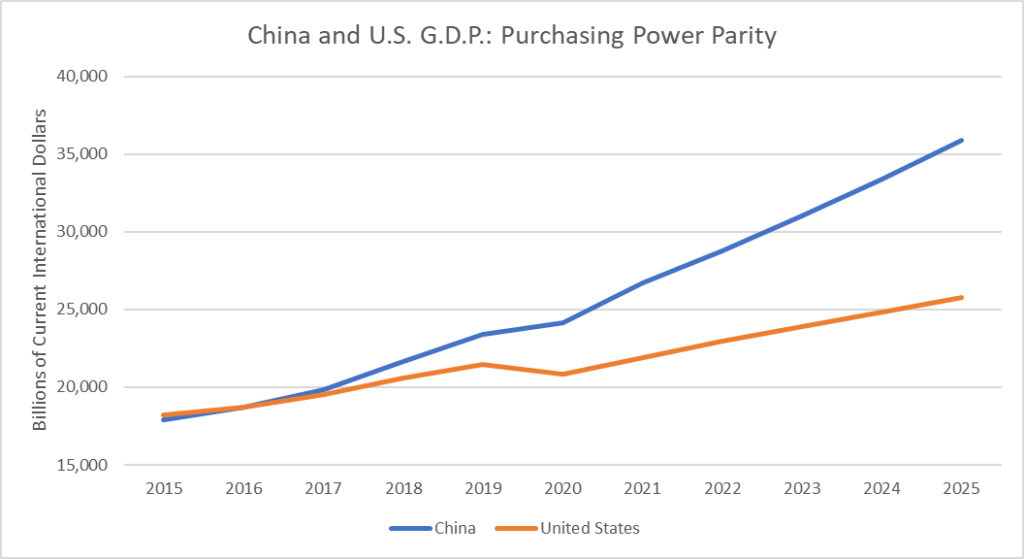
As the chart shows, China’s economy first passed the U.S. in 2017. It is projected to be more than 16 percent larger this year, and by 2025 is projected to be almost 40 percent larger by 2025.
Purchasing power parity (PPP) measures of GDP are based on applying a common set of prices for all goods and services produced across countries. While it is difficult to measure accurately, most economists view PPP as being the better way to calculate GDP, since it reflects living standards and does not fluctuate with currency values. China does have four time the population of the United States, so it is still much poorer on a per capita basis.
The fact that China has a larger GDP than the United States is important for policy debates since many people seem to hold illusions are about the ability of the U.S. to influence China. While United States can take steps that will damage China’s economy, even the harshest measures will only have limited impact, and China will be able to take steps to overcome them through time. This is important background for debates on China policy.
A brief history of Brexit – all 2,000 years of it
55BC-409
Becoming Europeans
Julius Caesar’s offer for Britain to join Europe on Roman Republic terms is patriotically rebuffed. But the treacherous British elites have sniffed the international lifestyle of Rome, and are soon going there to hand over a small percentage of tribal GDP as offerings at the Capitol. By 43, they understand modern financial vehicles known as coins and are worth annexing by Emperor Claudius’s European superstate. Boadicea (despite probably not existing) tries to take back control, but the wheels come off her chariot, and for the next 350 years the Britons are ruled by a snappily toga-ed continental elite and their collaborators.
409-443
Brexit #1
The legions exit Britannia, to fight one another where it matters. Tired of taxation without defence, the Britons cry freedom and go it alone. But they are unable to obtain mutually acceptable bilateral trade deals with the Picts and Scots, who insist on their right to attack in coracles. So the Britons beg the Romans to let them back in. The Romans are too busy trying to hold the newly acceded Hungarians to European norms of behaviour, so the desperate Britons turn to some obscure Germans called the English, who record the approach thus: AD443 This year sent the Brit-Welsh to Rome & them assistance bade against the Picts, but they gave them none, for that they fought with Attila, King of the Huns, & then sent they to the English.
Anglo-Saxon Chronicle
The English agree to do the fighting in return for residency rights in the south-east. But they soon call over their dependants, swamp the Britons, and impose their own culture.
793-1042
Scandinavian E fta

Harold II, last Anglo-Saxon king of England, portrayed on the Bayeux Tapestry before his defeat to William the Conqueror.
Print Collector/Getty Images
1066
Re union with Europe
William the Conqueror creates a new single market with northern France. Being English now means tending pigs, sheep and cows so that the French-speaking elite can feast on pork, mutton and beef. For the next 900 years, any monoglot Englishman is not quite comme il faut . And if you don’t understand that, well, it just goes to show.
1533
Brexit #2
Henry VIII wants a divorce, really, really badly; a would-be new elite wants to disrupt the Catholic church. They use cutting-edge German social-media technology – printing – to invent fake news: if England breaks with Rome, there will be a financial dividend for everyone, and a boost for the Tudor NHS.
‘Then shall these great yerely exaccions cease … Then shall we have ynough and more then shall suffice us, whiche shall be the best hospitall that ever was founded for us.’
Supplycacion for the Beggars (1528/9)
1689
Back into Europe
Brexit #2 plunges the British Isles into ferocious wars. At last, the desperate English invite the Dutch to invade and sort things out. So England gets a Dutch king who can barely speak English, then ceases to exist in 1707 when a new thing called Great Britain gets a German king who can barely speak English. But that’s fine because both kings, like the entire English elite, can speak French.
1815
Brexit #3
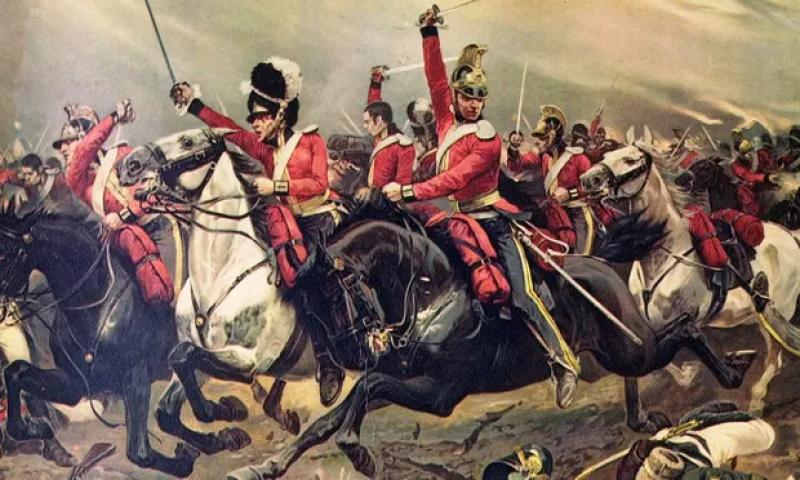
At Waterloo, the new United Kingdom fields 28,000 men, more than half of them Irish or Scottish, and beats Napoleon thanks to another 90,000 European soldiers. But being European is hard work, so we get out. Our exit strategy is brilliant: hand the wealthy industrial Rhineland to militarist Prussia – thus dooming the Danes, Poles, Austrians, French and pretty much everyone for the next 130 years.
1880
Brexit #4
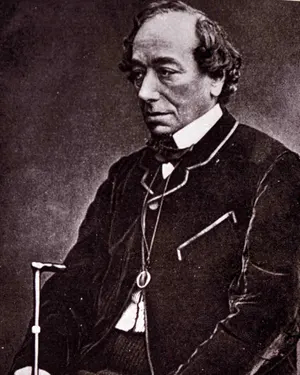
Benjamin Disraeli.
Universal History Archive/Universal Images Group/Getty Images
1914-75
Two world wars and one sane act
Having won at appalling cost, we again pretend to be non-Europeans, until we have to join France and the ghastly dictatorship that is Stalinist Russia to do it all again 20 years later. But we can’t tell the difference between “we held out bravely until the bigger players turned the game around” (true) and “we won the second world war” (false), even though the Americans now clearly run the world and we clearly no longer have an empire.
Boldly facing down this national delusion, Edward Heath, backed by Margaret Thatcher, just beats Labour and the Powellites (’fraid so) and gets us into Europe again. In 1975, we agree by a very large majority to stay there.
2021
Ourselves, alone
Thatcher is kicked out by her own party for turning into an American libertarian. Her continuity army, “like some demented Marxist sect” (Douglas Hurd), unleashes cultural warfare against Europe because they hate maternity leave. The stout John Major sees off the “bastards” (his word), but the spineless David Cameron lets the “swivel-eyed loons” (his words) have their referendum. Abetted by tax-exile news proprietors, Trotskyite nutters, and the touching overconfidence of pro-Europeans in our collective sanity, the English National party, led by the popular comedy turn Boris “Merrie Monarch” Johnson, narrowly wins, then claims that a one-all draw (1975 v 2016) represents the eternal will of the English people, so the rest of us are traitors.
Next up
The United Kingdom dies and the English are alone again at last. Happy new year.
The secret of Jacinda Ardern’s success lies in her conservatism
The New Zealand prime minister’s appeal comes from adding compassion, something her rivals have been unable to emulate

Understandably the global media paint the prime minister as a counter to other, more rightwing or illiberal, leaders. Similarly many overseas progressive activists and intellectuals have seized on her as someone they can learn from in their search for a way forward for the political left.
Yet the biggest lesson to be learned from “Ardernism” is the power of conservatism during a crisis. That is where the Labour party politician has excelled – in 2020 and in earlier years – as a leader. The then 37-year-old took the helm of a party in crisis in 2017, which was polling at just 24%, and took Labour into a coalition government just weeks later. In the latest general election her party won a record-breaking 50% of the vote, giving her the historic opportunity to form a new government without the need for coalition partners.
As prime minister she has excelled at crisis management, dealing with multiple disasters and threats. And in these crises the bulk of New Zealanders have craved conservatism rather than any type of radicalism. The population has wanted solid, reliable government.
By and large, Ardern and her government have delivered this. This is why the prime minister stands head and shoulders above any other politician in this country. Yes, she has been charismatic in her leadership, but more importantly she has been competent and politically centrist.
Ardern’s instincts have been to protect and conserve. She has trodden cautiously throughout the pandemic, providing reassurance and the promise of normality to those in fear of the worst.
Even the leader of the rightwing Act party, David Seymour, said this week: “She’s very good at reading public mood and putting out unifying messages.” He correctly explained: “She’s done that three times now – she did it after Christchurch, after White Island and through the Covid-19 period.” Seymour concluded that Ardern was “a superb front of house leader”.
It would be foolish to suggest anything otherwise. New Zealand enters into the festive season with barely any Covid-related restrictions inside the country. There is no community transmission of the virus.
New Zealanders credit Ardern’s leadership for saving lives and the economy. She is widely seen as “following the science”, and taking a compassionate approach by “going hard and early” when the virus hit in March, locking down the country to a greater extent than any other nation.
Ardern’s Covid leadership was not particularly leftwing. In the best conservative tradition she unified the nation, as she had done in the wake of other crises. This general approach to Covid actually had a large degree of consensus from across the political spectrum (albeit with differences over its implementation).
It was not surprising therefore that when it came to October’s general election many traditional National party voters shifted to Labour, wanting to reward Ardern. Corporate leaders praised her – and she does listen to business (more so, it seems, than to unions). Unsurprisingly the whole of Labour’s election campaign was about Ardern, and her victory over Covid was central to this, with her electioneering mantra being that she had delivered “strong and stable government”.
Now, as the year ends, even rightwing political commentators are singing Ardern’s praises. It’s as if she is the centrist politician they wish was leading the National party. They want to claim Ardern as a fellow conservative.
This isn’t to say there is nothing progressive about Ardern, or that she is rightwing. She might be on the right of the Labour party, and she might have adopted many of National’s policies and approaches, but she does something that her opponents seemingly can’t emulate: espouse compassion as part of her conservatism. Her self-declared “politics of kindness” isn’t particularly revolutionary, nor even very tangible, but it rings completely true to those who have seen Ardern navigate the nation’s crises.
The political left is, however, increasingly bristling at the conservatism of Ardern. There is growing angst about the failure to progress a traditional Labour party agenda. Poverty activists are now protesting against Ardern. Greta Thunberg tweets in disappointment about her lack of action on climate change. Columnists complain about Ardern’s lack of action on the housing crisis . It is said the rich are getting richer and the poor much poorer on her watch. And by continuing to rule out in 2020 any wealth or capital gains taxes, Ardern has irritated those who want to see transformation.
Ardern’s reputation with progressives took a particular dive this year on the issue of drug reform, due to her refusal to make a case for the legalisation of cannabis ahead of the referendum. Reformers knew Ardern’s endorsement would have got the campaign over the line, but Ardern knew sitting on the fence was less risky for her popularity.
Ardern now responds to the many complaints with the ultimate conservative argument, saying she wants to make incremental change “that sticks” by gaining consensus. She explains that she is a “pragmatic idealist” – which increasingly translates as being driven by public opinion.
The political left can celebrate a triumphant year in which their main party and politician are supremely popular. But they also need to accept that this is a direct result of Ardern’s conservative approach.
Ardern has started to use the traditional National party line about the need to “govern for all of New Zealand” (rather than what might be expected on the left – a progressive agenda to further the interests of those at the bottom). This conservative approach is what has previously kept the party of the right essentially in power for decades, presiding over the status quo. It now looks like it’s time for the conservatives of the left to do the same for the foreseeable future.
Dr Bryce Edwards is the political analyst in residence at Victoria University of Wellington, New Zealand, where he is the director of the Democracy Project .
Tags
Who is online
84 visitors
This is Trump's last opportunity to kill people with a maga-fuckup. Wanna bet on him... or against him?
------
Kavika may have posted something on this a few months ago.
------
There is a "deep state". It is composed of all the government employees who understand that they have sworn to serve the people rather than any one person. May they be praised! This excellent long-form deserves a seed of its own... but I'm running out of steam...
------
We had a debate on this topic a week ago. This is a different approach, worth thinking about.
-------
American media are stuck in the seventies, where China is concerned. This is not a good thing.
-------
Honoring a fine lady.
--------
A model for us all. Courage, integrity, ... The lady had it all!
-------
I believe I've already noted that American media have blinders when it comes to China...
-------
I am very glad to not be in Calais right now...
-------
Why couldn't she be American?
Well, the distribution seems to be a CF at the moment.
Many Native American tribes have ''heritage seeds'' and are preserving them. The Cherokee are the first to store them in the global storage vault.
Kudos to the scientists for fighting back at the EPA.
The Times forgot China, hmmmmm.
Roberta McCain and Katherine Johnson, two unsung heroes.
I'm done with Bexit.
Interesting news on the NZ PM. I was surprised at her stance on MJ.
Yes. Considering most "experts" were telling us we had no reason to even hope for a vaccine until 6 months to a year from now , but we have already vaccinated over 2 million people, I'd say we have reason to be somewhat satisfied so far.
From the New York Times, April 30, 2020 :
That would put us on track for a vaccine "to arrive" no sooner than the end of April or beginning of May 2021, and possibly not until October or November of 2021. So even under the best case prediction, we are 5 months ahead of schedule.
Another dire prediction from the same article:
In a context that moves as fast as this one, you're citing an article from April?
Yeesh.....
Yes - to remind people that we are exceeding expectations. We should be happily surprised, not disappointed.
[deleted]
Thanks for a fascinating group of articles, Bob.
I don't recall if Kavika had posted it, but I'm happy to see that the three sisters will be perpetuated notwithstanding whatever happens due to ignoring of or Trumpian resistance to the science concerning climate change.
Interesting, due to my own profession, to read something that perhaps I never paid that much attention to about proof vs evidence, but then I almost never argued a case in court.
It's not just the NYT that had anything to say about SinoVac, or SinoCan or SinoPharm or any other Chinese vaccines that have already provided excellent results - because, after all, they're Chinese, and Chinese = bad. A lot of it will be distributed at very low cost if any cost at all to poorer countries around the world. Maybe the western media condidered the vaccine to be how Chinese food is criticized - get vaccinated and then have to be vaccinated again a few hours later.
Loved the story about Roberta McCain. If John inherited her characteristics I would have liked to have seen him as POTUS, but unfortunately I think his first VP choice was an anchor rather than a boost. Couldn't stop laughing when I read she was stopped for driving 110 mph.
Okay, China's economy may be in the lead if you look at it that way, but a British organization that has been studying and making predictions about economies predicts it will surpass the USA to become the world's top economy in 2028.
I never bothered to pay much attention to the BREXIT situation at any time, and still don't.
As for Arcinda Ardern, her politics aside, she provided a good example that a government need not be authoritarian, but can be a democracy, and can STILL do a great job of containing the virus - as it COULD have been contained in the USA, but.........
China's management of its vaccine(s) is typical of why America is losing on the world scene. From the beginning, China has been preparing to share its vaccine(s) with the Third World... whom America has (as usual) completely abandoned.
The world sees America as a villain. Why is that?
LOL. I assume that's a rhetorical question.