
US grid will see 80 percent of its new capacity go emission-free

By: JOHN TIMMER (Ars Technica)

 S E E D E D C O N T E N T
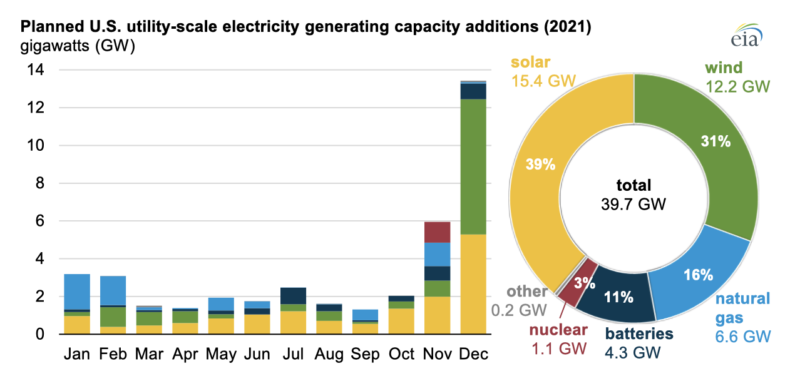
Earlier this week, the US Energy Information Agency (EIA) released figures on the new generating capacity that's expected to start operating over the course of 2021. While plans can obviously change, the hope is that, with its new additions, the grid will look radically different than it did just five years ago. The report includes the details of where a new nuclear plant may be started up, although it will be dwarfed by the capacity of new batteries. But the big picture is that, even ignoring the batteries, about 80 percent of the planned capacity additions will be emission-free.
New nukes?
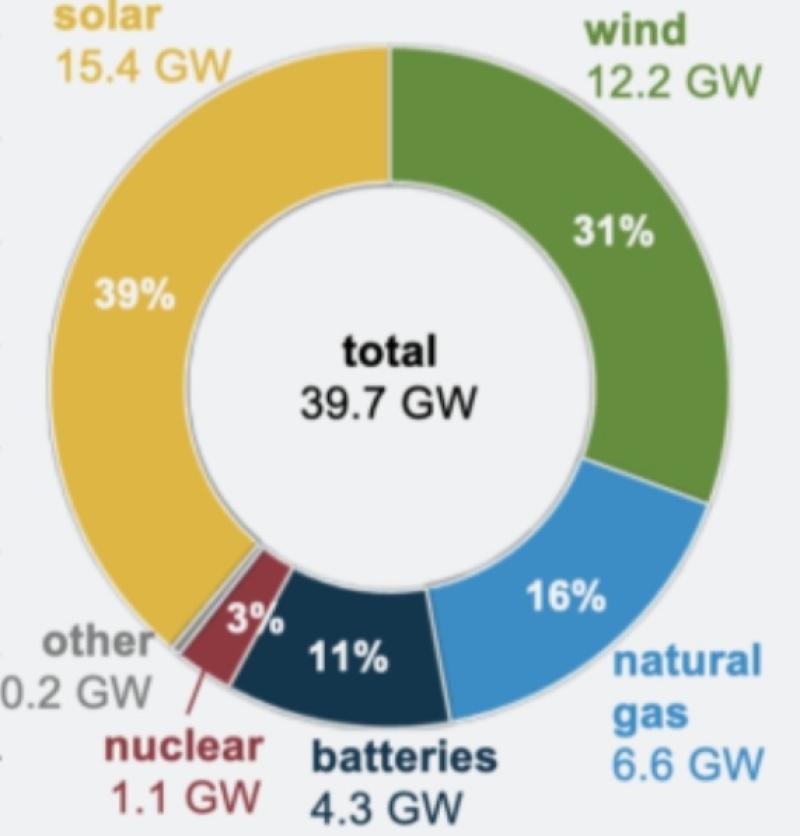
The EIA's accounting shows that just under 40 Gigawatts of capacity will be placed on the grid during 2021, but there are a number of caveats to this. First and foremost is the inclusion of batteries, which account for over 10 percent of that figure (4.3GW). While batteries may look like short-term generating capacity from the perspective of "can this put power on the grid?" they're obviously not actually a net source of power. Typically, they're used to smooth over short-term fluctuations in supply or demand rather than a steady source of power.
Still, given the rarity of grid-scale batteries even a few years ago, 4.3GW of them is striking.
Another oddity is a matter of timing. Last year, Virginia's Dominion Energy started up two offshore wind turbines as part of a pilot project that will lead the way toward the much larger Coastal Virginia Offshore Wind, which will top out at 2.6GW when it's completed in 2024. But these turbines won't formally enter commercial service until this year, so their 1.2MW count toward the 2021 figure.
Another case where the figures may end up not matching reality is the addition of 1.1GW of nuclear power in the form of a new reactor at the Vogtle site in Georgia. Construction of this plant and its twin has run consistently late and over-budget. If it's actually completed, it will represent the first new nuclear capacity added to the US grid in several years and will partly offset the closure of some smaller plants in recent years.
But the big story in 2021 will be the shift away from fossil fuels. Despite the Trump administration's attempts to tilt the playing field in favor of coal, there will be no new coal capacity added in 2021. Given the recent closure of several large plants, this is a guarantee that the rapid plunge in US coal use is set to continue.
Up until very recently, coal was largely being displaced by natural gas. But in recent years, wind power prices dropped to the point where a well-sited wind farm in the US could produce power at a price lower than the cost of buying fuel for an existing natural gas plant. And grid-scale photovoltaics had actually started to undercut wind power. But the market didn't respond to this new reality instantly, leaving natural gas dominating the capacity added to the US grid in recent years.
Economics kicks in
The market is now clearly responding. Less than 20 percent of the capacity added in 2021 will be natural gas (6.6GW), even if you disregard the battery capacity being added. That's down from 34 percent just two years ago, and over 60 percent three years ago. New additions are heavily concentrated in areas where a lot of natural gas is produced: southern Texas and near the Ohio/Pennsylvania/West Virginia borders.
Instead, wind and solar dominated, with 12.2GW of new wind capacity and 15.4GW of solar power. This is especially striking given that tax credits for renewable energy were set to phase out in 2020, leading many projects to be pushed through to completion late in the year. (Those credits ended up being extended in a recent budget bill.) Normally, the EIA predicts that these sorts of expirations cause the pipeline of new projects to empty out, leading to a temporary drop. There is absolutely no indication that this took place in 2021.
Notably, these values don't include residential solar, which is expected to add another 3GW to 4GW of capacity in 2021.
As in the past, Texas is one of the major sites of new wind construction, joined by its northern neighbor Oklahoma. Planned additions include a wind farm that's just a tiny bit short of a GigaWatt. Texas is also dominating solar additions, with over a quarter of the expected new capacity. Nevada and California will also be installing about 10 percent each, but they're closely followed by North Carolina, part of a growing trend of solar installations in the US Southeast.
The Biden administration expects to promote additional renewable energy projects as part of its pandemic recovery plan. While the renewable projects are unlikely to arrive quickly enough to alter the 2021 numbers, they could boost wind and solar even further in 2022. There are also a number of very large (GW-plus) offshore wind projects being developed along the US East Coast, some of which may start entering service over the next few years.

Tags
Who is online
128 visitors
Makin' progress...
Gotta save those coal reserves for the potential nuclear winter, lol
Good news.
Interesting observation but what does it mean nationally? There are three big electric grids, West, East and Texas (ERCOT)
Texas formed it's own system which does not cross state lines, to avoid being subject to Federal rules. Although in recent years
two connections have been made in easternmost TX to the national Eastern grid and three connections to Mexico are being consolidated,
ERCOT is still not subject to Federal rules.
The proposed Three Amigos project to connect East, West and Texas grids at Clovis NM has languished since 2009.
Traveling west from Dallas the wind farms stop abruptly around Clovis.
Dunno. I read an occasional article; no more.
I'm a fan of nuclear energy. By and large, it has a very safe track record and it is so much kinder to the environment that many of the alternatives. Much of the resistance to it is irrational and emotional.
Point of fact: Batteries are not a sustainable generation source.
Batteries are not a generation source, period. They're stockage.
That would depend on the type of battery. I imagine that the typical dry cell is considered charged at the end of the production process. That is why I didn't just say not a generation source at all. Splitting hairs I know.
I wouldn't fight over it... but it's kinda the essential nature of batteries. Batteries store energy. That's what they do. They reproduce energy that was produced previously.
I know that batteries store energy. That is why I made the comment in the first place. Some batteries, by manufacturing method, are made to be used once and then discarded. But the diagram above shows batteries as a source that generates 11%. That was what I was taking issue with. I didn't want some anal individual to say, "But actually..." so I added the caveat.
Capacitors store energy. Wood stores Energy. Coal stores energy. Atoms store energy. It is all the methods of extraction that makes that energy Green or not.
Personally, I would like to see us move away from these grand Mega and GigaWatt monstrosities towards a localized net of independently owned, as in every body has one, homeowner types of solar wind water power generation.
I agree. Some sources get more economical as the plant gets bigger. For others, smaller generators are not a problem. Those should be distributed, reducing transmission costs.