
World's first pure ammonia-fueled demonstration vessel completes maiden voyage in China

By: No Author Indicated

 S E E D E D C O N T E N T

World's first pure ammonia-fueled demonstration vessel completes maiden voyage in China

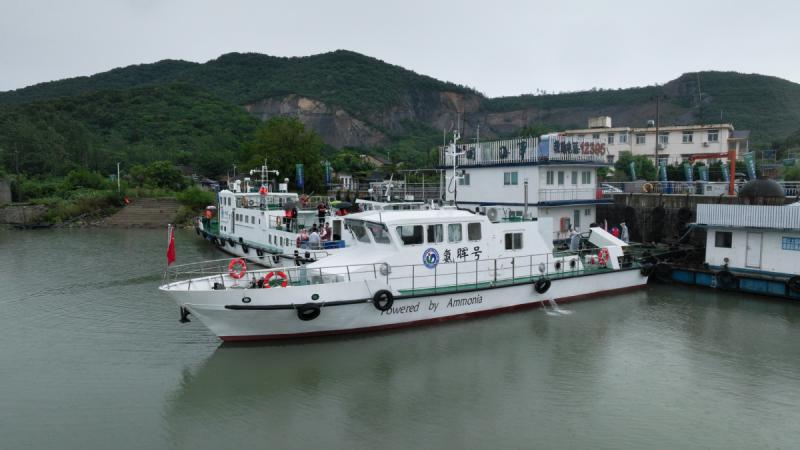
HEFEI -- The world's first pure ammonia-powered demonstration vessel, the "Anhui," successfully completed its maiden voyage in Hefei, East China's Anhui province, marking a major step forward for green shipping.
Ammonia, a major chemical industry feedstock, has a high energy density and due to its carbon-free nature, produces only water and nitrogen when fully combusted. This makes it a highly promising fuel for decarbonizing shipping.
In recent years, several shipping companies in countries like Japan and Norway have been investing in the development of ammonia-powered vessels. A report by the International Energy Agency published in 2021 estimated that by 2050, ammonia could account for around 45 percent of global energy demand for shipping in 2050 in the net-zero emissions. However, ammonia fuel also faces challenges such as ignition difficulties and unstable combustion.
Ammonia-powered Anhui was jointly developed by the Institute of Energy of the Hefei Comprehensive National Science Center and its subsidiary, Shenzhen Haixu New Energy Co., Ltd. It is equipped with a 200kW high-speed gas internal combustion generator, two 100kW propulsion motors, and a twin-screw propulsion system. It has a full load capacity of 50 tonnes and a rated speed of 10 knots.
According to Wu Dianwu from the institute, the research team overcame several key technological challenges. These include pure ammonia fuel plasma ignition, sustained combustion, efficient catalytic cracking of ammonia gas to produce hydrogen, and efficient combustion and control of hydrogen-ammonia mixed gas in internal combustion engines. The team also developed a pure ammonia fuel burner and various ammonia gas catalytic cracking devices.
The maiden voyage achieved stable combustion of pure ammonia fuel, nearly zero carbon dioxide emissions, and effective control of nitrogen oxides. This confirms the potential for ammonia-hydrogen fuels to be widely used in marine and land transport, as well as in industrial boilers and fuel cells, Wu noted.
Wang Junli, secretary-general of the Chinese Society of Naval Architects and Marine Engineers, said the vessel's successful voyage marked a major milestone in creating a clean, low-carbon energy system for water transport. If pure ammonia engines reach the megawatt level, their applications will expand significantly, holding significant importance in achieving China's dual carbon goals.
The administrator of this group reserves the right, along with the site moderators, to moderate all and any postings to this group, including the right to enforce the ToS, the CoC, and also including anything that the administrator deems within his sole discretion to be offensive, including and not limited to off topic or 'no value' comments, with the power to delete in exercising those rights.
It would be best, therefore, to be civil in posting on this group.
By now it should be well known that I am unable to open certain sources, videos and pictures. If I cannot, I will ask that they be described and explained. If the poster refuses to comply, their comment will be deleted. Instagrams are banned.

Tags
Who is online
102 visitors
Yet another way to cut down on carbon emissions.
Not really. While burning ammonia itself may not produce carbon emissions, making ammonia does, as it relies on fossil fuels to produce and is energy intensive to make.
That depends on the ratio of the amount of emissions to produce the ammonia as compared to an ordinary propulsion system used for a boat - a comparison should be required to make that claim.