
Robotic surgery performed remotely

By: By ZHOU WENTING

 S E E D E D C O N T E N T

Robotic surgery performed remotely

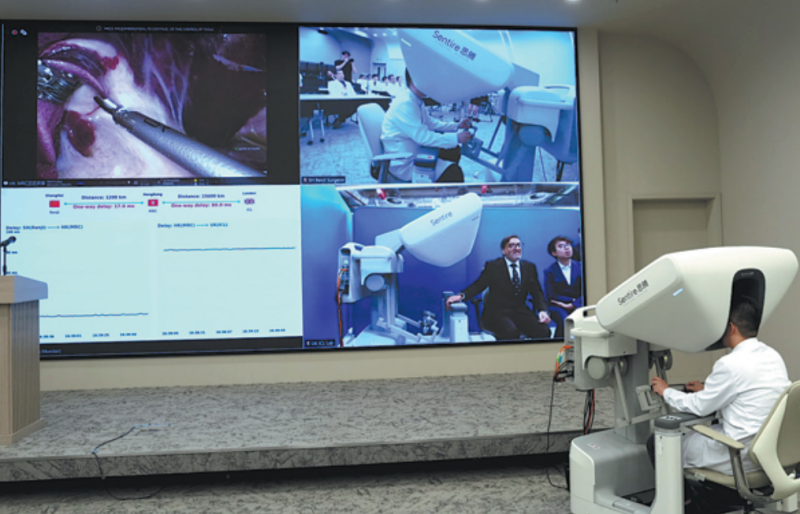
Zhang Zizhen, a gastrointestinal surgeon from Renji Hospital in Shanghai, conducts a remote operation through a robotic system on Thursday. CHINA DAILY
Three top surgical teams from China and the United Kingdom came together to conduct a remote robotic surgery spanning across continents on Thursday, with the medical teams saying it was like they were in the same operating theater.
Led by Shanghai Renji Hospital, in collaboration with the Chinese University of Hong Kong's Faculty of Medicine and London's Royal Marsden Hospital, the multisite coordinated surgery took place simultaneously in Shanghai, Hong Kong and London.
The experimental operation was performed on a pig in Hong Kong, and the doctors performed a relay laparoscopic robotic gastrectomy on it, using a domestically made remote platform of surgical robots.
Doctors from Renji Hospital, which is affiliated with Shanghai Jiao Tong University School of Medicine, said that the successful completion of the surgery not only validated the stability, precision and adaptability in multiple places of Chinese surgical robotic technology in remote clinical applications, but also demonstrated the potential for establishing highly efficient collaborative mechanisms across different countries and regions.
Zhang Zizhen, director of the gastrointestinal surgery department at Renji Hospital, was the first to connect to the surgical robotic system for remote operation. He completed the dissection and exposure of the gastroesophageal junction area smoothly, saying that the image quality of the system was clear and precise.
Subsequently, control of the surgery was transferred to the London team. Asif Chaudry, chief expert of upper gastrointestinal surgery at the hospital, maneuvered the robotic system to separate the stomach from the colon, pancreas and spleen, exposing the blood supplying arteries of the major organs in the upper abdominal cavity, and meticulously clearing the lymph nodes in the area.
Throughout the operation, he maintained real-time communication with experts in Shanghai and Hong Kong via voice conversation, praising the instant response of the surgical operating system, and saying that "it was as if he were right beside the 'patient'".
At the Hong Kong site, doctors were responsible for monitoring and system support throughout the surgery, ensuring the smooth operation of the system and providing clinical support to the surgical teams at the other two locations.
Lasting approximately one hour, the surgery was said by the teams to feature clear image transmission, smooth command responses and seamless transitions of control among the three surgical teams, showcasing a tightly coordinated surgical process. Also, the surgical perspectives and anatomical views for the doctors at different locations were highly consistent, guaranteeing the continuity and safety of the surgery.
"Such a multisite collaborative practice across regions and time zones reflects the path of promoting the cross-regional flow of high-quality medical resources through technical means, and provides a feasible reference for the future realization of the telemedicine model, in which patients don't need to move, experts are online, and resource are shared," said Wang Zheng, vice-president of Shanghai Renji Hospital.
The hospital will work with experts from all over the world to jointly explore new paths for the development and collaboration of telemedicine technology, providing practical samples for the systematic development of smart medicine in China, and bringing more advanced and high-quality medical services to patients, he said.
Chaudry emphasized that interdisciplinary scientific research and digital innovation are continuously reshaping the future of global cancer treatment and care.
"The fusion of clinical leadership, robotic technology and translational medical research enabled the teams to transcend national boundaries, operating as a unified surgical team. This means that regardless of where patients are located on Earth, they will be able to receive professional and personalized treatment plans," he said.
Major hospitals in China have accumulated experience in remote surgery. Using domestically made 5G surgical robots, doctors at Shanghai Chest Hospital performed remote lung cancer surgery on a patient in Kashgar prefecture, Xinjiang Uygur autonomous region, which is 5,000 kilometers away, in July last year.
The administrator of this group reserves the right, along with the site moderators, to moderate all and any postings to this group, including the right to enforce the ToS, the CoC, and also including anything that the administrator deems within his sole discretion to be offensive, including but not limited to political and/or off topic comments, with the power to delete in exercising that right.
It would be best, therefore, to be civil in posting on this group and not contravene the CoC, the ToS, and to not post comments that are political, insulting, taunting, trolling or offensive.
By now it should be well known that I am unable to open certain sources, videos and pictures. If I cannot, I will ask that they be described and explained. If the poster refuses to comply, their comment will be deleted. Instagrams are banned.

Tags
Who is online
92 visitors
Many decades ago a top Russian scientist suffered a serious brain injury, and the Russian government contacted the Canadian government, requesting the services of the world's most renowned brain surgeon, Canadian Dr. Wilder Penfield. Here is the story from TIME Magazine.
I recall that story as if it were yesterday. Dr. Penfield was flown with his regular assistant and needed equipment to England, where a Russian jet was waiting for him with Russian doctors on board with Xrays and test results to review the case on the way to Moscow. What I don't remember was the result of his surgery, but the TIME article, which I'm unable to open, will indicate it.
The reason I posted that story is that soon, hopefully, the remote technique explained by the article above will be developed and become available world wide so that having to ship expert surgeons around, and the time wasted by doing so, will no longer be required. Hopefully we are on the way for surgery by the world's top surgeons will be available immediately when needed no matter where in the world the patient is located.
Just googled it...
Lev never recovered despite intensive medical care his recovery was incomplete and he died 6 years later ...
Thanks folr filling me in. I believe he was too far gone for recovery, even with Dr. Penfield's help.
More proof of the world-leading excellence of American medicine.
Oh, wait...
Not going to catch up with present methods.
Falling ever further behind.
French universities, including Centres Hospitaliers Universitaires - university hospitals - are actively recruiting from American universities.
I worry about my son and grandchildren who live in Milwuakee. He has an excellent position there so he will not be looking for something similar in his home country. His wife and kids are American born and he has double citizenship.
For the time being, I have no knowledge of ICE preventing people from leaving the States.
The problem would be when he's at the border after visiting his mother and sister in Toronto.
It's terrible to think that today anyone with double nationality must be ready to be refused re-entry. My son... Myself...
Neil Young would have reason to be concerned - he's been pretty vocal about Trump.
Good "example"...