
Walk in the mists of time

By: Yang Yang

 S E E D E D C O N T E N T

Walk in the mists of time

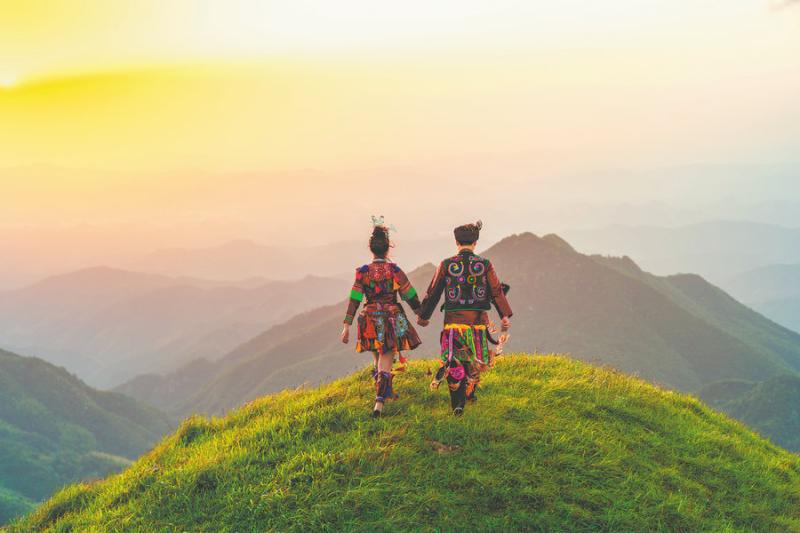
The western region of Hunan province is known for its diverse ethnic cultures. [Photo provided to China Daily]
Ancient towns showcase how life takes on a whole new meaning, Yang Yang reports in Fenghuang, Hunan.
My fascination with Xiangxi, the western region of Hunan province in Central China, was first sparked more than 15 years ago by a friend's vivid account of her visit to Fenghuang ancient town.
She painted a picture of a damp guesthouse nestled in riverside stilted buildings, creaky wooden floorboards underfoot, ethereal morning mist hovering over the Tuojiang River, and the stepping stones crossing the river — all as enchanting as the scenes depicted in the works of Chinese modernist writer Shen Congwen (1902-88). After all, Fenghuang, meaning "phoenix", is the hometown of this beloved author.
During these sweltering summer days, Xiangxi is oppressively hot. At noon, the sun scorches the land, its intensity amplified by high humidity. Even the slightest movement causes sweat to spring and drip, leaving one feeling sticky all over.
Yet, as I entered the ancient town's gate and descended a few steps, I was greeted by a view that perfectly matched my imagination.
The Tuojiang River, a clear greenish expanse, is much wider and faster-flowing than I had envisioned. Tiers of brownish-gray buildings line the riverside, and dark-blue mountains loom in the distance. People traverse the river on stepping stones, near a slender wooden bridge.
Captivated by this refreshing scene, I immediately fell in love with the town.
After exploring the former residences of Xiong Xiling (1870-1937), a prominent statesman, educator and philanthropist in modern Chinese history, and Shen, along with other famous attractions, my colleague and I embarked on a boat journey across the Tuojiang River, passing through the town's signature bridges.

Stilted houses in Fenghuang. [Photo by Yang Yang/China Daily]
Boating on the river is an essential experience for visitors to Fenghuang.
Starting from the wharf near the ancient town's north gate, we sailed southeast along the river. My colleague noted that many of the old stilted buildings, originally supported by numerous wooden pillars over the river, have been reinforced with rocks and concrete, rendering the wooden pillars obsolete.
As our boat approached the 600-year-old Hongqiao Bridge, I saw the long pillars standing in the water, supporting the few remaining authentic stilted buildings. These are the structures that have made the ancient town famous, described by Shen as "delicate stilted houses standing on slender, spindly legs".
The iconic Hongqiao Bridge, or Rainbow Bridge, was originally built during the Ming Dynasty (1368-1644) for auspicious purposes. It seamlessly blends function and beauty with its sturdy stone arches below and a two-story wooden pavilion above. Situated in the heart of Fenghuang, it offers convenient access to the town's attractions.
Our boat then glided under Fengqiao Bridge, or Wind Bridge, designed and funded by the renowned artist Huang Yongyu (1924-2023). This bridge, along with three others poetically named Rain, Snow and Fog, adds to the town's charm. The slender, flat Fengqiao Bridge features three pavilions in the middle and two decorated archways at its ends, showcasing Huang's artistic vision.
We then turned back and docked at the South Wharf, beside the seven-story Wanming Pagoda, and made our way to the Wanshou Palace, which also serves as the Huang Yongyu Art Museum.
A guide was regaling a group of tourists from Taiwan with stories about Huang, who passed away in 2023 at the age of 99. "A playful old soul, he drove a red Ferrari at the age of 93," the guide said. The crowd responded with a collective "wow".

Dong people celebrate festivals with lusheng (a reed-pipe wind instrument) shows in Tongdao Dong autonomous county in Huaihua, Hunan province. Songs and dances are important aspects of their daily lives. [Photo provided to China Daily]
After dinner, we headed to the Nanhua Bridge to await the moment when the ancient town's night lights would illuminate. Perched at a higher vantage point, it offers the best view of the entire town. Nearby, at the Snow Bridge, many others were also gathered, anticipating the lights.
My colleague mentioned that rain was imminent, but I insisted it wouldn't bother me. Just minutes after she left, the skies opened up. Holding an umbrella proved futile against the downpour. Suddenly, everyone scattered around the bridge converged under the pavilion in its center.
To my left, a man was livestreaming the night view of the ancient town. "Wait, the No 7 light is about to come on. No, it's not sleeting; it's the raindrops battering my umbrella," he narrated to his online audience.
As waves of cool rain poured down, drenching my clothes and hammering my umbrella, I couldn't help but let out screams. At 7:10 pm, when the lights finally flickered on, the ancient town, shrouded in heavy rain, appeared especially serene. Concerned about the possibility of flooding, I decided to wade through the shallow water back to my room.
I was spending the night at a guesthouse overlooking the river. In the evening, the bars across the water came alive with singers performing loudly. Most of the songs were popular hits from the early 2000s.

A local weaver of Miao ethnic group. [Photo by Yang Yang/China Daily]
After taking a shower, I sat on the balcony, singing along with the performers while enjoying the cool breeze and the enchanting night view of the town.
However, when my colleague suggested that I sing a song at an open-air karaoke in Furong ancient town, located in Yongshun county of the Xiangxi Tujia and Miao autonomous prefecture, I was too shy and declined.
Furong town, formerly known as Wangcun village, boasts a rich history spanning over 2,000 years. It served as the founding capital of the Tusi Kingdom of the Tujia ethnic group in the region, marking the origins of the 818-year history of the Tujia Tusi Dynasty.
As we crossed the brownish-black Tuwang Bridge (literally the Tusi King Bridge), we headed toward the temporary palaces of the Tusi kings. This bridge is a quintessential example of traditional Tujia architecture, featuring the distinctive "corner-turning tower "structure.
With elegantly upturned eaves and an imposing grandeur, the bridge embodies the dignity of royalty. Stone pillars at its ends are intricately carved with coiling dragons, symbolizing both authority and protection against evil spirits.
Descending the winding stairs through the temporary palaces, we arrived at the path beneath the town's signature landmark — the waterfall. Known as the "Millennium-old Town Perched on a Waterfall", the town is uniquely characterized by a waterfall cascading directly through it.
Walking behind the waterfall on a hot day is a delight. Glistening water curtains fall into the Youshui River, creating cool, humid breezes.
A one-hour boat journey downstream on the Youshui River will take you to another renowned geological attraction in Xiangxi — the Red Stone Forest National Geological Park in Guzhang county.

Furong town perched on a waterfall. [Photo by Yang Yang/China Daily]
Bordering the Youshui River, Furong town serves as a vital connection between Sichuan and Hubei provinces.
Since ancient times, it has thrived as a crucial commercial hub, where Tusi kings held significant events and convened meetings with other Tusi leaders.
From this town, rafts of golden nanmu, a precious mothproof wood, were transported to Beijing to construct the Forbidden City and the Ming Tombs.
In the past, businessmen would conduct their trade on horseback along the ancient Wuli Slab Street, a 2.5-kilometer stretch of stone-paved road, as a local guide explained.
In 1986, film director Xie Jin shot one of his acclaimed movies, Furong Town (or Hibiscus Town), featuring Liu Xiaoqing and Jiang Wen in the lead roles. In 2007, with tourism booming, Wangcun village was renamed Hibiscus town.
At the other end of Wuli Slab Street, I spotted a shop selling midoufu, a type of rice pudding, adorned with a poster of the movie Furong Town. In the film, Liu's character sold midoufu for a living just in this place.
The next morning, before setting off for another ancient town, I hurried to the shop to savor a delicious bowl of midoufu, along with a deep-fried rice cake and a deep-fried dough stick, which was immensely satisfying.

Intricately carved wooden window lattice in Liye. [Photo by Yang Yang/China Daily]
During the seven-day trip, in addition to visiting Fenghuang and Furong towns, I also explored other ancient towns in Xiangxi — Liye and Chadong.
In 2002, some 36,000 bamboo slips were discovered in Liye in the ruins dating back to the Qin Dynasty (221-206 BC), revealing insights into the Qin government's political system.
Chadong, a small town bordering provinces of Guizhou and Hunan, as well as Chongqing, inspired Shen's most famous novel, Biancheng (Border Town), a poignant love story that has touched millions.
At the entrance of a house where Shen once stayed in Chadong, many tourists sat at a table posing for photos. On the wooden wall behind the seat, a quote from Biancheng reads: "This person may never come back, or perhaps they will return tomorrow." It's the final sentence of the story.
My colleague asked me to sit down for a photo. "Judging by your smile, you'll be back soon," she said.
He Chun contributed to this story.
The administrator of this group reserves the right, along with the site moderators, to moderate all and any postings to this group, including the right to enforce the ToS, the CoC, and also including anything that the administrator deems within his sole discretion to be offensive or off topic, with the power to delete in exercising those rights.
It would be best, therefore, to be civil in posting on this group.
By now it should be well known that I am unable to open certain videos and pictures. If I cannot, I will ask that they be described and explained. If the poster refuses to comply, their comment will be deleted. Instagrams are banned.
Tags
Who is online
71 visitors
The author spoke of many bridges, but didn't show any. Here are some of them.
.
.
Wow!
Sounds like a fascinating place to visit!
Looks like I missed a great experience. But I'm not so sure I'd want to enter those stilted places.
I’ve seen pictures from around the world of places where people have to make incredibly steep climbs on narrow steps. (It seems a lot of them are monasteries especially in Asia.)
Also some dangerous looking climbs in parts of South America.
I like to travel but I have no desire to go to those risky places.
At times I enjoyed playing various sports, but mountain climbing was never one I wanted to try!!!
When I was in Hawaii December 1972 I did the most dangerous thing in my life, mostly out of not being aware of how dangerous it was. I climbed over the fence and went to the very edge of the Kīlauea volcano precipice. The smell of sulphur? was big, and looking down one could see flaming red fire between the floor patches. I didn't even think that the precipice I was standing on could have broken off and fallen with me to the volcano floor.
We took chances back there as well. Although the myth was that it was a danger to drive over the road between Mauna Kea and Mauna Loa (called "The Saddle Road") at midnght, we did it. I have never seen such a sky so bright with stars in my life. It makes it obvious why so many telecope observatories are located on Mauna Kea.
And I did the worst thing. I took home a piece of black lava rock not knowing that Pele puts a curse on anyone who does that. When I found out much later about the curse I threw the rock away into the reverse ravine behind our home. Then later still I found out that the curse could be reversed by returning the rock to the Big Island. I went looking for it, but it was gone. So maybe some of the bad things in my life that eventually led to my coming to China can be blamed on that, but China made a positive turn in my life.
However, there are glass-floored bridges in China, and I refuse to walk on them.
Nor have I climbed any mountains, save for those with steps. I while back I posted an article about Fen and me climbing the Sacred Buddha Mount Emei.
LINK -> Climb The Sacred Buddhist Mount Emei With Fen And Buzz - Buzz Of The Orient | The NewsTalkers
Cant resist this Buzz, you know the tom hanks movie , "joe vs the volcano"?
so we almost had a "Buzz vs the volcano ?
Side note as well, just read canadian first nations actor , graham greene , has passed away at 73 , famous for movies like , dances with wolves , thunderheart , and the tv show Longmire as just a short list of his credits .
Buzz vs the Volcano. LOL
Oh, I really am sorry to hear about Graham Greene. I enjoyed watching his work.