
Four of the Best Books on U.S. Political Assassinations

By: Mark Stricherz (TRUE WRITER BLOG)

 S E E D E D C O N T E N T

Four of the Best Books on U.S. Political Assassinations
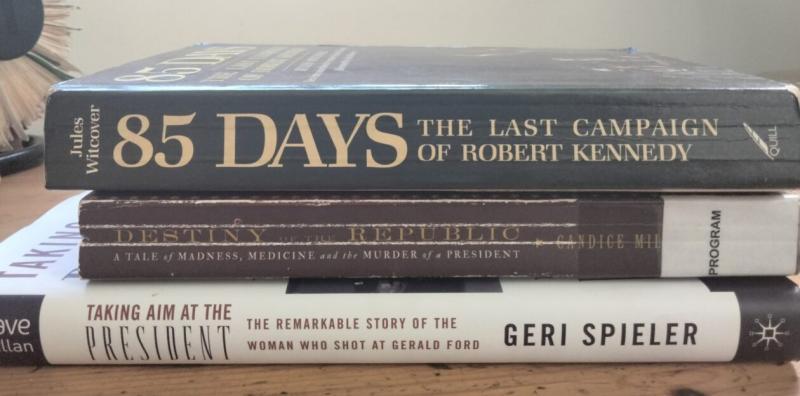
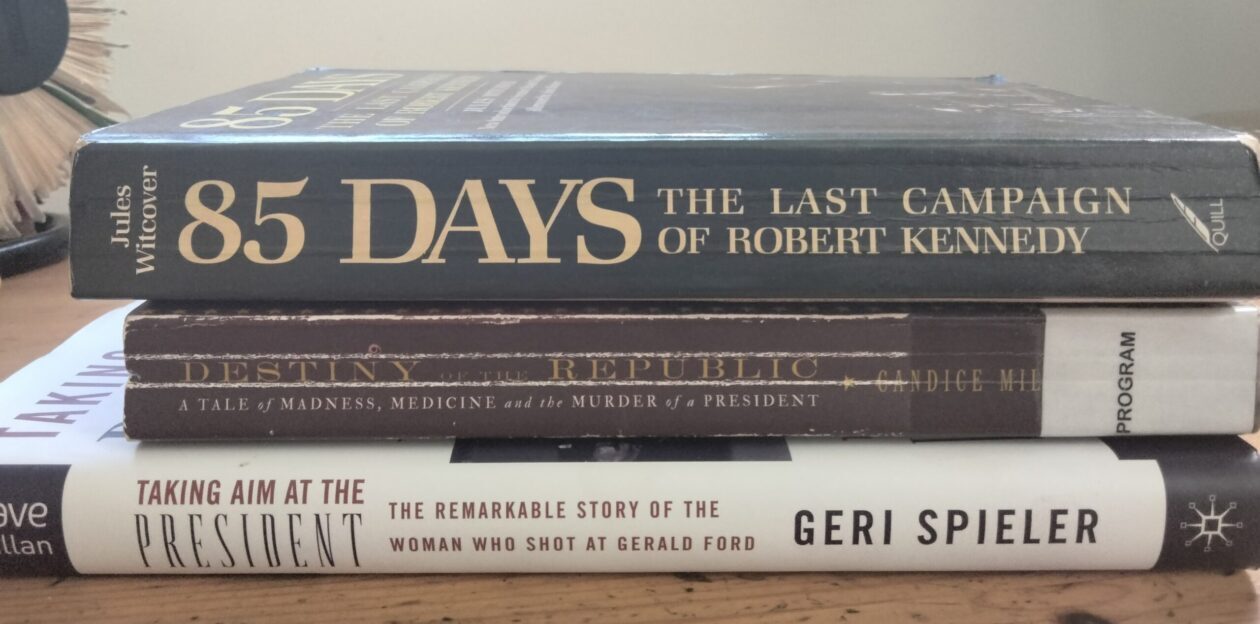
After former President Trump's near assassination, the author argues readers may want to dip into four books on high-profile political assassinations: Jules Witcover's "85 Days," Candace Millard's "Destiny of the Republic," Geri Spieler's "The Woman Who Tried to Kill President Ford," and Del Quentin Wilber's "Rawhide Down."
I am used to news about politicians being shot at. I grew up in the San Francisco Bay Area in the 1970s.
When I was six years old, at a conference in San Francisco an FBI agent declared my beloved home region to be the "Belfast of North America." He was referring to the nine-county area's many recent assassinations, assassination attempts, kidnappings, and bombings carried out at the behest of militant New Left radical groups like the Symbionese Liberation Army, the outfit that kidnapped heiress Patty Hearst, in their war against a repressive Establishment.
A year and a half later, my former congressman, Leo Ryan, was gunned down in Guyana, South America, while San Francisco Mayor George Moscone and City Supervisor Harvey Milk were shot dead at City Hall. (A weird fact: My sister Sarah was to be given the middle name of Jane when she was born in early 1976, but my parents thought better of it after they realized she would have had the same first name and the middle name of would-be Ford assassin Sara Jane Moore).
When I was ten, we fourth graders at Bancroft Elementary in Walnut Creek were called out of class to attend an impromptu school assembly after news broke that President Reagan had been shot. No one knew whether Reagan, the former two-term California governor, would live or die.
I don't recall us praying for President Reagan's recovery. However, I remember thinking we hoped he would recover. His death would have been demoralizing. Who wants to live in America where crazed assassins have more power than elected leaders?
Two generations of American schoolchildren have grown up without having to confront questions like this. That may have changed on Saturday night after former President Trump came within a few inches of being shot dead. (As he said later, "I'm not supposed to be here.") Who knows?
The following books don't take the country's pulse afterward. Rawhide Down and 85 Days describe not only the political leader but also provide background on the assassin or would-be assassin. Taking Aim at the President does the opposite: it focuses on the would-be assassin and gives only a little background about the politician, President Ford. Destiny of the Republic is a dual biography of President James Garfield and his killer, Charles J. Guiteau.
You can't blame the authors. Readers want to know about the dramatis personae—the assassins, the political leaders, and their circle of family, friends, and coworkers. It would be strange if the authors told the stories of some random schoolchildren!
In the meantime, you can get busy reading these four fascinating books.
Rawhide Down by Del Quentin Wilber
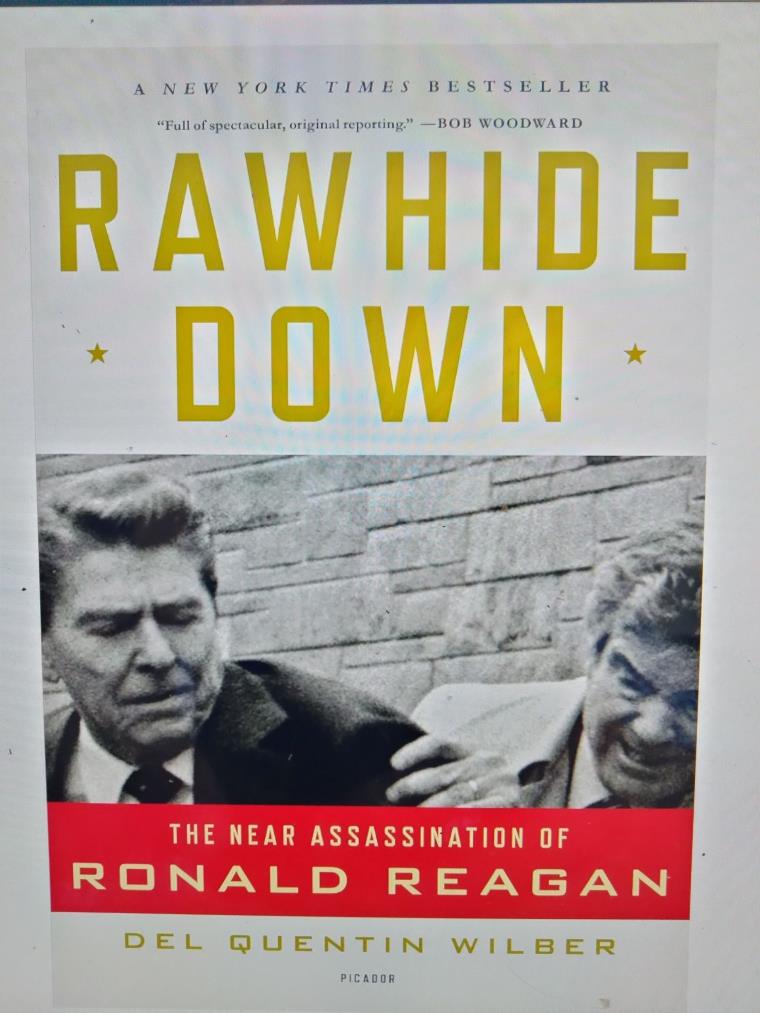
On the afternoon of Monday, March 30, 1981, President Ronald Reagan completed a speech before the AFL-CIO at the Washington Hilton in downtown Washington. Awaiting him was the presidential limousine. Behind a rope line, fifteen feet away, was John Hinckley, Jr.
Before President Reagan could step into the car, the 25-year-old Hinckley fired six shots. One bullet ricocheted off the limousine door and entered the president's left arm, where it broke a rib and punctured his lung.
The 70-year-old president, doctors believed, could have died. He was saved by two things. One was excellent health. The other was Secret Service Agent Jerry Parr, who made a split-second decision to take the wounded president to George Washington Hospital instead of the White House.
The story, incredibly, had not been told in book form until Rawhide Down . Washington Post reporter Del Quentin Wilber tells it masterfully. Based on more than 100 interviews, Mr. Wilber weaved accounts from the Secret Service Agents, especially Mr. Parr, who had not guarded Mr. Reagan before; the doctors who treated the president at George Washington University Hospital; the president's family and staff; and Hinckley himself.
This is the book that, to my mind, can be described as unputdownable. It's not only fast-paced but at 320 pages, slim. I find myself staying up late to finish reading a few more pages.
Taking Aim at the President by Geri Spieler
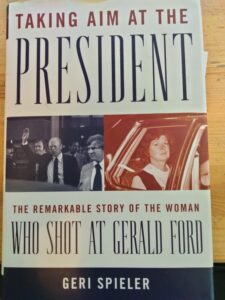
Of the assassins in the four books, Sara Jane Moore is one whose motives were political at least in part. She was a secretary in the People In Need food distribution program, a scheme the Symbionese Liberation Army cooked up in 1974 to bolster their public standing and finances after their heinous assassination of Oakland Superintendent Marcus Foster in November 1973. As I mentioned, the SLA was a New Left militant group that waged war against the Establishment in the 1970s. No one represented the Establishment more than the president and vice-president (Nelson Rockefeller), whose wealth drew Ms. Moore's ire.
To be sure, Ms. Moore was an unlikely assassin.
In September 1975, she was a housewife and the mother of four in Lafayette, California, an upscale community not too far from my family in Walnut Creek. Yet she was troubled mentally. At the age of sixteen, she disappeared for three days while growing up outside Charleston, West Virginia. When she was a young mother in Los Angeles, the newly divorced Ms. Moore put her young children unattended on a flight to West Virginia to be with her parents.
The story gets stranger still.
In 1974 and 1975, Ms. Moore was recruited by the FBI to infiltrate the United Prisoners Union, a radical group of ex-convicts. An FBI agent considered her dangerous, especially when President Ford returned to northern California on September 20, 1975.
San Francisco police arrested her for possessing a .44 Magnum. In addition, they attempted to check in with her FBI handler the very day she attempted to murder President Ford, who had been shot at seventeen days earlier in nearby Sacramento. Outside a side entrance to the St. Francis Hotel, she stood forty feet away from Ford as he waved to the crowd after giving a speech to a gathering of the World Affairs Council. She fired off two shots from her .38 Smith & Wesson revolver. Her first shot missed the president's head by six inches.
The bizarre story is told well in Ms. Spieler's book. While brief, it hints at the craziness of 1970s San Francisco and lays bare an even crazier person.
85 Days by Jules Witcover
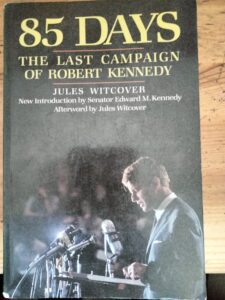
To my mind, the story of Senator Robert F. Kennedy's assassination in June 1968 is one of the saddest and most tragic of all.
He was the father of eleven children. He was forty-two. He drew worshipful crowds in big-city ghettoes and adulation in city streets. The Democratic Party was riven between its old guard and an insurgent new guard, and he seemed to be the one man (and they were all men in 1968) who could unify the party.
Instead, Senator Kennedy was shot dead after his greatest electoral triumph, winning the party's California presidential primary. Worse, one of the senator's doctors said if the .22 bullet from Sirhan Sirhan, a troubled Palestinian, had been one centimeter away from his brain, he would have survived and recovered within a few weeks.
Plenty of Kennedy biographies have been written, including several on his brief run for the presidency in 1968. Mr. Witcover's book is the most detailed and thorough. It captures the thinking of his closest aides, especially his de facto campaign manager Fred Dutton, wife Ethel, rival Eugene McCarthy, and the reporters who covered him.
Destiny of the Republic by Candice Millard
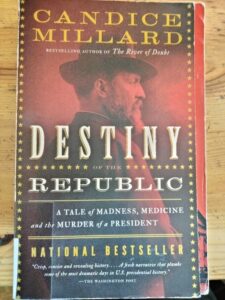
Another tragic story is the assassination of President James Garfield in 1881.
He was born in a log cabin in northeast Ohio, a supporter of racial integration, and a former major general for the Union Army during the Civil War. Less than four months into his presidency, he attempted to take a train near the Capitol to attend his reunion at Williams College in western Massachusetts. Waiting for him was Charles Guiteau, a thirty-nine-year-old office seeker who as Ms. Millard noted, was articulate, intelligent, and insane. He shot the president twice at point blank range.
That's the end of the story, right?
No, as former National Geographic reporter Millard shows.
The young president's doctors botched his recovery. A young Alexander Graham Bell sought to find the bullets in President Garfield's body with the modern equivalent of a metal detector. Garfield's doctors should have let Mr. Bell use the device without reservation. Instead, the doctors insisted he use it only one on side of his body, which turned out to be the wrong one.
Of the four books, Destiny of the Republic is the best written and memorably told. It makes you feel like you are alive in 1880s Washington.
~~~~~~~~~~~~~~~~~~~

I am a Pulitzer Prize-nominated reporter and writer in Washington, D.C. My stories and posts have appeared in many national magazines and newspapers. My book is Why the Democrats are Blue (2007). My friend Dan Kearns and I are working on a book, with the tentative title of "The Heroes of Jonestown."
The Code of Conduct and Terms of Service must be complied with.
Any comment posted about politics or religion not relevant to the seeds/articles that are posted will be deleted.
The administrator reserves the right to delete any comment he considers to be offensive, off topic or of no value.
Videos or images or links to sources that the Administrator cannot open must be described or explained when requested or they will be deleted.
Tags
Who is online
102 visitors
Are there no good books about Lincoln's assassination? And what about the assassination of JFK? It had the greatest effect on me of any American political assassination.
I'm afraid that all the books on the JFK assassination are conspiracy theories with the lone exception of Gerald Posner's "Case Closed: Lee Harvey Oswald and the Assassination of JFK."
On Lincoln there was "Chasing Lincoln's Killer" by James L. Swanson.
They say that when Lincoln was killed even people who once disliked him changed their attitudes after his death. That used to be true for all those public figures who were shot. It is not so now.
I can really understand how attitudes can change after an assassination. I have felt it myself.
I remember that one vividly. I haven't thought about it in years, but I remember that at the time there was a lot of speculation as to who was really behind it. (Prime suspects included the Mafia, the Cubans...and a few others I've forgotten).
Could it have been the powerful right wing extremely wealthy people?
There are so many theories. The latest being that a secret service agent in the following car had his rifle cocked when the shots rang out and fell back in his seat, accidently firing off the fatal head shot that killed Kennedy. The author of that theory explains that the fatal shot involved a bullet that explodes which is different than the first shots which were bullets that pass though rather than explode. He concludes that is why the secret service took possession of the President's brain (which contained the bullet/fragments) and never returned it.
Posner on the hand points out that Oswald had the job at the School Book Depository long before the Dallas trip was even planned and that Oswald was probably involved in a failed attempt on the life of a retired General months before.
And we all know how Oliver Stone felt. Unfortunately, his movie became documentary for some.
It is a conspiracy theorist wet dream.
The Kennedy assassination was an example of crime of opportunity. Lee Harvey Oswald worked at the book depository. He read a newspaper article that the Kennedy motorcade was going to pass right by the building where he was working , and put two and two together so to speak.
Oswald was not innocent, and was not a patsy. He had tremendous consciousness of guilt as demonstrated by his actions right after the shooting.
A reasonable assumption.
When I went to Dallas I went to Dealey Plaza, and it is a very small place. Oswald had time to set up his snipers nest as he wished and he was a competent marksman. There is no question he was capable of hitting Kennedy with bullets.
I can't argue that.
After all this time we have to put it to bed.
Never kniew about the Secret Service theory.
I was at home watching TV and saw Ruby shoot Oswald live.
I dont think I saw it live, I cant remember. But I did see it right afterwards the same day on the news.
I do remember I was a freshman in high school and an announcement was made that the president was shot and killed and school was canceled until further notice.
There are moments in your life that are so extreme you can remember where you were and what you were doing for the rest of your life. That is one of them, and 9/11 is another.
Sorry that I can't recall the name of the book. They made it into a very compelling documentary.
I believe the day JFK was shot was a Friday and I was in grade school taking a test, when one of the nuns told us the news and then told us to go back to the test.
On 9/11 I had a limo service. It was a very busy morning. I myself had delivered many people to Logan Airport. As the news came in, I went back to the office and began to look at where those customers were dropped off. I thought back to conversations I had with people on the way in. I know at least one woman was spared because she told me that she had changed her flight from LAX to a more convenient local airport closer to her home in CA.
It was just affter we had lunch and were gathering back in law school class in Toronto for the afternoon lectures when a classmate who was fairly big and bulky and had a kind of handlebar mustache took to the dias and announced to the class that JFK had been shot. After classes I entered the subway station to go to where I was living, and heard the subway staff talking about it. When I got to where I was living, I got in my car and drove back to my parents' home in Hamilton (40 miles away) where I sat in front of the TV for the whole weekend - and saw live when it happened that Jack Ruby yelled something at Oswald who was walking with officers and shot him.
As for 9/11, I had just driven my wife to work and was heading back home, and listening to the car radio while driving north down the Mount Pleasant Avenue dip in Toronto when the news announcement about the 1st tower crash interrupted the program. I got home in time to turn on the TV and see the second tower crash.
Those situations are indelibly etched on my mind and memory.