
6 in 10 Canadians say they can never trust Americans the same way again

By: By Uday Rana - Canada's Global News
 S E E D E D C O N T E N T

6 in 10 Canadians say they can never trust Americans the same way again
'It looks to me, based on these data, that Canadians feel that their relationship with the United States has changed in a fundamental way,' said an Ipsos leader.

Canadians are not feeling the trust with their neighbours south of the border after months of U.S. President Donald Trump's tariffs against Canada, new polling by Ipsos conducted exclusively for Global News has showed.
Six in 10 Canadians (60 per cent) say they can never trust the Americans the same way ever again, the poll found.
"It looks to me, based on these data, that Canadians feel that their relationship with the United States has changed in a fundamental way," Ipsos Public Affairs CEO Darrell Bricker said.
"They're looking for Canada to create something that protects our own sovereignty within a North American context and make sure that we're able to survive on this part of the continent that we live on as an independent country."
In March, Trump imposed his first round of tariffs on Canada. This was followed by months of on-again-off-again tariffs, counter-tariffs and trade uncertainty between Canada and its biggest trading partner, along with repeated remarks by Trump about annexing Canada.
The Ipsos poll found that 71 per cent Canadians feel that these Canada-U.S. disputes will continue for several years and are not going to be resolved soon.
The poll also asked respondents whether they approve of Prime Minister Mark Carney's handling of the relationship with the U.S.
Around half (51 per cent) said they approve of the way Carney and the federal government are managing Canada - U.S. relations, while one-third (32 per cent) disapprove and 18 per cent are not sure.
This is in contrast to the 60 per cent of the respondents who said in June they had confidence in their political leaders to "manage" Trump.
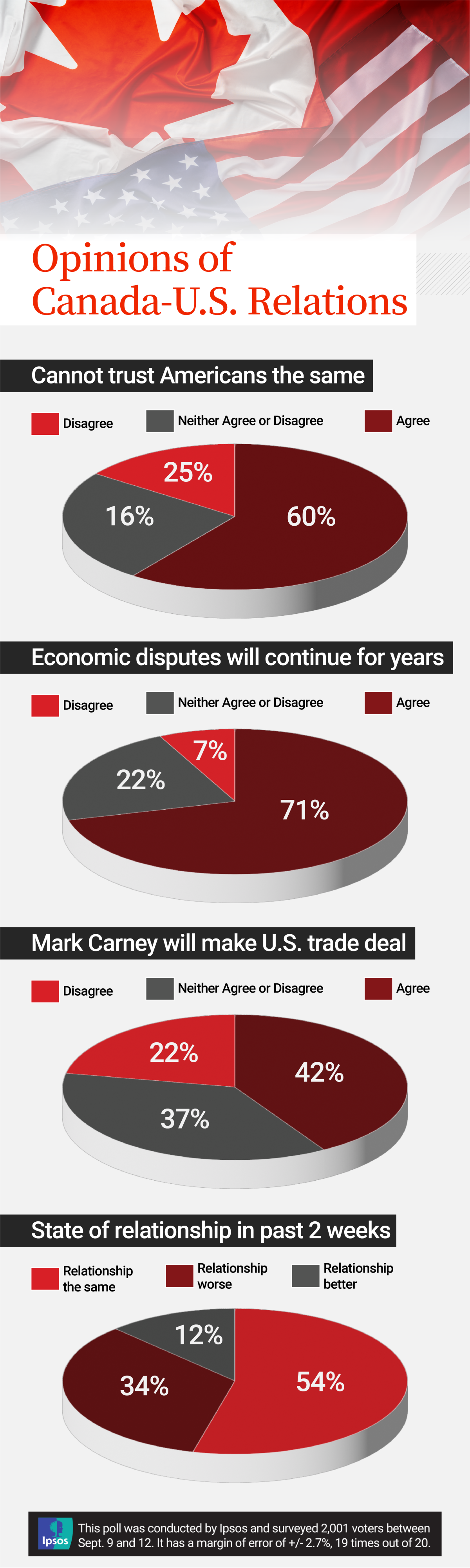
Thursday's poll found that 42 per cent of Canadians said they believe Carney will succeed in negotiating a new trade deal with the Trump administration.
Meanwhile, 22 per cent disagree and the remainder are undecided (37 per cent).
"During the course of the election campaign, the big commitment that the prime minister made was he was the person who would be able to deliver some sort of a deal with the United States that would get us through these tariff issues. But Canadians don't have a lot of confidence that that's actually going to happen, or at least anytime quick," Bricker said.
Bricker said the rise of the 'Buy Canadian' movement is going to present challenges to American brands operating in Canada.
"If you're an American brand in Canada these days you're going to have an interesting relationship with governments, but you're also going to have an interesting relationship with consumers and consumer citizens," he said.
The 'Buy Canadian' sentiment has held steady among Canadians. In June, a PwC poll showed that 75 per cent of Canadian consumers said they would pay more for premium or locally produced food products.
Canadians are also more reluctant to travel to the U.S. An Ipsos Poll conducted exclusively for Global News for Canada Day found around three-quarters of Canadians surveyed say they intend to avoid travel to the U.S.
Statistics Canada data also shows a decline in Canada-U.S. travel.
The negative perception among Canadians about the U.S. came with a renewed sense of patriotism for many, with nearly half of those surveyed in June (47 per cent) saying they are more likely to feel proud to be a Canadian than they were five years ago, up a whopping 31 points since last June.
Most Canadians believe that Canada's problems run deeper than Trump, with only 30 per cent saying that "when Trump goes away all of Canada's problems go away."
These are some of the findings of an Ipsos poll conducted between September 9 and 12, 2025 as part of our Trump, Tariffs, and Turmoil syndicated study. For this survey, a sample of n=2,001 Canadians aged 18+ was interviewed online, via the Ipsos I-Say panel and non-panel sources, and respondents earn a nominal incentive for their participation. Quotas and weighting were employed to balance demographics to ensure that the sample's composition reflects that of the adult population according to Census data and to provide results intended to approximate the sample universe. The precision of Ipsos polls which include non-probability sampling is measured using a credibility interval. In this case, the poll is accurate to within ± 2.7 percentage points, 19 times out of 20, had all Canadians been polled.
The administrator of this group reserves the right, along with the site moderators, to moderate all and any postings to this group, including the right to enforce the ToS, the CoC, and also including anything that the administrator deems within his sole discretion to be offensive, including and not limited to off topic or 'no value' comments, with the power to delete in exercising those rights.
It would be best, therefore, to be civil in posting on this group.
By now it should be well known that the administrator is unable to open certain sources, videos and pictures. If he cannot, he will ask that they be described and explained. If the poster refuses to comply, their comment will be deleted. Instagrams are banned.

 Article is LOCKED by moderator [Buzz of the Orient]
Tags
Who is online
84 visitors
Believe me, I am NOT at all happy about this turn of attitudes. I always enjoyed the USA and liked the people I met there, and over the years I spent a lot of time travelling all over the USA, attended many different kinds of festivals, even shared ownership of a Florida golf condo with my brother. What happened to sour it? You guessed it - TRUMP!!! Hopefully, when he is no longer in a position of authority, things will cool and attitudes will change to the friendliness, good-neighbourliness and co-operation that existed before he fucked it up.
I've only met a few Canadians, but the ones I met were all quite friendly. Really nice people.
I agree for the most part but they can be just as dandy as any ugly American. One example I can give you was in Little Cayman on a dive trip. One of our Dive Masters was Canadian. For clarification from Quebec area. He started singling out the Americans on the boat, make fun of people he was supposed to be taking care of. A real douche bag. Well after he thoroughly embarrassed himself and the rest of the crew I told the Captain the boat wasn’t leaving until they replaced that dickhead. Which they rapidly did. No way that prick was going to be in charge of caring for any of my people underwater.
Every nation has its douche bags. Canada isn’t immune to it
If the guy was a Quebecois, I can understand how you feel.
lol, I knew you would. That’s why I clarified what part of Canada he was from.
Those of us from Montreal feel the same about those from Toronto.
I was being specific. By using the word Quebecois I meant a French Canadian, not an English Quebecer.
As it is everywhere, most people are friendly.
As it is everywhere, most people are friendly.
I think you're right.
But I can think of one place where many (most?) people are not mostly friendly-- and that is on social media websites.
The ones who aren't friendly feel they are safe from bad repercussions because they cannot be personally identified. That is one of the evil things about those sites.
[deleted][✘]
[✘]
Once the trade issue is settled and Vance is President, I'm sure attitudes will change.
Trade relationships have been damaged in terms of trust. That trust was earned with decades of consistency. Trump has shown that the USA is capable of electing an irresponsible tyrant, and it will take decades to earn back that trust (if ever).
It is good to see that you tacitly admit that Trump has done damage and that a new PotUS would almost certainly be an improvement.
I doubt Vance will ever see the presidency unless he ascends to complete an unfinished Trump term. That is, I doubt he would be elected as PotUS.
The only trade issue is Trump imposed completely arbitrary, unfair and unnecessary tariffs on Canada. It could be settled today if he didn't purposefully want to destroy our relations with our closest allies.
If an evil, vile reactionary like Vance is elected President, I'm sure attitudes will change for the worse. He will undoubtedly give Canadians reasons to dislike the U.S. even more than Trump has.
While I agree in principle, I do not see anyone (including Vance) who would net be a worse PotUS than Trump.
When you listen carefully to what Vance has to say (and I'm not saying you don't) and realize who has promoted his political career (Peter Thiel, among others), I think it's fair to say that Vance could prove to be even worse than Trump, as awful as that is to contemplate.
And how will that be?
For example, do you thinking that then more Haitian immigrants will-- or will not-- be eating our cats and dogs?
You won't have that anymore.
A friend of mine just got home from a 2 week rail tour of Canada. She ordered a manhattan in a restaurant and was told that they are not serving bourbon. When she asked if they were out of bourbon they replied no, they just aren't serving American liquor anymore.
You mean she was not aware of the Canadian response of "Buy Canadian" and the removal of American liquor from the shelves caused by Trump's unjust and unfair tariff war and insulting 51st state threats?
That's exactly what I mean Buzz.
Okay.
All that stuff tastes the same to me... isn't Crown Royal Canadian?
I had seen a new story with a photo of shelves in a Canadian grocery store. The items all had (very conspicuous) tags on then saying "Made in Canada".
Apparently many Canadians now carefully check items they want to buy to see if they are made in Canada.
Personally I will trust american individuals based on their behaiviour and will continue to distrust leadership based on their behaiviour
And yes behaiviour is spelled with a "u"
LOL. "U" betcha.
And of course its spelled with an "ai" as well!
LOL. Now let's not embarass anyone.
I just returned from Toronto. Every Canadian I encountered was nice as hell. I expected less based on all the articles like this I see, but could not have been more impressed with the experience. Not a one of them mentioned the total douchebag who is running our country into the ground.
I'm sure you were nice to them as well. It could have been different if you were being an asshole. Those who say they were mistreated probably caused it by themselves (and I'm thinking of someone specifically).
Why are Canadians upset? American consumers are paying the tariffs, Canadian aren't. American businesses are having to absorb the tariffs or pass them on to consumers. We've been told repeatedly that Trump's tariffs are only harming the people of the United States. So, why are Canadians upset?
Tariffs dissuade consumers from buying imported products. But beyond that, Trump has been a total asshole to Canada. What response would you expect from the Canadians?
Goods and services that we must import (when no other viable choice exists) result in higher prices for US consumers. Goods & services that are not necessary will see a decline in purchases (which of course irritates the tariffed nation).
That is a dishonest misrepresentation, and you know it. The information provided (as if you did not know) is that tariffs ultimately are a consumption tax on USA consumers. There is no claim that tariffs only harm US consumers.
The proper use of tariffs is to temporarily reduce imports, helping a strategic domestic industry gain competitive strength. Traditionally, tariffs have been well-defined (not whimsical) and have had a clearly apparent purpose.
Trump is abusing tariffs ... and doing so stupidly. All he is doing is raising domestic prices and souring international relationships. He is an incompetent, dangerous buffoon.
How does that affect Canadian consumers? Why would Canadians be upset over a tax they don't pay?
Then who else is harmed by Trump's tariffs? Canadian consumers don't pay that consumption tax. Canadian businesses don't pay the tariffs. It appears that Canadians are upset with losing uncompetitive access to the American market. Canadians are upset that they might be required to compete with US domestic manufacturers. How much market security and economic resilience should the United States sacrifice to satisfy Canadian profits?
So, which domestic industry is not strategic? Don't ignore the lessons learned during the pandemic.
Imposing corporate taxes on domestic manufacturers provides an unearned advantage for foreign manufacturers and imports. Prior administrations also abused taxes to raise domestic prices and deliberately give an advantage to imports. Trump may be raising domestic prices with taxes but the difference is those taxes are giving an advantage to domestic manufacturing.
Taxes on imported goods is producing revenue for the government. That's no different than taxes on domestic manufacturing. All taxes on business and goods are passed on to consumers. Should government policy be focused on using taxes to give an advantage to foreign manufacturers or domestic manufacturers?
Trump is using taxes to provide an advantage to domestic manufacturing and production. Why is that stupid?
It affects Canadian businesses who lose part of their market which affects the Canadian economy which affects all Canadians. This should be obvious.
Again with questions whose answers are obvious. Instead of posting such questions, go directly to a Google or AI source. Here is what ChatGPT offers:
The better question is which industries are considered strategic to the USA.
Now you are off on a different topic.
Trump was elected primarily to address the economy and since the only problems with the economy he inherited were high interest rates and high prices, his focus was expected to be on lower consumer prices (little he can do to lower interest rates). His actions did the opposite. His actions are stupid. Focus.
Which I did point out. More precisely the tariffs impact Canadian businesses profit margins. Without tariffs in place, Canadian businesses can maximize profit by slightly undercutting prices of domestic producers. With tariffs in place, Canadian businesses cannot undercut domestic prices so easily so must either take less profit or abandon the market.
Strategic industries in the US are crucial for national security, economic competitiveness, and technological advancement. As an example, Transportation related manufacturing (including automobiles) is a strategic manufacturing sector for the US. Energy production is a strategic industrial and manufacturing sector for the US.
How are business taxes a different topic? Government utilizes business taxes as incentives and disincentives. Tariffs are a tax incentive for more domestic manufacturing. Corporate taxes are a disincentive for more domestic manufacturing.
Trump was elected primarily to put America First. That means Trump was supposed to address other nations taking advantage of the US. Trump can be accused of having too much faith in American investors and businesses. But that would make Trump gullible, not stupid.
Trump stupidly imposed tariffs which raise consumer prices and did so in a manner that damaged international relationships.
What drives people to try (absurdly) to defend this buffoon?
Trump being a buffoon doesn't make the tariff policy wrong. A buffoon that pursues appropriate policy is still a better choice than a rock star celebrity that pursues damaging policy.
Why should the United States give up competitiveness, economic resilience, and jobs just to avoid offending Canadians?
No shit, Nerm. What makes his tariff policy wrong is what I have outlined in my posts.
A ridiculous false choice.
Let's not forget that insulting 51st state shit he continues with. Let's not forget that other than America's demand for Canadian fossile fuels and lumber, the American deficit in its trade with Canada becomes an American trade surplus, and what about the services sector wherein America enjoys a hefty surplus which helps to balance the differential?, America DESERVES the retaliation. The fentanyl excuse, when it was only 1% of what crossed America's southern border, when NO border can possibly be 100% effective was a ridiculous excuse. The Canadian people are intelligent enough to understand those things (in my opinon because of superior public education), so the response from the people is understandable.
On our Southern border, the flow of Fentanyl is from Mexico into the U.S.
From everything I've read its the opposite on our Northern border. Most of the flow of Fentanyl there is from the U.S. going into Canada.
Think of it this way: if you were trying to smuggle Mexican Fentanyl into the U.S.-- why would you first go all the way up North to first smuggle it into Canada-- and then try to smuggle a second time by going South to the US?
Much easier to smuggle it dierectly into the U.S.
By boat (directly from Mexico to the U.S.) And I believe some is also smuggled by small airplanes directly from Mexico to the U.S.
In addition to that...apparently overall smuggling of Fentanyl into the U.S. has been declining significantly:
Well, then, let's make the USA the 11th province.
Lol absolutely not. I for one don't want to have to deal with all that silliness
You're very good at minimizing.
Lol, it's a gift
Its really quite simple.
For many products, Americans have several choices of what to buy. If, because of tariffs Candian products become more expensive, many Americans will buy less Canadian products (which are now more expensive then they used to be).
This will hurt many Canadian businesses (due to lower sales... because of the tariff caused higher prices).
Its really not all that complicated . . .
Yes, it is. If Canada undercuts prices because of lower taxes and less stringent regulations, business and jobs will move from the United States to Canada. As you point out, it is all about the money.
What is not complicated is acknowledging that the United States is being harmed. The US needs those businesses, profits, and jobs for tax revenue. The US has out of control government deficits. The US taxing its own businesses would work like tariffs on our own economy; people would buy more imports because imports are taxed less and priced lower.
Under free trade policy, the competition is not about quantity or quality of goods. It's a competition between governments over tax rates, regulatory costs, currency exchange rates, monetary controls, and labor requirements. Since the government plays an oversized role in domestic competitiveness with imports then it is appropriate for the government to use tariffs to equalize costs for imports to match costs for domestic business.
Reducing the deficits will require either cutting government services or raising taxes. If the people of the US want those government services then tax revenue is needed. The government raising taxes to pay for those wanted services will raise prices for consumers. That is unavoidable. But the necessary taxes should not cause businesses to close and eliminate jobs. That won't increase the needed government revenue.
Never having studied political economy, this is all getting a liittle over my head.
Let's walk through one example of how this works. (I haven't looked up the actual numbers. The chosen figures are just for illustration and not a real world analysis.)
For our example there is a Canadian enterprise, ACME Widgets, whose primary business is producing something that is exported to the US. The Canadian government can impose a tax on ACME Widgets to pay for services provided the Canadian people. But ACME Widgets will pass that tax cost on to consumers which, in this case, are located in the US. So, US consumers are providing the revenue for the Canadian government when they buy the Canadian produced goods.
Essentially US consumers are providing the revenue the Canadian government needs to deliver services to the Canadian people.
Now lets say the Canadian government taxes business 15% while the US government taxes business 30%. Who would have a natural price advantage based on the difference in tax rates? The taxes will be passed through to consumers. The Canadian government can maintain a price advantage for ACME Widgets' exports by adjusting tax rates to be lower than US tax rates. That means the Canadian government would capture revenue from consumption of the goods but the US government won't.
The result is that the Canadian government is taxing US consumers and using Canadian enterprises to serve as tax collectors. See how Free Trade can place the US at an unfair disadvantage?
I think it's time to lock this article since it's SUPPOSED to be about Canadians loss of trust in America, but seems to be drifting into political economy.
So, why does the seed focus attention on tariffs, trade deals, and political economics? It seems Canadians expect economic disputes to continue which is what the article suggests is the cause of the loss of trust.
The topic of discussion, as presented in the seeded article, is political economics.
You're right, tariffs are a major factor with respect to ending the decades-long trust that existed on these two neighbours. On the basis that the article discusses tariffs more so than the level of trust, and suggesting that the explanation of the tariffs should indicate that Canadians are misguided in their understanding of their effect, is not the reason I posted the article to begin with. Since the discussion has taken this direction, and seems to be a sufficient explanation posted by you there is no purpose in continuing it, and I have an even better one to post about the negative effect for the USA that the H-1B visa change will have for the USA so that you can argue economic reasons why it will be a benefit rather than a detriment for America.
While the title indicates generic Americans en mass are not trusted, I think that the American Political Establishment might be a better place to place their distrust.