
One Hundred Years of Fortitude

By: By WANG KAIHAO

 S E E D E D C O N T E N T

One Hundred Years of Fortitude

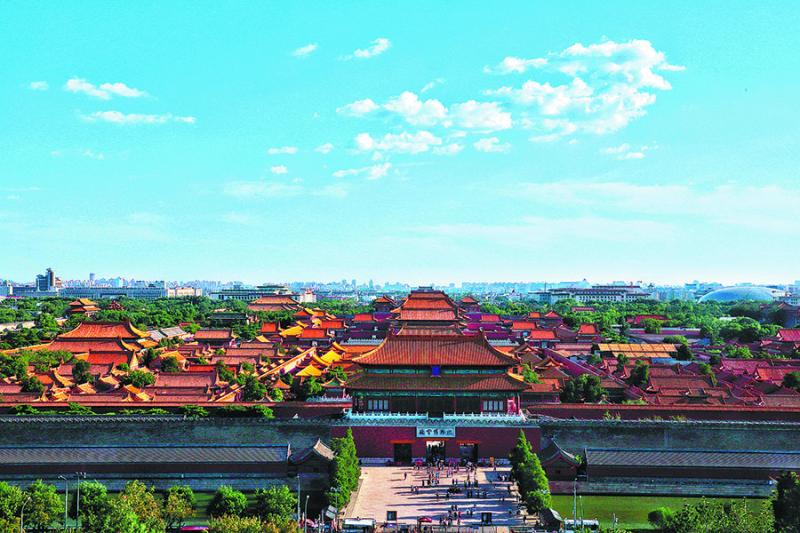
A panorama of the Palace Museum seen from Jingshan Hill in 1956. [Photo provided to China Daily]
From Imperial decline and wartime peril to global recognition and digital innovation, the Palace Museum's story is one of resilience, devotion and cultural brilliance.
It was Nov 5, 1924. The last emperor of China, Puyi, was suddenly driven out of the Forbidden City by a warlord, when the country suffered from a lasting and deep social crisis.
More than 12 years after the monarchy fell, Puyi, who was allowed to keep his royal title within the compound surrounded by red walls — the inner court of the Forbidden City — and, in fact, had never left — finally bid farewell to this enclave of a long-gone imperial era.
For this mighty architectural complex, which dates back to 1420 and spans over 720,000 square meters in the heart of the ancient city of Beijing, a new epoch had come.
The Palace Museum was established the following October: The city was no longer "forbidden". A curtain was lifted on a century-long story of perseverance, diligence and dedication to safeguarding history.
In 1933, Japanese invaders had arrived at the foot of the Great Wall. As war loomed over Beijing, a massive rescue mission was launched to relocate more than 13,000 boxes of precious cultural relics from the Palace Museum southwards, and later westwards, to protect them from destruction.
None of the treasures were destroyed in the yearslong trek across half of China, which was a miracle. Yet, many large pieces had to remain behind. The most significant "relic" of all — the breathtaking Forbidden City itself — could never be moved.
During the years when Beijing fell into enemy hands, the museum's custodians undertook an unprecedented surveying and mapping of the palace complex, a pinnacle of ancient Chinese construction. At the very least, they hoped to leave references for future generations, should this cultural wonder disappear in war.

The view seen from the same location in 2024. [PHOTO BY JIANG DONG/CHINA DAILY]
The museum seemed blessed. Against all odds, it survived, remaining through hardship and upheavals, until it finally embraced the dawn of new times.
Since 1949, the year when New China was founded, comprehensive inventories, studies, and the restoration of its collections have continued. Renovation of ancient architecture breathed new life into these buildings, which also hosted milestone exhibitions one after another. Over the decades, more than 280,000 cultural relics were added to the inventory of the former royal collections, through purchases, donations and transfers. Today, the Palace Museum holds more than 1.95 million items, according to statistics released this month — the largest collection of any museum in China.
These include paintings, calligraphic works, jades, bronze wares, gold and silver wares, enamels, embroideries, and countless other treasures. Here, it is a microcosm of an over 5,000-year-old Chinese civilization, aged yet robust.
The Palace Museum was inscribed onto the UNESCO World Heritage List in 1987, one of the first entries from China. It has always been a gem of human civilization as well, and functioned as a key platform of cross-cultural exchange. Even in the 1930s, when the threat of war intensified, the museum still hosted monumental overseas exhibitions in London and Moscow, displaying the splendor of Chinese art and culture to the world.

Zuo Yuan stone from the Warring States Period (475-221 BC), which once endured the southwards evacuation, on display in July. [PHOTO BY JIANG DONG/CHINA DAILY]
In more recent years, international engagement has only deepened. Since 2012, the museum has organized more than 50 exhibitions of cultural relics from other countries and regions, and joined more than 20 overseas exhibitions.
Boundaries of the Forbidden City have been continuously "expanded". Over half of its inventory, or about 1 million relics, have been digitized, offering many possibilities for "exhibitions" online or in virtual spaces.
As the centennial anniversary of founding of the Palace Museum approaches, it is worthwhile to look back on its extraordinary journey and to nurture even greater expectations for this place of miracles.

Palace Museum staff pack cultural relics in 1933 to evacuate them southwards and protect them from imminent war. [Photo provided to China Daily]
.

A group of French guests view bronzeware on display in the Palace Museum in the 1950s. [Photo provided to China Daily]
.

Visitors at the exhibition Rejoicing in Woods and Springs: A Journey through Garden Cultures in China and the Wider World in April. [PHOTO BY JIANG DONG/CHINA DAILY]
.

The antique clock gallery of the Palace Museum in the 1930s. The museum houses over 1,500 mechanical clocks. [Photo provided to China Daily]
.

A restorer working on a timepiece on Sept 18. Most of the clocks come from the former royal inventory of the Qing Dynasty (1644-1911). [PHOTO BY JIANG DONG/CHINA DAILY]
.

A half-bitten apple and biscuits left in a room of the Forbidden City when the last emperor Puyi was driven out of the royal palace in 1924. [Photo provided to China Daily]

Staff fixing a wooden lattice in the Hall of Mental Cultivation (Yangxin Dian), former residence of the last eight Qing emperors, on Sept 18. [PHOTO BY JIANG DONG/CHINA DAILY]
.

[PHOTO BY JIANG DONG/CHINA DAILY]
The administrator of this group reserves the right, along with the site moderators, to moderate all and any postings to this group, including the right to enforce the ToS, the CoC, and also including anything that the administrator deems within his sole discretion to be offensive or off topic, with the power to delete in exercising those rights.
It would be best, therefore, to be civil in posting on this group.
By now it should be well known that I am unable to open certain videos and pictures. If I cannot, I will ask that they be described and explained. If the poster refuses to comply, their comment will be deleted. Instagrams are banned.
Tags
Who is online
71 visitors
It seems that potentates like to collect antique clocks. It was interesting for me to see the Antique Clock Gallery in the Palace Museum (a/k/a The Forbidden City) because when I was in Madrid half a century ago I toured the royal palace, and particularly remember the Antique Clock Room, especially since I was in it when the clock struck on the hour and the calamity of bells ringing was deafening.
Looking back on things, The Forbidden City was built in 1925. What I don't know is when the majority of those clocks were obtained in the first place. Clocks were rare and expensive in the early 1800's and didn't become commonplace until the early 1900's so it's possible that those clocks were collected by earlier emperors.
;Very interesting. Thanks for that information.