
The Best Movies Released During World War II

By: Taryn Flaherty (MovieWeb)

 S E E D E D C O N T E N T

The Best Movies Released During World War II

The 1930s and 1940s were unmistakably a terribly difficult time for both the United States and the rest of the world. Between the Great Depression and the Second World War, the world went through unspeakable tragedies. War brings out the worst in humanity and that was evident during the events of World War II. The war started just after the Great Depression ended in 1939 and lasted until September 1945. The world was put through six years of devastation and unnecessary loss of human life. People at home needed something to help them escape the harsh realities of the state of the world. Many people turned to the movies.
As with the Great Depression, there were actually a surprising amount of incredible movies that were made and released during WWII. For over a hundred years movies have been a source of comfort for people and a way to escape to a world that is outside their own, and that was more true than ever during the war. People needed to experience something that would excite them, thrill them, make them laugh, and make them feel something other than fear and worry. Many wonderful, enthralling movies were made during this time, so here are ten of the best movies released during World War II.
9. Gaslight (1944)

George Cukor's Gaslight was the film that won Swedish-American actress Ingrid Bergman her first of three Academy Awards. The film is set in the 1880s and follows a recently married woman who returns from Italy to her former London home ten years after hr aunt was murdered in the very same house. Her new husband takes a strange obsessive interest in the home, an interest so strong that it may drive her to a breaking point. As Paula (Bergman) begins to notice odd things occur around the house, such as missing pictures and gaslights that dim on their own, Gregory's intentions are questioned and Paula's sanity tested. It's one of Bergman's best performances and one of the most exciting thrillers of the '40s. It is also where the modern-day term "gaslighting" comes from.
8. Arsenic and Old Lace (1944)

Cary Grant is one of the Golden Age's favorite leading men, if not their favorite. Grant's charismatic personality and handsome good looks lead to people describing his presence as the "Cary Grant" persona. He is excellent in any genre of film, but he particularly excels in comedy. His comedy is always timed perfectly and both his facial expression and his body language conveys physical comedy like a trained comedian.
In Frank Capra's Arsenic and Old Lace , Grant plays a writer named Mortimer Brewster who is known for his dislike of marriage. When he does decide to finally get married, her brings his fiancee to his aunts' house to tell them the news. Much to his surprise, he discovers that his two single aunts have a disturbing hobby; killing lonely old men and hiding them in their basement. Everyone in Mortimer's family is completely off their rockers in the best way. The chaos that is constantly in his aunts' house stemming from them is already hilarious, but the chaos that ensues due to his cousin who believes he is Teddy Roosevelt is uproariously funny.
7. Suspicion (1941)

The beginning of the long-running partnership between auteur director Alfred Hitchcock and his devilishly handsome right-hand man Cary Grant started with his 1941 thriller Suspicion . This was one of the first film that showcased Grant's acting chops beyond comedy. The film-noir follows a shy young heiress named Lina (Joan Fontaine) after she marries a charming man named Johnnie Aysgarth (Grant). All is well in couple's paradise until Lina begins to suspect Johnnie is planning to murder her.
Hitchcock utilized Grant's natural comedic abilities to have Johnnie charm the audience while simultaneously using his dark eyes to convey the look of a potential murderer. Hitchcock desperately wanted the suave Grant to be the killer of his story, but the studios did not like the idea of their handsome gentleman star portraying the villain. Still, at the end of the film, as he drapes his arms around Lina, the audience is left to ponder whether Johnnie is a good guy or not.
6. Citizen Kane (1941)

Orson Welles' Citizen Kane is often regarded as one of the most important and influential films of all time. Welles' directorial debut is loosely based on the life of newspaper mogul William Randolph Hearst, which Hearst was famously against. The film starts after the death of newspaper tycoon Charles Foster Kane as reporters scramble to decipher the meaning of the millionaire's last word spoken, which was "rosebud". From then on, the events of Kane's life leading up to his death are shown through a series of flashbacks that detail his rise to success and his ultimate downfall. The story is told from the perspectives of four different people who were close to Kane, all giving their own version of the media mogul's life.
While it is considered one of the greatest movies of all time now and frequently included in lists of the best film ever made, it wasn't always that way. The movie was a box office flop and faded into obscurity despite nine Academy Award nominations, until the '50s when it was shown internationally and received praise from foreign critics. The unique structure and editing of the film were considered to be a huge accomplishment for its time, which has led to the declaration by many critics that it is one of the best films.
5. The Philadelphia Story (1940)

Serving as both one of James Stewart's earlier starring roles and the reunion of Cary Grant and Katharine Hepburn, The Philadelphia Story centers around Philadelphia socialites Tracy Lord (Hepburn) and C.K. Dexter (Grant) who impulsively married and just as quickly and passionately divorced. Two years later, Tracy is set to remarry an ordinary businessman at her family's mansion when two unexpected guests arrive; Macaulay "Mike" Connor (Stewart), a friend of her absent brother, and Dexter. Dexter is now a tabloid reporter looking to get the inside scoop on Tracy's new marriage, and Mike is a writer who agreed to write a story about the Lord family. In true rom-com fashion, a love triangle forms between the three, and shenanigans ensue the day before the wedding of the century. The pairing of Grant, Stewart, and Hepburn is genius and makes for a thoroughly entertaining and delightful story about love and gossip.
4. The Lady Eve (1941)

Preston Sturges' classic rom-com The Lady Eve is perhaps one of the best to be released during World War II. The film stars Golden Age icon Barbara Stanwyck as Jean Harrington, a con artist. Jean meets a wealthy but unsophisticated man named Charles Pike (Henry Fonda) on a cruise and the two fall in love. However, a miscommunication causes the couple to split on bad terms. To get back at him, Jean disguises herself as an English woman named Eve just to tease and irritate him. This is a perfect example of a screwball comedy at its best. Jean/Eve consistently outsmarts and outwits Charles as he stumbles around clueless to the rouse Jean has constructed. It's funny, charming, and endearing.
3. His Girl Friday (1940)

Cary Grant was truly Hollywood's favorite actor to cast in the '40s. In Howard Hawks' His Girl Friday , Grant plays Walter, the editor-in-chief of The Morning Post newspaper in New York. His star reporter Hildy (Rosalind Russell), who also happens to be his ex-wife, walks into his office to tell him she's quitting and boarding a train to Albany where she is getting remarried to an insurance agent named Bruce (Ralph Bellamy). Realizing that he doesn't want to lose Hildy as a reporter or a wife, Walter decides to do anything he can to persuade her to stay for good. From dangling a juicy story in her face to continuously painting Bruce in a bad light, Walter makes it his mission to prevent Hildy from getting on the train. Walter's desperation to keep Hildy in his life creates a completely chaotic environment in the newsroom that keeps a bustling atmosphere the entire time. The dialogue is whip-smart and quickly delivered.
2. Mildred Pierce (1945)

Michael Curtiz's film noir Mildred Pierce was released about a month and a half after World War II ended, but it was filmed during the war. Film noirs were extremely popular in the '40s, but it was somewhat rare to see a female-led story in the genre. The film revolves around the titular character, played expertly by Joan Crawford, who is a hard-working mother that makes personal sacrifices in order to support the wealthy lifestyle of her spoiled daughter Veda (Ann Blyth).
After divorcing her husband, Mildred opens up a successful restaurant to continue to uphold the ritzy lifestyle Veda has grown accustom to. No matter what her mother does for her or how much she sacrifices, it is never enough for Veda. She grows into a cold, calculating young woman who would figuratively (and probably literally) throw her mother under the bus if meant she could continue to live the life she believes she is owed. Veda is a horribly selfish character, and the film puts a daker spin on the mother-daughter relationship by emphasizing the intricate complexities of the power dynamic.
1. Casablanca (1942)

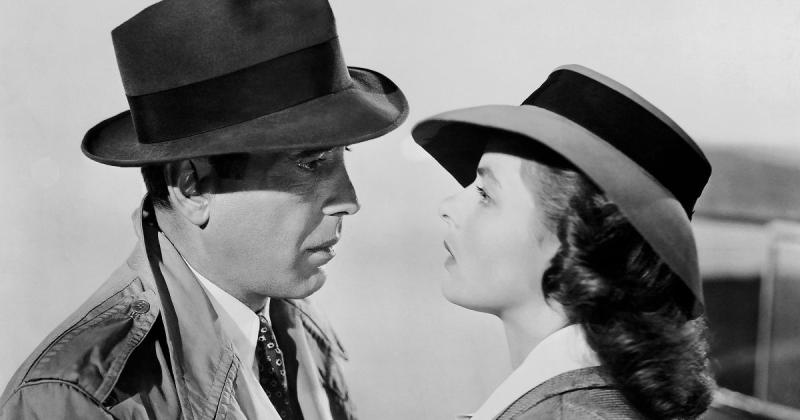
"Here's looking at you, kid" is quite possibly one of the most famous lines uttered in any movie in film history. Which is fitting, considering Casablanca is one of the most cherished pictures of all time. As the only movie on this list to directly tie into the war that was happening in real-life, Casablanca follows a cynical expatriate American cafe owner in Morocco as he deals with the war and reminisces about time spent with the love of his life. Rick's (Humphrey Bogart) life is turned completely upside down when his former love Ilsa (Ingrid Bergman) waltzes into his cafe seeking help to leave Morocco. Now, Rick must decide whether to help Ilsa and her fugitive husband escape the Nazis.
Part war drama, part whirlwind romance, Casablanca is perhaps one of the greatest movies of all time, and certainly the best to be released during WWII. Bogart and Bergman's chemistry is still palpable over 80 years later, as is the fear people felt during the war. It is a beautiful yet heartbreaking story of love and loss, but somehow it is also an oddly comforting film.

Discussion of politics and/or religion will be limited to the plots and themes of the movies or TV movies and series themselves and any religious comments or proselytizing or commentary concerning current politics not in reference to the movies or TV movies and series themselves will be deleted along with all CoC and ToS violations. As well, anything posted that the administer of this group deems to be offensive, off topic or of no value will be deleted. Videos and images that the administrator cannot open must be described in text or they will be deleted. Instagrams are not permitted.

Tags
Who is online
122 visitors
Any author who puts Casablanca as number one on a movie list is okay with me. But look at only SOME of the movies that were released during ONLY the year1939: Mr. Smith Goes to Washington, Four Feathers, Young Mr. LIncoln, Stagecoach, Wuthering Heights, Gunga Din, The Man in the Iron Mask, Ninotchka, The Hunchback of Notre Dame, Only Angels Have Wings, Beau Geste, Drums Along the Mohawk, Gone With the Wind, Goodbye Mr. Chips.
How could you leave out the Wizard of Oz. Yes, 1939 was a banner year for Hollywood and one could argue so was 1940. There are more movies I would add to the author's list. That was a time when the movies and those who acted in them were famous. Today I don't the public cares as much about it as they did then.
Oooops! I copied those movies from a list, and I saw and meant to post Wizard of Oz but accidentally skipped over it. Maybe the public doesn't care as much because most of the new movies are not up to par. So many movies are so dark you can't see what's happening, and the actors mumble or fly through their lines... That's why I've always preferred the classics.
That is true. Aside from the technological improvements (and technology always improves) the quality, with rare exceptions, has declined since the 70's.
There is something to say even for the failures of the early days when screen writing was in its infancy. For example: in 1941 there was a movie called "Dive Bomber." It was terribly written and features the legendary Errol Flynn. However, some of the filming took place on what was to become America's most decorated warship, the aircraft carrier Enterprise and the filming of that was memorable. (A side note is that Flynn did something to annoy Halsey to the point where Flynn was ordered off the Carrier.)
My point is that even the bad ones had some redeeming value.
That's why I've always preferred the classics.
They will always remain as true classics.
The writer looks like she is 25 years old. I hope she has seen all the movies she is recommending.
WWII is generally accepted as having begun on Sep1 1939 when Germany invaded Poland , so any of the 1939 movies named here that were released before Sep 1 would not be technically eligible for this list.
Here are a few that should have been considered to be on the list
The Grapes Of Wrath (for sure)
Yankee Doodle Dandy
Air Force
So Proudly We Hail
Laura
Double Indemnity
Meet Me In St Louis
It doesnt necessarily make it a great movie, but Going My Way won more Oscars (7) than any movie of the time period other than Gone With The Wind.
I'll let you get by for using the term "generally."
"The Sino-Japanese War (1937-1945) was one of the most destructive conflicts of World War II. It began with the Marco Polo Bridge Incident of July 7, 1937, and ended with Japan's surrender on September 2, 1945. This war marked the culmination of growing Japanese aggression toward China since an earlier Sino-Japanese War (1894-1895). With half of China ruined, 20 million Chinese (military and non-military) dead, and 480,000 Japanese soldiers killed on Chinese soil, the eight-year conflict was one of the bloodiest in world history."
Introduction - Sino-Japanese War of 1937-1945: A Resource Guide - Research Guides at Library of Congress
Here are a few that should have been considered to be on the list
I go along with those.
I think Sep 1st 1939 is generally used as the start of a world war. The Japanese Chinese war began as between just two nations although it eventually certainly became incorporated into the world war. The invasion of Poland immediately triggered the involvement of many nations.
That was the Second Sino-Japanese War. The first one started in 1894.
I think the Chinese consider that the Second Sino-Japaneee War, the War of Resistance started in 1933.
China announces change to history books. Second World War started in 1937
After The War | Chinese scholars call for ‘truthful’ WWII accounts, slam Western ‘historical nihilism’ | South China Morning Post
It was detrimental to Japan and a benefit to the allies during WW2 that China's resistance to the Japanese invasion kept Japanese solders tied up in China
LINK -> Military expert: more Japanese soldiers killed by China than by the US and Soviet Union - People's Daily Online
Absolutely!
It also did a few other things:
It gave the Imperial Japanese Navy the chance to tell the emperor that the army failed and thus they were given priority to conduct the rest of the war.
If I recall correctly, this mindset change really didn't happen until after the Doolittle raid. Before the raid the Army still was the lead in how to conduct the war. After the raid, the changes were returning more air groups to defend the Japanese islands thus weaking the Pacific as well as putting the Navy front and center in how to conduct the war in the Pacific.
Are you saying that it was a benefit or a detriment to the Allies?
Asking you the same question - Are you saying that it was a benefit or a detriment to the Allies? And it's 3'40 a.m. and I still can't sleep.
Sorry man, not being able to sleep really sucks. While I get up frequently anymore to visit the head, I'm very grateful that I've never had a time when I could not sleep.
As for the change in Japanese strategy after the Doolittle raid, I would say it definitely helped the Allies. It was a huge morale boost for the Allies first. It was also a huge shock to the Japanese who before the raid thought their islands were invulnerable to American attack. It was a huge embarrassment to the Japanese Navy which was responsible for defending the home islands. It was the push to set up expanding the Japanese frontlines in the Pacific which was started with the plans to attack and invade Midway. Add in the code breaking that occurred, the Americans knew what was happened and as we all know were able to ambush the Japanese fleet and sink four of their main carriers.
I don't know enough Chinese history to know how the aftereffects of the raid impacted them beyond the retribution the Japanese took on the Chinese. They killed around 250,000 Chinese civilians as I recall, I do not know how much Chinese military were killed. I don't know how the Chinese government handled the aftereffects and how they used it to strengthen their civilians and troops but I would imagine they did use it as best they could.
Overall, the Chinese part of WWII was a big part of the allies being successful overall. Had the Japanese had that 1.5 million troops available when they attacked Pearl Harbor, it is conceivable that they could have invaded California, and the war would have been much different.
Thanks for that explanation and your thoughts on that, Snuffy. I did get a better night last night - I actually slept in later, which was a really rare thing for me.
It primarily benefitted the allies.
That does make the most sense.
Chiang Kai-shek would probably agree, since it not only tied up much of the Japanese army but also weakened the Nationalist Chinese forces. Stalin supplied Mao's army even though he thought they wouldn't eventually win their revolution. Some historians argue that it was Stalin's aid that was the decisive factor in Mao's win over Chiang Kai-shek. I have already pointed out that when Japan apologized for the invasion after the war, Mao told them apologies were not necessary since the war with Japan helped the Communist cause. So, I guess Mao was the second beneficiary after the allies.
I thought Japan has NEVER apologized for its viciousness imposed on the Chiness people, including their forcing "comfort women".
Refusal to apologize for Nanjing is an unerasable stain on Japan
LINK -> Refusal to apologize for Nanjing is an unerasable stain on Japan - CGTN
Apologizing for going to war is all they did:
"In 1960, when Mao Zedong spoke to a Japanese literary delegation, he mentioned, "I spoke to many Japanese friends about this incident, and some of them said that it was not good for Japan to invade China. I said of course the invasion was bad, but we should not look at this bad side alone, on the other hand, Japan has done us a great favour in China. If Japan had not occupied half of China, the Chinese people would not have awakened. In this respect, we have to "thank" the Japanese Imperial Army ."
Mao Zedong thanking Japan controversy - Wikipedia
As to the war crimes the Japanese committed against the people of China & the Philippines and POWs, there was accountability:
"In Tokyo, Japan, Hideki Tojo, former Japanese premier and chief of the Kwantung Army, is executed along with six other top Japanese leaders for their war crimes during World War II . Seven of the defendants were also found guilty of committing crimes against humanity, especially in regard to their systematic genocide of the Chinese people.
On November 12, death sentences were imposed on Tojo and the six other principals, such as Iwane Matsui, who organized the Rape of Nanking, and Heitaro Kimura, who brutalized Allied prisoners of war. Sixteen others were sentenced to life imprisonment, and the remaining two of the original 25 defendants were sentenced to lesser terms in prison.
Unlike the Nuremberg trial of German war criminals, where there were four chief prosecutors representing Great Britain, France, the United States and the USSR, the Tokyo trial featured only one chief prosecutor—American Joseph B. Keenan, a former assistant to the U.S. attorney general. However, other nations, especially China, contributed to the proceedings, and Australian judge William Flood Webb presided. In addition to the central Tokyo trial, various tribunals sitting outside Japan judged some 5,000 Japanese guilty of war crimes, of whom more than 900 were executed."

Japanese war criminals hanged in Tokyo | December 23, 1948 | HISTORY
Saying those things is not the only mistake Mao made.
IMHO the leader who got it right was Deng Xiaoping. He saw that China under Mao had a GNP of $200. He then looked at Japan, the country that lost the war and saw how well their economy was doing. He saw how well South Korea was doing. He correctly calculated that those countries became wealthy by selling goods to the American marketplace and Deng turned China into a manufacturer that would concentrate on the American marketplace.
I'll give him the credit he is due.
I admit that I didn't check whether the ones I listed for 1939 were before or after Sept 1 1939, but none of them were released after 1939.
While I've seen most of these movies, I am definitely not the target audience for them. Old films are just, usually not my thing. I only ever watched Casablanca on German television. I was told it was some kind of annual New Years thing there.
I only saw 3 or 4 of them. Here's a little test for Casablanca watchers. What are the two of them looking at in the movie description screenshot?
They are looking at the German army roll into Paris.
You got it.