
Cruisin' Down Memory Lane: Cars During the 1950s in America

By: Arkie Shibley
 S E E D E D C O N T E N T

Cruisin' Down Memory Lane: Cars During the 1950s in America
A magazine ad for a 1958 Chevrolet Brookwood. (Cred: Consumer Guide Auto)
The 1950s were a defining era for automobiles in America, shaping the way people lived, moved, and interacted with one another. This post-World War II decade saw an unprecedented surge in economic prosperity, which led to a boom in consumerism and a newfound fascination with cars. During this golden age, automobiles became symbols of freedom, status, and the American dream, profoundly impacting public perception, pop culture, and government policies.
Public Perception and Car Culture
The 1950s witnessed a significant shift in the American lifestyle, with more people moving to the suburbs, seeking space and privacy away from the bustling city centers. Owning an automobile became a necessity for many families as it facilitated commutes to work, allowed for leisurely drives, and provided access to the burgeoning highway system. Cars represented more than just a mode of transportation; they embodied individuality and personal expression.
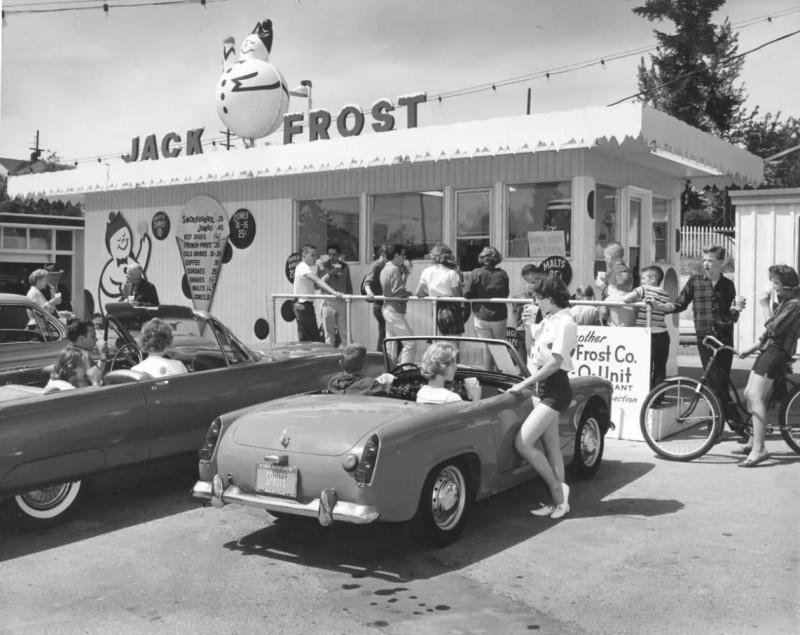
Car culture flourished during this time, giving rise to a fascination with drive-in theaters, drive-thru restaurants, and car clubs. Teenagers embraced the newfound freedom offered by automobiles, making cars an integral part of their social lives. Carhop restaurants and diners became popular, and cruising became a favorite pastime for young people, cruising down the main streets of their towns on Friday nights in their flashy vehicles.
Teens arriving at a drive-up restaurant on a hot summer day in the 1950s.
Pop Culture and the Influence of Cars
Cars also found their way into various aspects of pop culture during the 1950s. Hollywood played a significant role in promoting car enthusiasm through iconic films like "Rebel Without a Cause" (1955), featuring James Dean, which showcased the rebellious and carefree spirit often associated with teenage drivers of the era.
Automobiles also found a prominent place in music, with songs like "Hot Rod Race" by Arkie Shibley and "Maybellene" by Chuck Berry glorifying the allure of fast cars and the open road. These tunes, filled with themes of romance, adventure, and freedom, resonated with the youth and further ingrained cars into the cultural fabric.
Chuck Berry singing "Maybellene," his rock-and-roll song about a hot rod race between a man and his unfaithful girlfriend. (Cred: retrokimmer.com)
Government Perception and Policies
The government also played a crucial role in shaping the automotive landscape during the 1950s. The construction of the Interstate Highway System, initiated by President Dwight D. Eisenhower, began in the mid-1950s and had a profound impact on car travel. The expansive network of highways not only made long-distance travel more convenient but also facilitated suburbanization and the growth of car-dependent communities.
Moreover, the automotive industry thrived during this period, driven by the "Big Three" automakers: General Motors, Ford, and Chrysler. Their cars showcased innovative designs, advanced technology, and powerful V8 engines. These companies were often at the forefront of developing new trends, which intensified the public's interest in owning the latest and greatest cars.
A 1957 Map showing routes to be added to the then-new Interstate Highway System. (Cred: ajfroggie.com)
Notable Cars of the 1950s
Chevrolet Bel Air
This iconic 50s vehicle originated as a slightly more premium modification of the Chevrolet Deluxe Styleline. However, in 1953, it received many all-new body panels and revamped internal engineering that set the bar for many post-war Chevy models to come. In 1955, it began to set the bar for the style of the decade as well. This year's second-gen Bel Air models introduced the iconic flared rear wings, square shape, two-toned color schemes, and chrome accents that are most often associated with the name. Models released throughout the rest of the decade continued to make these ornaments more flashy and extreme, but from 1960 it began to look more and more like the average sedans of the day. This gives Bel Airs from the 50s the air of being frozen in time, forever emblematic of the decade of their creation.
A vintage magazine ad from 1956 showing off the new Bel Air body alongside the new Corvette.
Chevrolet Corvette
One of America's most famous sports cars, the Chevrolet Corvette, was first unveiled to the public in concept form in January 1953. Its hand-shaped fiberglass panels and Chevrolet's promises of performance conveyed the passion behind the project, and enough interest was garnered in the month of this announcement that manufacturing formally began later that same year. The Corvette's uniquenesses made it desirable enough at launch, but as the decade progressed, new tweaks really made the model shine. The 1956 Corvette introduced the iconic colored side scoops and the hydraulic convertible roof to the body, and the 1957 added a four-speed manual transition and heavy-duty brakes and suspension. On top of this, 1957 introduced the "Ramjet" fuel injection system, making the car one of the first in the country to produce one horsepower per cubic inch. Seeing as the Corvette is the only two-door U.S. sports car remaining from this era, it's easy to conclude that its first decade of production engrained it in the public psyche fairly successfully.
Another ad for the 1957 Corvette that highlighted its uniqueness among its American competitiors.
Ford Thunderbird
The Thunderbird was designed as Ford's answer to the unveiling of the Corvette prototype. Design and engineering teams worked around the clock, producing the first Thunderbird prototype in almost exactly a year, unveiling its sleek design to the public at the Detroit Auto Show in February in 1954. Even though the Corvette that it competed against was expressly a sports car, Ford marketed the Thunderbird as a personal luxury car, creating the entire car classification in the process. But the differences didn't seem to matter much to the general public; in its first year of sale, twenty-three Thunderbirds sold for every one Corvette, ensuring that the iconic Thunderbird shape was showcased in towns and cities all over the country. This intersection of style and sales engrained this "competition car" in the DNA in the 50s forever.
A 1955 Ford Thunderbird. (Cred: Silodrome)
Cadillac Eldorado
As evidenced by the literal translation of its name meaning "the golden one," the Eldorado was envisioned as the epitome of luxurious experiences that a Cadillac customer would expect. Its first model in 1953 was packed with quality-of-life features, including a convertible roof, windshield washers, a built-in heater, power windows, and a radio that automatically searched for nearby signals. Its luxuriousness peaked in in 1958 with the introduction of the Eldorado Brougham model, which featured even more space-age technologies: self-leveling air suspension, an automatically opening and closing trunk, sliding power seats, electric door locks and the included leather cigarette case and beauty vanity kit all made this over $13,000 model (around $136,000 today) the most well-equipped American car around. The Eldorado's style was also in a class of its own; the 1959 model in particular stands out as one of the decade's most memorable. Its stylish reworking of the already beloved bodywork made it instantly recognizable from the shape of its front grille and its massive rear fins.
A 1959 Cadillac Eldorado, complete with trademark front-end styling and flared rear wings. (Cred: Hot Rod)
Chrysler New Yorker
The Chrysler New Yorker went through many redesigns and improvements throughout its 55-year production history, but its 1950s incarnations were impressive in their own right. The 1949-1954 models showed off Chrysler's trademark knack for mechanical innovation with the introduction of tech like the "Presto-Matic" transmission that allowed for two different gear ranges. It also introduced the FirePower V8 Hemi engine as an option in 1951, which quickly became a favorite of Chrysler owners and hotrodders alike due to its 10 second 0-60 time. The 1955-1959 models followed up on this generation's success, distinguished themselves with improved mechanics and designs. Gone were the wood-paneled doors of the old New Yorkers; these models' trademark rear wings and unique front ends made them fit right into the popular vehicle landscape. New Yorkers of this generation also had Hemi engines until their discontinuation in 1959, thus setting them and their earlier models apart for straddling the perfect line between power and luxury.
A 1957 Chrysler New Yorker in the trademark 50s teal color. (Cred: RM Sotheby's)
Ford Fairlane
The Fairlane was created as Ford's top full-size offering for the latter half of the 50s, and it achieved this distinction by becoming the best-selling Ford car for multiple years. Each of the two generations of Fairlanes this decade bore ooze 50s style in different ways. The first generation Fairlane, produced for the 1955 and '56 model years, stands out for its pointed corners and iconic two-tone colors divided by a line of chrome styling. The '57-'59 models toned down the color palette and reworked the ratio between the colors, but was no less visually remarkable due to its further exaggerated angularity and push-button retractable roof. Big-block V8s and smooth three-speed automatic transmissions rounded out the package, making the Fairlane a well-performing and good-looking model perfectly suited for any 50s family.
A Ford Fairlane ad from the winter of 1956.
The 1950s was a transformative period for automobiles in America, shaping not only the way people traveled but also their lifestyle, culture, and aspirations. The legacy of this decade can still be felt today, as classic car enthusiasts and nostalgia seekers continue to cherish the remaining models of these iconic vehicles and the memories they evoke of a bygone era.
No politics, no religion, no instagrams, and commentary must be civil. The ToS and the CoC will be enforced, and anything that the administrator deems to be offensive will be deleted. YouTubes, videos and images that the administrator is unable to open must be described and explained or they will be deleted.

Tags
Who is online
104 visitors
This article sure as hell is memory lane for me, starting with Drive-Ins. There was an A&W Rootbeer one not too far from where I lived that saw me quite a few times, and at the other end of town was the Stoney Creek Dairy drive-in that had the best ice cream in the whole area. Those were the days when the car-hops would come to the car to take your order, and then deliver it on a tray that affixed on the top of the car door with the window down, like this:
And the cars - my dad had a 1957 Chrysler New Yorker sedan that was all black but still had that silver stripe along the side. I can still recall driving it down a long straight hill on a 4-lane divided highway until the needle on the speedometer showed the maximum 120 - fastest I've ever driven a car. This is a 1957 Chrysler New Yorker speedometer.
My dad traded the Chrysler for a 1960 Cadillac Coupe deVille that was almost identical to the 1959 one in the article, save that the tail fins were reduced to be less extreme. This image is identical to the car he bought, even to the colour.
It was so damn long it almost needed 2 parking spaces. I've told the story before here that he first test drove a 1959 Jaguar Mark IX that I fell in love with so I never liked the Cadillac.
Holy smoke, I just posted this yesterday and it's already at the bottom next to be pushed off the page. I thought it would interest Americans but I guess I'm the only one here who remembers those happy times. In fact, for me, the 1950s were the best of times. I was 13 in 1950 and my teenage years followed - high school through university and then Law School. How many times have I posted on NT: "Please Scotty, beam me back to the early 1950s.?
Am I the only grownup on this site who remembers those wonderful days?
I was riding a bicycle in the 1950's.
No, that is not me.
This chain was my drive in hangout in the 60's.
I worked at a Tastee-Freez the summer I turned 16. Hot summer nights we had
long lines for soft serve ice cream cones.
Tastee Freez is still around, although not many of them . Back in the day there were maybe a dozen of them in Chicago, now there are none. The only one in Illinois is in Champaign. I guess there also some in Arizona, California and Alaska.
They still have the chocolate dip.
I can't remember when my dad got me my first bike, but I can remember it, my first getting on it, and first ride, as if it were yesterday.
I can't open that link - I assume it's a drive-in.
I bet you "Tasteed" that "Freeze" occasionally back then.
I remember seeing some of those cars. That two- tone red Chevy Bel Air reminds me what so many cars of that era looked like.
(As I had mentioned previously I remember my father’s two tone Blue 1953 “Oldsmobile 88”. IIRC it was one of the first ones to have automatic transmission).
My first father-in-law had an Olds 88 of around that vintage as well. Leave of the "s" and you've got me, but not for much longer.
You'll probably outlive us all Buzz.
I'll drink to that.
I can also relate to the drive-ins and the whole scene surrounding them. I also remember two popular chains: Dairy Queen and White Castle.
And also the time of the Drive in movies.
I can recall that there was at least one Dairy Queen drive-in being not that far from me. As far as drive-in movies go, there was one I visited a few times on the other side of my city, close to the Stoney Creek Dairy I referred to above.