
Flying Tigers veteran's lasting friendship with China endures

By: No Author Indicated
 S E E D E D C O N T E N T

Flying Tigers veteran's lasting friendship with China endures

NEW YORK — At 21, Jack Goodrich flew the Hump into China, the vital air route that kept supplies flowing to China over the Himalayas between 1942 and 1945 during World War II.
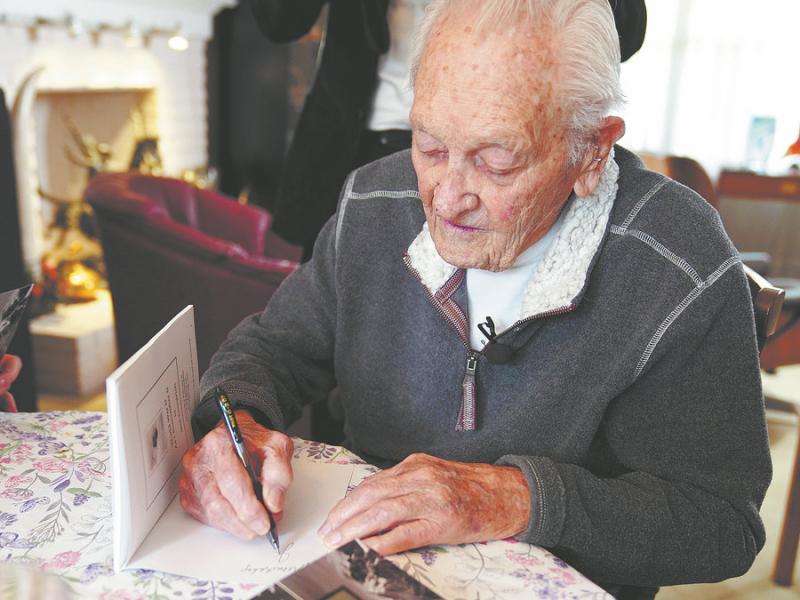
Goodrich welcomed Xinhua News Agency to his home in Malvern, Pennsylvania, where he has lived for 67 years. His memory remains remarkably sharp. He recalls the altitudes he flew, the year he left China, and even the taste of eggs in Kunming, Yunnan province, the southwestern Chinese city where he later helped establish a school. Above all, he remains convinced of one thing: friendship between China and the United States matters more than ever.
'I came back. They did not'
Goodrich's love of flying began when he was about 10, carving delicate model airplanes from balsa wood with a close group of friends. There were six boys in his childhood circle. Three became pilots during World War II. Only Goodrich returned home.
"I was very fortunate," he says. "I came back. They did not. That was a really sad time."
After the US entered the war against Japan while he was still in high school, Goodrich trained as a pilot during a bitterly cold winter in St. Louis, Missouri. He was assigned as a copilot on the twin-engine C-46 military transport aircraft. But just before departure, he was transferred to a smaller but famously dependable C-47. When he admitted he had never flown one, the pilot simply told him not to worry.
He did.
After Japanese forces cut the Burma Road in 1942, the only way to keep China supplied was by air. Transport pilots flew from bases in India and Burma (now Myanmar) across the eastern Himalayas on a route they called simply the Hump — battling poor weather, thin air, primitive navigation, and terrain that had already claimed hundreds of aircraft and crews.
Goodrich was 21 when he was promoted from copilot to pilot, and given his own aircraft and crew.
"To have my own ship at 21," he says, "that was quite a change in responsibility. I had to make sure we all got home safely."
His base was in Myitkyina, northern Burma, on the banks of the Irrawaddy River. For eight months of the year, the flights were perilous but manageable with clear skies and only enemy fighters to avoid. Everything changed during the monsoon. Powerful winds slammed into the Himalayan slopes and produced violent turbulence and walls of cloud that no small aircraft could safely cross.
"We flew through them anyway," Goodrich says. "Night and day. China and the Flying Tigers still needed supplies."
They flew on instruments from takeoff, on oxygen at 16,000 feet (4,877 meters) and above, skimming 1,000 feet above peaks rising to 15,000 feet. One monsoon night, midway to Kunming, his radio operator picked up another aircraft making nearly identical position and altitude calls. Seconds later, they broke through the clouds, and a C-46 screamed past so close overhead that it sheared off their radio aerial and damaged the rudder.
"If he had gone left, right, or under," Goodrich said, "both planes would have gone down."
The other pilot had instinctively pulled up. When both crews landed safely in Kunming, Goodrich found the shaken pilot sitting silently with a cup of coffee. It remains the closest he believes he ever came to not making it home.
'Kunming was the reward'
Life on the ground at Myitkyina was harsh. The men lived in tents beside the jungle, without electricity or fresh milk, often hunting to supplement their rations. One night, while shaving by flashlight at 2 am, Goodrich turned to see two huge glowing eyes only a few yards away. He was convinced he was staring at a tiger. Instead, it was a curious water buffalo. Embarrassed by his fright, he threw his razor at the animal until it wandered off, then reassured the men who rushed from their tents.
"Oh, go back to sleep — it was only a tiger."
Kunming was the reward.
While their planes were unloaded, crews hurried to the mess tent run by Chinese cooks.
"Eggs any time of night or day," Goodrich recalls, smiling at the memory. "Toast with jam and butter, coffee with cream and sugar. I loved it every time."
'Believe in tomorrow'
Goodrich left China in December 1945. Back in the United States, he followed the path taken by many returning veterans, studying engineering before joining what became one of the country's largest construction companies. During his 35-year career, he helped build power stations, steel mills, dams and nuclear facilities before retiring as a vice-president.
"I was proud of that," he says.
The bond with China never faded.
Over the decades, Goodrich worked with the Sino-American Aviation Heritage Foundation to preserve the history of the Flying Tigers. He spoke to students and community groups, returned to China several times, and watched a school in Kunming — founded after he and his Chinese friends bought a single house — grow into a full campus.
"I've always been very appreciative of our friendship," he says.
The world he sees today is not quite the one he had hoped would emerge after the war. China-US relations face growing strains. Conflict in the Middle East has shaken energy markets, foreign policy and everyday life far beyond the region. Long-standing alliances are also being tested.
Goodrich does not deny those challenges. Countries will disagree, he says, sometimes loudly and for years. But he draws a firm line at violence.
"There's only one thing that's going to happen in a war," he says. "Equipment is going to be destroyed, and young men are not going to come home. Death."
He thinks of the five boys who carved balsa wood models with him as a child, the ones who went to war alongside him, the ones who did not return. He thinks of the Chinese pilots and generals and cooks and friends who made something real out of a wartime alliance — a friendship, a school, a jade ring passed to a son.
Years ago, during a visit to China, he said, "It is a pleasure to come back and find that the friends we made so many years ago in the stress of war are still our friends. May we remain such forever."
At 102, tending his garden, Goodrich still means it.
"Believe in tomorrow," he says. "It's going to come. Make it worthwhile."
The administrator of this group reserves the right, along with the site moderators, to moderate all and any postings to this group, including the right to enforce the ToS, the CoC, and also including anything that the administrator deems within his sole discretion to be offensive, including and not limited to off topic or 'no value' comments, with the power to delete in exercising those rights.
It would be best, therefore, to be civil in posting on this group.
By now it should be well known that I am unable to open certain sources, videos and pictures. If I cannot, I will ask that they be described and explained. If the poster refuses to comply, their comment will be deleted. Instagrams are banned.

Tags
Who is online
86 visitors
The descendants of the Flying Tiger Americans keep up their attachment to China with reunions with the descendants of their Chinese comrades. I had the privilege of meeting with one of the Chinese Flying Tiger pilots who had flown cargo planes "over the hump" when I was at the museum in Chongqing around 19 years ago. Behind us are photos of him and his family from during the war.
I always love the retelling of this piece of history. Not enough Americans know their history.
Btw China tied up a lot of the Japanese army in WWII.
There are also movies about the Chinese people rescuing American pilots and crew whose planes crashed in China during WW2. Thirty Seconds Over Tokyo was one of the first, but there are two Chinese ones partially in English that are very movng in which young women die rescuing Americans. Lover's Grief Over the Yellow River, and In Harm's Way, which is based on a true story.
We were great allies once upon a time.
It's unfortunate that there are those in the USA who consider China to be an enemy - maybe because China had spied on the USA, but then the USA spied on China as well cause that's what nations do, or maybe China stole technology secrets, but with the way China is developing its technology these days maybe the USA should start stealing Chinese technology, but they don't really have to because China shares its technology with the world. IMO China has more reason to consider the USA an enemy because of its selling arms to and officials visiting Taiwan - crossing the biggest red line any nation has ever had. .