
A century after he left, Toronto is still Ernest Hemingway's town

By: Emma Johnston-Wheeler/TorontoToday

 S E E D E D C O N T E N T
A century after he left, Toronto is still Ernest Hemingway's town
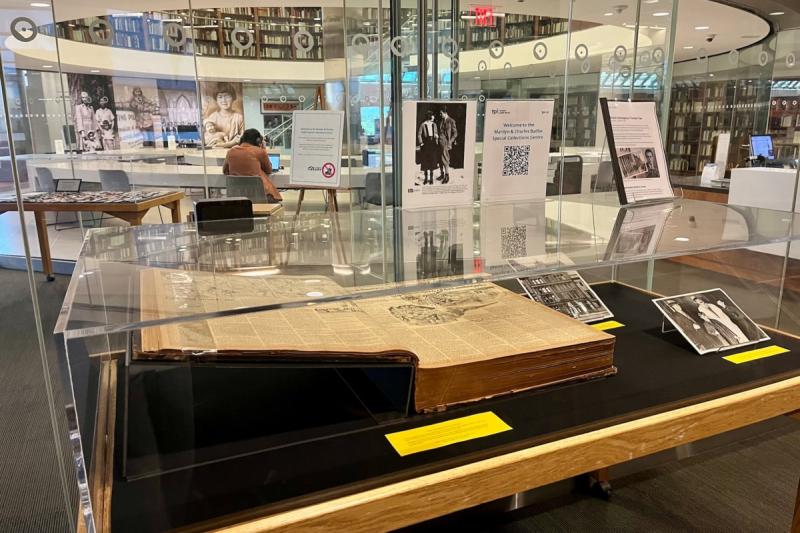
Ernest Hemingway’s final article in the Toronto Star is on display at the Toronto Reference Library as part of the 2026 Hemingway Society Conference / Emma Johnston-Wheeler/TorontoToday
More than 200 of the world's leading Ernest Hemingway scholars have gathered in Toronto this week for a conference that organizers hope will shed new light on how one of literature's most studied authors is understood.
The five-day conference, hosted by Toronto Metropolitan University (TMU) in partnership with global literary organization The Hemingway Society, focuses on a largely overlooked chapter of Hemingway's career: the nearly 200 articles he wrote for The Toronto Star between 1920 and 1924.
While those articles have been known to scholars for decades, conference co-chair Irene Gammel says they have rarely been studied as literary journalism.
"We haven't yet examined what's significant about them," said Gammel, an English professor at TMU and director of the university's modern literature and culture research centre. "These are incredibly important pieces that teach us a lot about Hemingway during a time of transition, while he was moving from being a journalist to being a writer."
That fresh perspective is why TMU successfully bid to host the international conference in Toronto.
"When you want to do that in a major way, the best way to do so is to bring the world's leading association to the place itself," she said. "They can walk the streets that Hemingway walked in 1920 and in 1923 to 1924," she said.
Toronto as Hemingway's classroom
Although Hemingway would later become synonymous with Paris, Spain, Key West and Havana, Gammel argues that Toronto played a defining role in his development.
Before publishing The Sun Also Rises in 1926, Hemingway spent four years reporting for The Toronto Star, covering everything from court proceedings at Old City Hall to boxing matches at Massey Hall. He also reported overseas on the aftermath of the First World War, the Greco-Turkish War and the rise of facism in Italy.
His feature writing was equally wide-ranging. He wrote about getting a free haircut from a student barber, fox farming on Prince Edward Island and Toronto street life, often inserting himself into the story. "He becomes a character himself," said Gammel.
One story drawing particular attention at the conference is Hemingway's final Toronto Star article, "Must Wear Hats Like Other Folks If You Live in Toronto," more widely known as "The Freiburg Fedora."
 Ernest Hemingway's final article for The Toronto Star, widely known as "The Freiburg Fedora," was published under the pseudonym John Hadley on Jan. 19, 2024. Emma Johnston-Wheeler/TorontoToday
Published on Jan. 19, 2024 under Hemingway's pseudonym, John Hadley, the satirical piece recounts Hemingway getting laughed at on a streetcar by a pair of women who think his battered Fedora makes him look like the notorious Toronto gangster Norman "Red" Ryan, who had recently escaped prison while on route to a meeting with the mayor at City Hall.
By earnestly defending the hat in response, Gammel said he turned himself into the story's flawed protagonist.
"His heroes are all antiheroes at the same time," she said. "He experiments with himself and this kind of brutal honesty to convey this characterization."
Walking through Hemingway's Toronto
To coincide with the conference, organizers have created a self-guided walking tour that traces Hemingway's life through the city.
Stops include Old City Hall where Hemingway reported on court hearings, First Canadian Place where the Toronto Star newsroom was located from 1929 to 1971, Massey Hall and the Arts and Letters Club, a private members club for creatives where Hemingway was nominated for membership but declined because he could not afford the initiation fee.
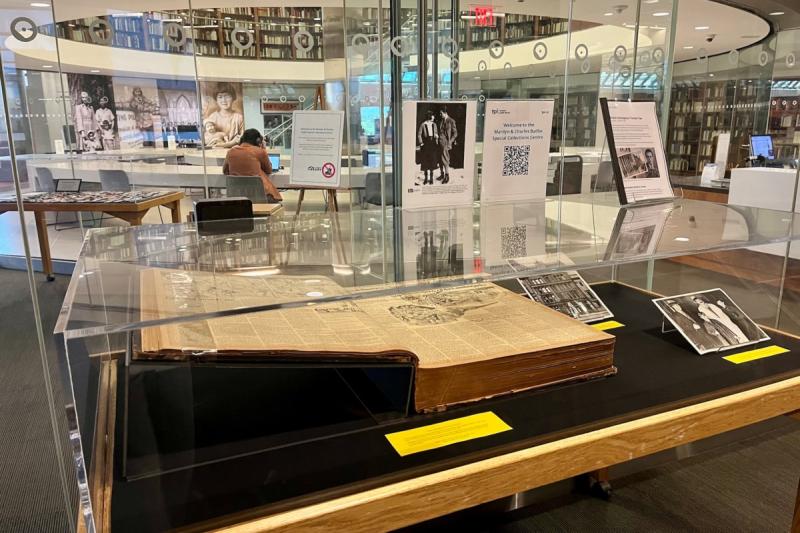
The tour also visits the Toronto Reference Library, where Hemingway's articles are preserved in its special collections. To mark the conference, the "The Freiburg Fedora" is currently on display in the Baillie Special Collections Centre.
The final stop is the French bistro and cocktail bar Maison Selby on Sherbourne Street, which in 1923 was a hotel that Hemingway and his wife Hadley temporarily lived in while awaiting the birth of their first child.
"People can sit there and get a sense of that space that Hemingway saw at the time. The architecture is still very much the same, and that's something that's often very important to literary scholars," said Gammel.
"Those are opportunities that we can give the visitors, the scholars, the writers, the biographers and the journalists who are here investigating Hemingway in Toronto."
New directions in Hemingway scholarship
Beyond revisiting the past, the conference also explores Hemingway's relevance today, with presentations ranging from artificial intelligence and "Hemingway bots" to the reception of the writer's work in countries like Turkey and Ukraine.
Gammel plans to preserve many of the conference's discoveries in an upcoming editing collection, Hemingway's Toronto , that she hopes to publish with the University of Toronto Press.
For her, however, some of the conference's biggest breakthroughs are already happening in the lecture rooms.
"When you hear people speak, you are suddenly immersed in these new findings," she said. "People are moved by these discoveries."
As scholars continue to examine Hemingway's Toronto years, Gammel hopes the city will finally receive recognition for the role it played in shaping one of the 20th century's most influential writers.
The Code of Conduct and Terms of Service must be complied with.
Any comment posted about politics or religion not relevant to the English Literature articles that are posted will be deleted.
The administrator reserves the right to delete any comment he considers to be offensive, off topic or of no value.
Videos or images or links to sources that the Administration cannot open must be described or explained when requested or they will be deleted.

Tags
Who is online
86 visitors
Hemingway and Toronto back then.
Nobody here has any thoughts on America's most iconic writer?
He neglected his children, fucked over people who were supposed to be friends and cheated on multiple wives.
"Well, nobody's perfect", but then that makes him an ideal candidate to be PotUS, doesn't it?
What does that have to do with his ability as a writer?
Beyond that, it was Hemingway himself who taught us about the wisdom acquired over a lifetime:
"There is nothing noble in being superior to your fellow men. True nobility lies in being superior to your former self."
I had never seen a picture of him as a young man before. At least I had thoughts of Toronto, having lived there half a century.
In some ways it seems that Toronto was to Canada as New York City was to the US.
Could be.
Hmmmm - Didn't know that Heinlein was considered iconic.
IMHO - much better than Hemingway.
It is a matter of taste.
Or as the Frenchies say, "chacun a son gout" (which has nothing to do with the gout I've been painfully living with).
I preferred to read Sci-Fi myself.
Dad got me a library card when I was 10 - 1954 - and SciFi was coming out strong. He'd drop me off in the morning and pick me up in the afternoon (summer time of course) - and I'd head straight to the SciFi section - then to the record section to get a few musical masterpieces to listen to while I read.
Couldn't beat it with a stick - Asimov, Bradbury, Clarke, Heinlein, Herbert, etc - dreams come true
ALL of those, and more - Edward E "Doc" Smith and his Skylark and Lens series novels. My brother used to buy the Sci-Fi pulpmagazines and I would read them after him (Astounding Stories, Galaxy, etc)
I never quite got into Hemingway. I prefer Fitzgerald.
Gatsby and Benjamin Button made pretty good movies.
I'll never forget when Doug tried to console his wife:

"So, you feel lost — lots of people have felt lost before. Don’t you think The Great Gatsby felt lost before he became a magician?”
???
Doug Heffernen is a fictional character known for certain characteristics such as not having any discipline when it comes to food and a total aversion to reading. His wife was reading the Great Gatsby when she was out of a job. She said she felt lost. Doug tried to console her by saying the Great Gatsby might have felt lost before he became a magician. Doug obviously thought the title implied the story was about a magician. I guess that it isn't so funny when it has to be explained.

How about a little inspirational verse on a Sunday morning?
I'm unable to open the link you posted. Please copy what it was to your computer library and then copy it from there to post herel.
It is only a quote from Hemingway:
"Every man's life ends the same way. It is only the details of how he lived and how he died that distinguish one from another."
How did Hemingway die ?
He shot himself with a shotgun, same as his father had done.
Other than that, he led a full life and was one of America's finest writers.