
Scientists Say Completed Genome From Clovis-Era Skeleton Proves Native American Origins


For more than 20 years anthropologists have debated whether the first Americans arrived in the New World by walking over a land bridge across the Bering Strait, as millions of schoolchildren have been taught, or by sea from southwest Europe, perhaps in animal-skin kayaks.
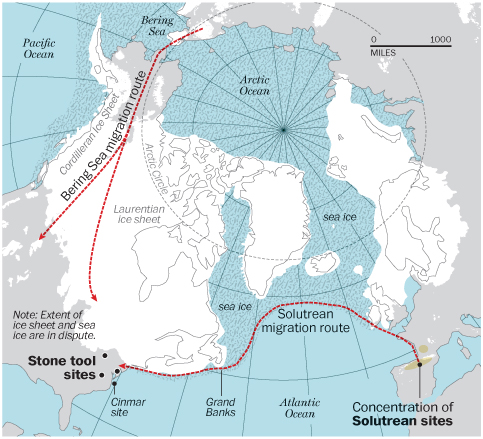
A new analysis challenges the out-of-Europe hypothesis, which has figured in a political debate over the rights of present-day Native American tribes
[Graphic: Tywkiwdbi.blogspot.com]
Scientists announced on Wednesday that they had, for the first time, determined the full genome sequence of an ancient American, a toddler who lived some 12,600 years ago and was buried in western Montana.
His DNA, they report, links todays Native Americans to ancient migrants from easternmost Asia.
The study, published in the journal Nature , is the final shovelful of dirt on the European hypothesis, said anthropological geneticist Jennifer Raff of the University of Texas, co-author of a commentary on it in Nature.
The idea that the first Americans arrived millennia earlier than long thought and from someplace other than Beringia which spans easternmost Russia and western Alaska has poisoned relationships between many Native Americans and anthropologists.
Some tribes fear that the theory that the continents first arrivals originated in Europe might cast doubt on their origin stories and claims to ancient remains on ancestral lands.
Despite the new study, other experts say the debate over whether the first Americans arrived from Beringia or southwestern Europe, where a culture called the Solutrean thrived from 21,000 to 17,000 years ago, is far from settled.
They havent produced evidence to refute the Solutrean hypothesis, said geneticist Stephen Oppenheimer of Oxford University, a leading expert on using DNA to track ancient migrations. In fact, there is genetic evidence that only the Solutrean hypothesis explains.
Elk antlers
The partial skeleton of the 1-year-old boy, called Anzick-1, was discovered when a front-end loader hit it while scooping out fill in 1968.
The grave and its environs contained 125 artifacts including stone spear points and elk antlers centuries older than the bones, said anthropologist Michael Waters of Texas A&M Universitys Center for the Study of the First Americans, a co-author of the Nature study.
That suggests that the antler artifacts were very special heirlooms handed down over generations, Waters said. Why they were buried with the boy remains unknown.
The distinctive stone tools show that the boy was a member of the Clovis culture, one of the oldest in North America and dating to around 12,600 to 13,000 years ago.
The origins and descendants of the Clovis people have remained uncertain, but the boys genome offers clues.
The genetic data from Anzick confirms that the ancestors of this boy originated in Asia, said Eske Willerslev of the Natural History Museum of Denmark, who led the study.
The DNA shows that the child belonged to a group that is a direct ancestor to as many as 80 percent of the Native Americans tribes alive today, he said: Its almost like he is a missing link between the first arrivals and todays tribes.
The most likely scenario, said Texass Raff, is that humans reached eastern Beringia from Siberia 26,000 to 18,000 years ago.
By 17,000 years ago, receding glaciers allowed them to cross the Bering Strait.
Some migrated down the Pacific coast, reaching Monte Verde in Chile by 14,600 years ago, while others including the ancestors of Anzick-1 headed for the interior of North America.
The genetic analysis found that the boy is less closely related to northern Native Americans than to central and southern Native Americans such as the Maya of Central America and the Karitiana of Brazil.
That can best be explained, the scientists say, if he belonged to a population that is directly ancestral to the South American tribes.
Todays Native Americans are direct descendants of the people who made and used Clovis tools and buried this child, the scientists wrote. In agreement with previous archaeological and genetic studies, our genome analysis refutes the possibility that Clovis originated via a European migration to the Americas.
Not all experts are convinced.

Tags
Who is online
91 visitors
Which route was used for early man to migrate to the north american continent may be important to modern day Native Americans, but it makes little difference to me .... 17,000, 20,000 years ago ....that's forever as far as I'm concerned.
I know we enjoy a substantial number of Native American members on NewsTalkers, so when I came across this article I thought I would seed it to see what our NA members would have to say.
Thanks for posting the article Jerry. I believe that the group from Europe, what is now parts of France and Spain were dubbed the ''seal hunters''.
I would tend to believe the Beringa theory, then the European one. Both IMO fail to account for new discoveries that are being made on a regular basis. There is a dig in South Carolina right now that claims them have discovered artifacts dating back 25,000 years. Pre dating the Clovis people.
Discoveries in Montana, Wyoming, Arizona and New Mexico keep adding to what we know of the Ancient Ones.
For example a recent discovery in the Mountains of Wyoming of a series of very advanced villages at the 10,000 foot level, that were continuly inhabited for 2,500 years opened upa whole new theory of howour people migrated.
Always interesting, but I'm sure there will be more and more discoveries that will keep changing history.
A excellent book to read that covers the ''ice bridge'' theory is ''Red Earth, White Lies'' by Vine Deloria.
I'm not convinced either. From what I've read, the Solutrean migration seems more plausible, especially when examining the actual conditions of crossing the Bering Straight at the times mentioned. It would be more likely that people migrated BACK across Beringia to Asia.
Still, the battle rages on, lol.
I read a very interesting book recently called "Across Atlantic Ice" that was quite thorough in collating hard data from flintknapping and weather conditions throughout the migratory period.
However, I dont think that discounting the potential for pre Ice Age migrations can be logically done either, which might actually give credence to both origin points.
Here is more interesting information.
...
It seems to put to rest the idea that European peoples being first here.
Some more food for thought:
And then there's "1491" which tells of the 26 skeletons found in Brazil/Bolivia that were 40,000 years old and the Peruvian artifacts dating back to 38,000 years.
It will be many, many years before the passes will be proven. Let's just leave it at - we were the first
Here is another
1st, we have always been here.
And always will be


Well.... yeah.
Works for me....
RED is right...
Just like the ''Star People'' BF.
You're welcome Kavika.
I have seen articles about people from the southern part of France being early migrators to the N. AmericanContinent, but I'm not knowledgable enough about all the different hypotheses to make a viable judgement. I just find the whole discussionfascinating.
Ihavelearned a lot from this article and the comments posted on the thread.
21,000 years is close enough to forever for me.
IMO, they don't.
I don't understand why it's not reasonable to assume both, or even all, hypotheses have a degree of credibility and early man migrated to this continent from various sources.
I'm convinced you feel that way because you have evidence you are a directdescendant of those aliens.
BLUE is Correct a/k/a The Left
I'll second that
OMG, I agree with Robert!
I've been here forever.
I've been here longer than that. If you don't believe me, look at my avatar.