
How Close Are We Really To A Robot-Run Society?


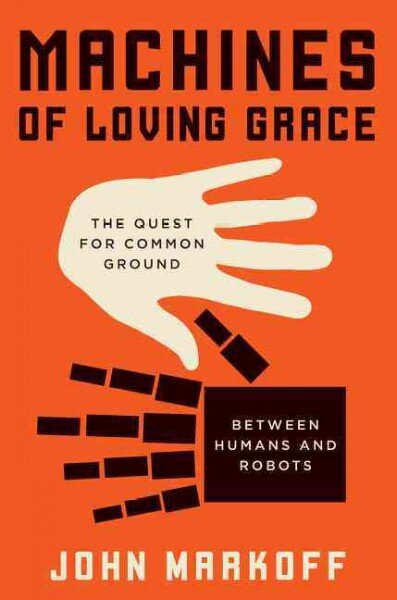
From Rosie, the Jetsons' robot maid, to Arnold Schwarzenegger's cyborg in The Terminator, popular culture has frequently conceived of robots as having a humanlike form, complete with "eyes" and mechanical limbs. But tech reporter John Markoff says that robots don't always have a physical presence.
"I have a very broad definition of what a robot is," he tells Fresh Air's Terry Gross. "A robot can be ... a machine that can walk around, or it can be software that is a personal assistant, something like Siri or Cortana or Google Now."
Markoff, the author of the new book Machines of Loving Grace, points out that artificial intelligence plays a role in many of our lives sometimes without our even realizing it. "I have a car that I bought this year ... that is able to recognize both pedestrians and bicyclists, and if I don't stop, it will," he says. "That's a very inexpensive add-on that you can get for almost any car on the market now."
Looking ahead, Markoff predicts further advances in driverless-car technology. He also foresees a generation of computer chips that don't require batteries; instead, they would run on sunlight or vibration or sweat.
"In the next five years ... this [computer chip] technology will fan out all around us and create applications we can't even think about today," he says. "They'll be used for robotic sensors. They'll be made to make robots more mobile. And they'll be used to do a million other things we can't even conceive of, and it will continue to transform our society."
Interview Highlights
On the role of humans in designing artificial intelligence
Despite a lot of the perspective in Silicon Valley that these things are evolving very rapidly on their own, in fact, they're still designed by humans. So what I've realized is we have an increasing ability to design [ourselves] into our systems that we're building or design [ourselves] out of our systems, and that's a decision that's being made, sometimes knowingly and sometimes unknowingly by the people who design these machines. ...
On designing cars that avoid crashes
The bar for autonomous vehicles is incredibly low. Human drivers are terrible. We do an absolutely miserable job. ...
What if we could design, instead of a driverless car, a car that wouldn't crash, which is sort of a different way of looking at the problem. What if we could protect ourselves from our foibles? I think the automobile industry is actually moving very quickly to that and that cars will be safer and will be protected from our smartphones and whatever else we're doing in our car that we shouldn't be doing.
So it's going to happen gradually. So, for example, Tesla and General Motors next year are introducing something that's known as "Super Cruise"; the car will largely drive itself at freeway speeds on the freeway. Already on the market today there's a technology called "Traffic Jam Assist" ... from companies like Audi and BMW and Mercedes and others that allows the car to drive by itself in stop-and-go traffic, and it follows the car in front of it in traffic, and it stays in the lane, and it goes fast and slow and it actually frees the driver up. My argument is, getting over that last hurdle to actually truly self-driving cars is going to be really, really tough and I don't think it's going to happen in the next decade. But getting to the point where the driver supervises rather than actually manually drives is something we'll come to expect over the next half-decade.
On Google's self-driving car project
A very interesting thing happened in the Google self-driving car project that probably didn't get enough notice earlier this year. ... They added this new kind of car that didn't have a steering wheel ; it didn't have a brake; it didn't have an accelerator. It was like an elevator, and it was made to be limited to 25 miles an hour, and the idea was that you wouldn't take it on the freeway, but maybe in a downtown area, or on a campus you could call a car from your smartphone and it would show up and it would take you to where you were going ... and you would get out and you would be there. ...
I think for the whole of society if the vehicles are safer, even though there may be these individual bad things that happen, that we should go in that direction because right now ... [drivers] are incredibly unsafe ... and do crazy things all the time.
On warehouse technology
There's all kinds of technology flowing into warehouses. ... I was in a warehouse in upstate New York where one half of the warehouse was sort of existing technology, which is pallet jacks and forklifts and workers with headphones on that speak to them in five different languages flying around the floor picking up cases and taking them to the waiting trucks. It was just a frenzy of activity and that's sort of today's technology. The workers were controlled by a centralized computer.
And then on the other side of the warehouse there was this amazing machine that looked like a giant pachinko machine, where the cases were actually arrayed like data inside a computer, I guess. The packages that were most frequently used were at the front, and ... [there were] sort of levels of [20] packages high by 20 or 30 wide, and these little go-karts would fly down these aisles, grab the package or the case and then bring them back to this centralized Rube Goldberg-like loader at the front. And the packages would come down and they would be put down on a pallet. And they would be automatically wrapped, and then automatically put in the back of the truck. So on every level, people are being taken out of the equation. I actually think that maybe that's not a bad thing as long as we as a society can find something else meaningful for those people to do. ... That's where the disconnect is.
Tags
Who is online

75 visitors
Artificial intelligence is the current boogie man in the closet that will surely lead to the end of mankind on the planet, experts say it is so.
So the lines are dawn with those that fear and rage against the machines on one side and those that welcome technological advances and the innovations they bring.
The answer like for all other questions is likely somewhere between those two extremes.
"The answer like for all other questions is likely somewhere between those two extremes."
The opposite is true. When most people thought the earth was flat was it extreme to claim it was round?
When people asked how do we end WWII was it extreme to unleash atomic bombs?
"Those that sit in the middle of the box will never see outside of it." Dean Moriarty
Nice rhetoric, but where do you stand are machines taking over the world or is the danger of AI merely a hoax?
And I doubt your quote will become a daily maxim, since moderates get things done while extremists scream and holler at each other.
Thanks for dropping by
I guess we know what stores you shop in
Hey the site ate my comment!
I already feel that robots are taking over...
No matter where you call, you get a "menu". Sometimes, it takes 5-10 minutes to reach a person. When something small goes wrong with the car, the entire car quits. In the old cars, something could go wrong and the car may complain, but it kept going... Then, there are computers. All this automatic crap that installs itself somehow messes up all the other automatic crap that was previously installed.
That movie AI, by Spielberg was scary! (I thought.) Just something else for humans to be mean to...
Dowser
Stay very, very calm ....we will always need smart geologists like you!
I'm very excited about technological advancements and I have no fear. The only thing to fear is fear itself. Maybe now we can start thinking about reducing the world's population.
Or colonizing the moon or Mars!
And the rate of population growth is slowing, though I do agree that slowing it even more would be a good thing
Total Population of the World by Decade, 19502050
(historical and projected)
(mid-year figures)
rate (%)