
Record High in U.S. Say Big Government Greatest Threat Now 72% say it is greater threat than big business or big labor


Record High in U.S. Say Big Government Greatest Threat
PRINCETON, NJ -- Seventy-two percent of Americans say big government is a greater threat to the U.S. in the future than is big business or big labor, a record high in the nearly 50-year history of this question. The prior high for big government was 65% in 1999 and 2000. Big government has always topped big business and big labor, including in the initial asking in 1965, but just 35% named it at that time.
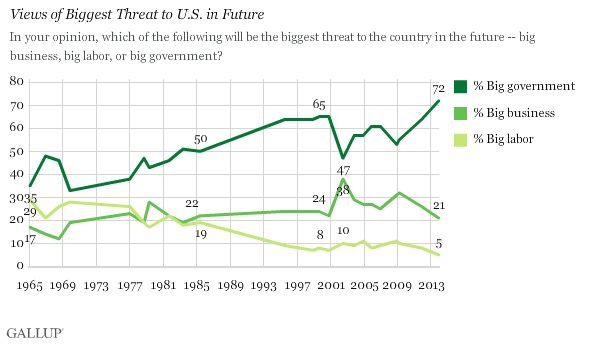
The latest update comes from a Dec. 5-8 poll. Gallup has documented a steady increase in concern about big government since 2009, rising from 55% in March 2009 to 64% in November 2011 and 72% today. This suggests that government policies specific to the period, such as the Affordable Care Act -- perhaps coupled with recent revelations of government spying tactics by former NSA contractor Edward Snowden -- may be factors.
Currently, 21% name big business as the greatest threat, while 5%, a record low, say big labor. The high point for big labor was 29% in 1965. No more than 11% of Americans have chosen big labor since 1995, clearly reflecting the decline of the labor movement in the United States in recent decades.
The historical high choosing big business, 38%, came in 2002 , after a series of corporate scandals rocked major corporations including Enron and Tyco. Also at that time, Americans may have been less willing to choose government given the rally in support for government institutions and officials after the 9/11 terrorist attacks.
Americans were also more likely to view big business as a big threat during the recent recession, with more than three in 10 choosing it in 2008 and 2009, a time when many large corporations, including financial and automotive companies, failed or were in danger of failing without government intervention. But fewer Americans now view big business as a threat -- the current 21% is the lowest Gallup has measured since 1983.
Republicans Especially Likely to See Big Government as Threat
Even though Americans have always viewed big government as the greatest threat, the degree to which they do so has varied. In recent decades, since the start of the Clinton administration, perceptions of big government as a threat have varied depending on the party of the president. Since Barack Obama took office in 2009, an average of 64% of Americans have named big government as the greatest threat. That is up from an average 56% during George W. Bush's administration from 2001-2008, but similar to the 65% average from 1993-2000 during the Clinton administration.
This pattern is largely driven by Republicans, who generally are more likely to be concerned about the size and power of government, and this concern is amplified when a Democrat is president. Democrats are more likely to see government as a threat when a Republican is in office; however, they tend to see government as less threatening than Republicans do, and their concern about big government topped out at 62% in 2005 under Bush.
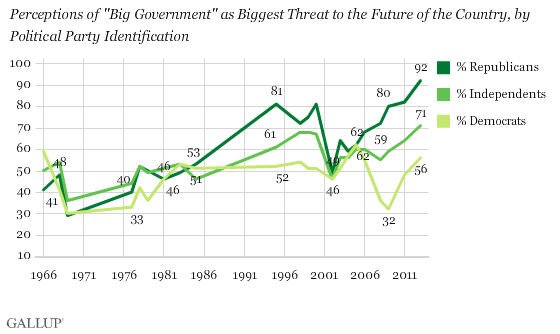
During the Johnson, Nixon, Carter, and Reagan administrations, party differences were much more modest than they are today.
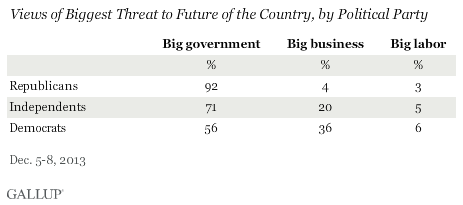
Each party group currently rates big government as the greatest threat to the country, including a record-high 92% of Republicans and 71% of independents, as well as 56% of Democrats. Democrats are most likely of the partisan groups to name big business as the biggest threat, at 36%; relatively few Republicans, 4%, view big business as the most threatening.
Implications
Americans have consistently viewed big government as a greater threat to the United States than either big business or big labor, but never more than they do now. That may be partly a reaction to an administration that favors the use of government to solve problems. Also, the revelation of widespread government monitoring of U.S. Internet activity may be a factor in raising Americans' concern about the government. The threat of big business may seem diminished now, during a relatively calm period for big business, with rising stock values and relatively few major corporate scandals such as occurred in the early 2000s. Also, the labor movement is far less influential in U.S. policy today than in the past, including in 1965, when Gallup first asked the question.
In the future, Americans likely will continue to view big government as the greatest threat of the three, partly because of Republicans' reluctance to rely on government to solve problems, and because Democrats and independents are also inclined to view big government as a greater threat than big business or big labor. But the percentage of Americans viewing big government as the greatest threat will also likely to continue to vary, in response to current conditions in the political and business environments.
Results for this Gallup poll are based on telephone interviews conducted Dec. 5-8, 2013, with a random sample of 1,031 adults, aged 18 and older, living in all 50 U.S. states and the District of Columbia.
For results based on the total sample of national adults, the margin of sampling error is 4 percentage points at the 95% confidence level.
Interviews are conducted with respondents on landline telephones and cellular phones, with interviews conducted in Spanish for respondents who are primarily Spanish-speaking. Each sample of national adults includes a minimum quota of 50% cellphone respondents and 50% landline respondents, with additional minimum quotas by region. Landline and cell telephone numbers are selected using random-digit-dial methods. Landline respondents are chosen at random within each household on the basis of which member had the most recent birthday.
Samples are weighted to correct for unequal selection probability, nonresponse, and double coverage of landline and cell users in the two sampling frames. They are also weighted to match the national demographics of gender, age, race, Hispanic ethnicity, education, region, population density, and phone status (cellphone only/landline only/both, and cellphone mostly). Demographic weighting targets are based on the March 2012 Current Population Survey figures for the aged 18 and older U.S. population. Phone status targets are based on the July-December 2011 National Health Interview Survey. Population density targets are based on the 2010 census. All reported margins of sampling error include the computed design effects for weighting.
In addition to sampling error, question wording and practical difficulties in conducting surveys can introduce error or bias into the findings of public opinion polls.
View methodology, full question results, and trend data.
For more details on Gallup's polling methodology, visit www.gallup.com .
Tags
Who is online
93 visitors
Is it Obama or is it the tea party members elected in 2010?
The economic points made by jwc2blue are true and valid but they do not detract from the reality of the survey data presented in the article and there are multiple causes (in the private and public sectors) for the increased economic activity and improving GDP while the distrust of big government is what it is.
Very interesting article and the augmenting economic data show that the distrust of big government is beyond the business and economic sectors of the country
jwc2blue
You addressed the economic but that is not the only distrust of big government, think about the issues of late (whether you think they are scandals or not are immaterial) at the IRS, the NSA, the military etc
It is not about the size, but the scope and activities of the government that make people think of and distrust big government
The sequester and shutdown shrunk government or at the very least prevented further expansion.
It is encouraging to see the results of this poll. Between Snowden and the Obamacare failure people are finally waking up to see the danger of big government. Big government has always been our biggest threat and now more people than ever see it.
jwc2blue
No kidding, well I did see that
My "opinion" about the scope vs the size is what "I think" a lot of people based their answers to the survey on
John
Good points which seem to clearly validate the pol results that citizens of the country for the most part think that expansive government is a threat to the future of the country
You also need to take the filibusters into consideration that successfully blocked liberal spending bills. Remember Obamas so called jobs bill that was blocked. It was actually a spending bill designed to increase government spending.
jwc2blue
You missed the point cleanly not even a foul tip
The point is that the scope of government intrusion (not actually the size or spending levels) is what has influenced people's thinking and the revelations about the IRS and the NSA for instance have fueled that idea whether it is right or wrong.
It is the perception and perception as they say is reality when it comes to politics and polling
If you ever learn how to read a graph you may stop hurting yourself . The graph show a change in trend .
And yet among Dems such a concern is not demonstrated . The graph does not show that trend within Dem ranks but it does among the more populous Indies . When are Dems going to begin to perceive that threat ?
That is a recent development . Such a fraction was not the historic average .
Is it possible we agree on something ? How did that happen ?!
Further, the Democrats have been labeled for years as the ones responsible for the growth of government while the reality is quite different.
That actually makes me wonder why Dean posted the article.
Between Snowden and the Obamacare failure people are finally waking up to see the danger of big government.
And now I know.
Atta boy Dean, don't let facts get in the way of yourpropaganda.
Yea Dean, don't let the propaganda get in the way of your facts.
Although it is true....
Under Obama, a Record Decline in Government Jobs.
But it had nothing to do with Obama promoting it. In fact if Obama had his way there would be many more government jobs, but the Republicans blocked most of his efforts to do so.
Over all including a decline of 12,000 public sector jobs in the Labor Department report for December government employment is down 2.6 percent over the last three years, compared to a decline of 2.2 percent in the early Reagan years. That is a record. This info is from December 2012.
That record, which will seem a dubious distinction to public-sector employees, is largely a result not of federal policy but of shrinking state governments. State employment fell 1.2 percent in 2011 the largest percentage for any year since counting began in 1955. The number is down 2.2 percent over the last three years. It was up 1.2 percent during Reagans first three years, declining in only one of the years.
Local government jobs used to be deemed super safe. Since the federal government started tracking the statistic in 1955, there have been only six years when local government employment declined. They have come in threes: 1981, 1982 and 1983, the first three years of the Reagan administration, and 2009, 2010, 2011, the first three years of the Obama administration.
The declines were a little larger under Reagan. The local-government job count fell 3.8 percent under him but just 3.5 percent over the last three years. But if teacher employment is the measure, the cuts have been greater under Mr. Obama. Education jobs at the local level are down 3 percent under Mr. Obama, compared to 2.1 percent in the early Reagan years.
Federal employment fell 1.3 percent in 2011, but for the three years it is up 1.3 percent, while the total fell by the same amount in Mr. Reagans first three years.
Now this is the part that tells the facts and not the propaganda.
The declines in government jobs in both the Reagan and Obama presidencies coincided with major recessions, of course, which reduced tax receipts for all levels of government. If Mr. Obama had had his way, state and local government job losses in 2011 could have been reduced with more federal assistance, but such proposals were blocked by Republicans in Congress.
There is no reason to think Mr. Obama is as happy about the reduction in government workers as some Republicans. But like it or not, the Obama administration has turned out to be anything but a big-government one.
Some other notes from todays jobs report:
Manufacturing employment, the subject of my column today , rose by 23,000 jobs and was up by 225,000 jobs, or 1.9 percent, for the year. It was the second consecutive annual increase after 12 declines in a row. Construction jobs increased by 0.8 percent in 2011, the first annual increase since 2006.
So you can see how graphs can be misleading. When the economy is in the pits, 50 million people are on food stamps 5 years into his presidency, unemployment is still over 7% and the biggest reason it has come down is people getting on disability or just getting out of the work force because finding a decent job was next to impossible.
The national debt has already gone up by at least $6 trillion dollars nearly doubling what it was when Obama took office and is expected to be more than double what it was when he took office when he leaves.
The government is paying Americans around $200 billion a year not to work, There are more people on disability than the population of NYC and their spouses and children also received supplementary benefits as well. That's 14 million people on disability.
Obama decided the unemployed shouldn't have to look for a job in order to receive unemployment benefits reversing Clinton's success.
I thought he was going to have a heart attack about the sequester which cut 10% off of government growth in spending. Now that isnt 10% off governmental spending but 10% off growth of governmental spending. And with this last jobs bill with the help of the RINO politicians theyve found a way around that eliminating the requirement of 60 votes to get more taxes or money from the people. It only requires the Senate to have 51 votes now. And this has nothing to do with the evil little man Harry Reids nuclear option.
More than 16% of Americans are considered in poverty plus 20% of children and has gone up every year since Obama was elected the first time.
Over half the jobs created during 2013 were part time jobs.
Obamacare is the largest increase in taxes for the middle class in the history of this country.
25% of the GDP or all that is being produced by the working people in this country is being consumed by the government.
Americans are now paying $1.7 trillion dollars a year in regulatory cost under Obama so really a bigger chunk of the GDP is going to the government since that is about 11% plus the 25% is equal to 36% of working peoples production is going to the government.
Median family income for the middle class down by 5% as cost go up.
How long has that recession been over now?
US News
Mort Zuckerman: The Jobs Picture Is Far Worse Than It Looks
As in the Great Depression, millions are suffering unemployedbut this time they're invisible
...
You are giving Obama credit for the shrinkage in state and local spending.
Where is the GDP linegraph for Federal spending? You can see from the bar graph that it is up, not down.
But GDP does not tell the whole story about federal inroads on people's lives. It does not yet include Obamacare for one.
If you look at the graphs the first thing you will notice is the GDP grew pretty good under the private sector which is the only sector that actually produces profits.
The government GDP went down basically because of several things such as the war in Iraq was ending as per Bush's agreement with Iraq not Obama's agreement. We left Iraq the same time Bush and the Iraqi government agreed upon before Obama even came into office, although he takes credit for it.
I'm actually a little surprised the private sector did so well considering the country was in such a mess after Bush and two years of Democratic control of both houses. In my opinion, Bush may have well been a Democrat as he spent like one and once the Democrats gained control of both houses he became a total lame duck for the last two years of his presidency.
When Bush came into office we were heading right into a recession and then 911 happened. The military expanded and we had the Iraq War which increase the government GDP tremendously. If you notice you will see the first year Obama increased the government GDP and then the election of 2010 put a real dent in his spending.
When a country is going into a war its government GDP is naturally going to go up and when a country is ending a war its government GDP is naturally going to come down.
Clinton to me is one of the luckiest presidents to have serve when he did. When he came into office a recession was ending and the Dot.com bubble was starting to kick in and peaking during his last term and ending at the end of that term with a recession. People were closing there doors everywhere.
These graphs are way to simplified to give the whole picture as a whole and can be quite misleading. I will give the Democrats credit that during Clinton's first term when the democrats had control it appears they did a pretty good job of it.
Key points;
1) Perceptions. This poll is based on perceptions which are what we basically see, feel, hear, etc but are not an accurate gauge of reality. There was no attempt or mechanism to further define what "Big" means.
2) Propaganda. Make no mistake, the media in general is the star here. The airways and cables are so jam packed with misinformation, it has raised the anxiety of the public whom believe in the false impressions they are told. There are so many different misinformation outlets that it adds to the confusion.
3) What it means - This is where the spinsters come in. The poll is silent as to why the public feels government is too big so in jump the idealouges to give us their opinion as to what the poll means. The emphasis is "their opinion" as there is no evidence as to why people answered the way they did. Without such facts, "their opinions" are meaningless.
Obviously the money being spent by conservative groups like the Tea Party and the GOP is working to sell fear as well as ever. How proud you must be Dean.
More proof that conservatives only care about perception, not reality.
The NSA spying, Obamacare and expansion of the welfare state are reality. Those receiving a government check will be the last to admit it. They don't want to bite that hand that feeds them.
obviously, the pollsters are just a bunch of science denying, gun and religion clinging, racist homophobe terrorists with bombs strapped to their chests, who want all poor people, expecially black poor people, to go without any healthcare.
If you actually read what I said you would notice I talked about a CHANGE in trend .
However I agree that the CHANGE was brought about by business abuses of that era .
The second graph also reveals that its was Dems who sharply reversed their stance in 2005 until 2008 . They started trusting big govt again . Then 2008 happened . What that shows is Dems are dupes for big govt . It takes a crash for them to mistrust big govt even though that is a business cycle thing ... Very odd .
Corporations have dominated life in the US since its inception . What country have you been living in ?
Your a fear peddler Dean and part of the problem.
You would burn the house down just because you didn't like the color of the wall paper in the kitchen. I never knew till this article just how far you would go. You are no friend to the real America.
I take it you are one of those getting a check.