
Can vegans stomach the unpalatable truth about quinoa?


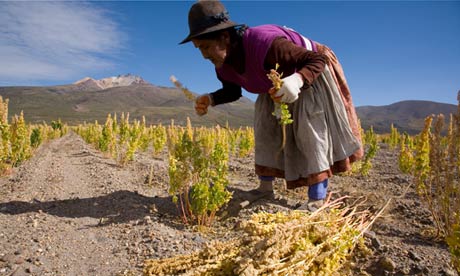
Not long ago, quinoa was just an obscure Peruvian grain you could only buy in wholefood shops. We struggled to pronounce it (it's keen-wa, not qui-no-a), yet it was feted by food lovers as a novel addition to the familiar ranks of couscous and rice. Dieticians clucked over quinoa approvingly because it ticked the low-fat box and fitted in with government healthy eating advice to "base your meals on starchy foods".
Adventurous eaters liked its slightly bitter taste and the little white curls that formed around the grains. Vegans embraced quinoa as a credibly nutritious substitute for meat. Unusual among grains, quinoa has a high protein content (between 14%-18%), and it contains all those pesky, yet essential, amino acids needed for good health that can prove so elusive to vegetarians who prefer not to pop food supplements.
Sales took off. Quinoa was, in marketing speak, the "miracle grain of the Andes", a healthy, right-on, ethical addition to the meat avoider's larder (no dead animals, just a crop that doesn't feel pain). Consequently, the price shot up it has tripled since 2006 with more rarified black, red and "royal" types commanding particularly handsome premiums.
But there is an unpalatable truth to face for those of us with a bag of quinoa in the larder. The appetite of countries such as ours for this grain has pushed up prices to such an extent that poorer people in Peru and Bolivia, for whom it was once a nourishing staple food, can no longer afford to eat it. Imported junk food is cheaper. In Lima, quinoa now costs more than chicken. Outside the cities, and fuelled by overseas demand, the pressure is on to turn land that once produced a portfolio of diverse crops into quinoa monoculture.
Tags
Who is online

121 visitors
Related article... Quinoa brings riches to the Andes .
I had never heard of this, so am grateful for the education. Yeah, I'm behind the times, but here, we eat potatoes. Sometimes, we eat rice. If we're looking for a grain, we go with corn, oats, or wheat. But, what the hey? What do I know?
I'm hoping that we can help them develop methods that will help them produce it locally, so that the people that live there can get what they need at a low price. Perhaps we could help the government subsidize it, or something, so that the poor can get what they need to survive.
SIGH!
Every time that I try to eat hummis, which I really like the taste, I get choked on it. Just like cole slaw... Some things I don't swallow well, it seems, and end up choking and gagging and have to leave wherever I am in case I throw up. Ugh.
Is it finely ground? I may try it! It sounds interesting, for sure!
I don't particularly like it either.
Oh Debby is going to be very upset. She lives on the stuff
Personally, I have tried it and I don't like it. Now I don't like it more. I hate it when our lifestyle affectindigenouspeople. We feel chic and they go hungry.
There's got to be a better way.
I'm with you.
Dearest Neetu, I love the cornbread at Cracker Barrell... Well, I got a piece of the stone ground cornmeal imbedded in my cheek and had to go to the dentist to get it out. Grainy stuff-- jsut gets me.
I like the stuff and was bummed out to read this.
What Iintendedto find out while doing some reading, was how this must be positively affecting the the farmers of Peru and Bolivia. What I found is that it's a mixed blessing. kinda like the oil boom in Western North Dakota, there are those who profit and those who lose.