


 NASA Ames/JPL-Caltech/T. Pyle Artist's illustration of Kepler 452b.
Today, a team of NASA scientists hit a new milestone in the20-year hunt for a planets outside our solar system by finding a worldmore like Earth than anything we've ever seen before .
Their momentous discovery points to a planet outside of our solar system about 1,400 light years from Earth. They're calling it Kepler 452b.
This amazing find comes with the tantalizing question: Does this planet currently have life or did it at some point in the past?
Right now, scientists don't have powerful enough instruments to answer this burning question. However, there are qualities about this newly-found planet that are extremely exciting.
For starters, it orbits around a single star that is very similar to our sun.
Stars come in many different sizes and temperatures. There are giant stars, which can be tens of thousands of times larger than our sun, whichare relatively short lived and explode when they die. These stars are not a likely place to search for life. On the other end of the spectrumarestars that are verysmall and cool and which will outlive our sun by billions of years that might notgive off enough energy foran Earth-like planet to reach temperatures that would allowit toharbor liquid water.
Kepler 452b's star, however, is in the same family of stars as our sun. It's basically an older cousin ofour sun.
Here's a chart that showshow much energy Kepler 452b is receiving from its star compared to Earth. It gets about 10% more sunlight than we do:
 Matthew Stuart
This brings us to the next intriguing quality of Kepler 452b: Its orbit.
This exoplanet is locatedat just the right distance about 93 million miles from its star to harbor liquid water on its surface. NASA can'tsay whether there is water on the surface, but just that there is a sweet spot around every star, called the habitable zone, where a planet will receive enough sunlight, but not too much, forwater toexist in its liquid state.
Andit doesn't take a rocket scientist to tell you that where there's water there's the potential for life.
Here's where Kepler 452b is in it's orbit compared to Earth and other exoplanets. Note that the chart doesn't show the actual distance from the planet's star, but instead how much energy the planet gets from sunlight. (If the star were a small, dim one, then the habitable zone would be closer to the star to absorb enough thermal energy.) The green band below highlights the habitable zone:

But water isn't the only thing you need for life. You also need time millions and billions of years'worth.
Scientists suspect that the first life forms on Earth were spawned between 3.5 and 3.8 billion years ago. That means planet Earth was a desolate place for its first 200 to 500 million years. And humans didn't arrive on the scene until just 200,000 years ago.
The team can estimate the age of Kepler 452b by calculatingthe age of its star. They report that this star is about 6 billion years old that's 1.5 billion years older than Earth and our sun. Which leads to the exciting conclusion by Jon Jenkins, the Kepler data analysis lead at NASA's Ames Research Center who lead the study:
"It's simply awe-inspiring to consider that this planet has spent 6 billion years in the habitable zone of its star, which is longer than the age of the Earth," Jenkins said. "That's considerable time and opportunity for life to arise somewhere on the surface ... should all the necessary ingredients and conditions for life on this planet [exist]."
And then there's the size of the planet to consider.
Large planets, like Jupiter and Saturn and most of the exoplanets known today, have no rocky surface to speak of. They're just giant balls of gaseous atmosphere. From what we've seen and from what we understand about planet formation, you have to be small to have a solid surface.That's a problem for Kepler 452b.
The team measured Kepler 452b's size at about 60% larger than Earth's. So, Kepler 452b is still very small as planets go and, therefore, likely a rocky planet instead of a gaseous one. That's good news since we tend to think that life on other planets will need something to stand on unless there are flying aliens eluding our detection in Jupiter's skies.
This illustration compares the relative size of Kepler 452b to Earth:
 NASA/JPL-Caltech/T. Pyle
A rocky surface isn't the only benefit to Kepler's size, though.
As stars like our sun and Kepler 452b's sun age, they tend to get hotter. Some planetary scientists think that within about a billion years, our sun will get hot enough to trigger a runaway greenhouse effect on Earth that will result in the evaporation of our oceans evaporating, signaling the end of life on our home world.
However, even though Kepler 452b and its star are a billion years older than we are, the newly discovered world might be in better shape. As NASA states in a release regarding the latest results:
"Since it is 60% bigger than Earth, it is likely to be approximately five Earth masses, which provides additional protection from the runaway greenhouse effect for another 500 million years."
To put this into perspective, if Earth were the same size as Kepler 452b, we would likely have at least a couple hundred million more years before we had to worry about catastrophic solar-evolution induced global warming. That of course doesn't leave us off the hook for our own, more modest but still potentially disastrous, impact on Earth's climate.
While all of these qualities weigh substantially in Kepler 452b's favor for having life either now or some time in the past, t's not necessarily the most likely place we'll find life.
 NASA / Jet Propulsion Lab-Caltech / SETI Institute
The one thing we really need to know first is if there's water on its surface. Unfortunately, as remarkable as the Kepler telescope has been at finding far away worlds, we will have to wait for at least the next generation of space telescopes , and possibly decades longer than that, before we have the ability to spot water on planets in other solar systems like Kepler 452b.
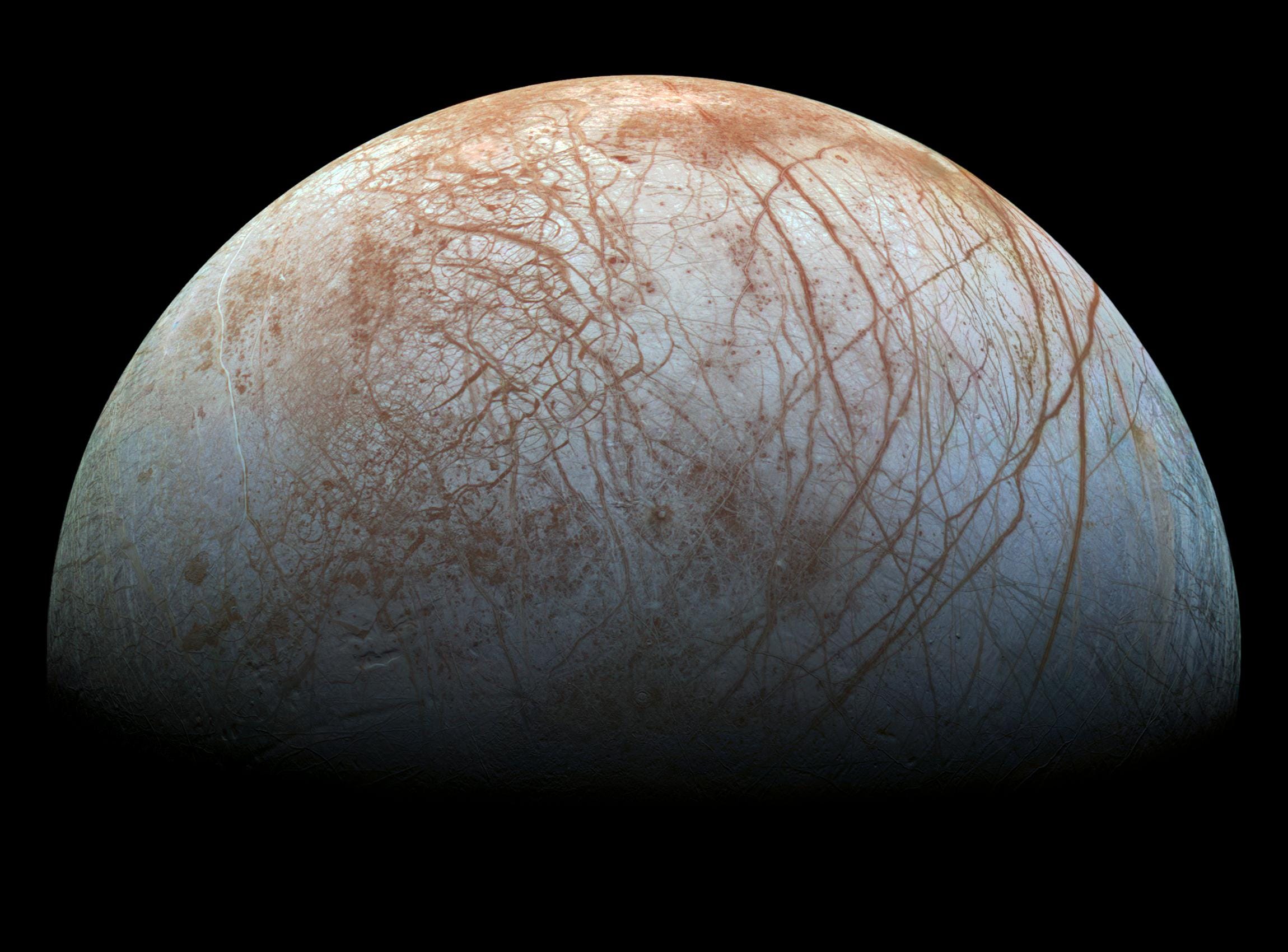
Meanwhile, there are places in our own solar system which almost certainly harbor large quantities of liquid water: Saturn's moon Enceladus and Jupiter's moon Europa.
Both of these are believed to have vast, deep oceans underneath their outer icy surfaces. The life that could be swimming in these oceans would have to be able to survive under pretty extreme conditions, but scientists like Steve Vance, who is a member of the Europa mission science team at NASA's Jet Propulsion Laboratory, thinks that there definitely could be something down there:
"My modest thought about what kind of life might be at Europa involves the kinds of things that we see at heads of thermal vents [on Earth], mainly microorganisms," Vance told Business Insider earlier this year .
And there's always the possibility that we'll find microbial life hidden deep beneath he surface of Mars.
One thing is clear: In the race to discover the first alien life, astrobiologists just got a major new contender.


A planet similar to earth, of a comparable age and size, orbiting around a sun very similar to our own.
Earth 2.0!
Space exploration and discovery is very cool
Now we haveto figure out an effective, safeand timely means to travel to and more closely study Kepler-452
Being that many light years away would mean that anyone who starts out from Earth will not survive to reach it. That means a large enough ship that can maintain within itself a life-sustaining environment would be required as it would take generations to reach that planet. Think of the movie "Silent Running":
Buzz
The way we travel now that is true
It's just possible these Keplarians will visit us before we visit them ...
They were going to visit, but then they read this....
"... To put this into perspective, if Earth were the same size as Kepler 452b, we would likely have at least a couple hundred million more years before we had to worry about catastrophic solar-evolution induced global warming. That of course doesn't leave us off the hook for our own, more modest but still potentially disastrous, impact on Earth's climate.
What really dissuaded them was reading news about Al Gore ...
They won't know about Gore for 1400 years. Even then, Gore will just be seen as a massive object hurtling through space, but only IF the Keplerans have invented telescopes by then.
Petey
I guess anything is possible
Robert G
So you are telling me that our MSM coverage is seen and heard as far away as 1400 light years.
Now that is a broad audience, thanks for the insight
Hal
So long as exploration is taking place, it can be unmanned vehicles in my view.
Closing in on the next frontier. In a couple of million light years, but we gaining.
Kavika
Perhaps only thousands of light years but that is still a mighty long way to go
The distance between our worlds is so vast that, by the time we see anything, it's 1400 years old. Just traveling to the nearest star, 4.2 light years away, will take 80,000 years (2700 generations). In that time, intelligent life could evolve, develop advanced civilizations, perhaps explore outer space, and have long since crumbled to dust. When you factor in the incredible luck of life (intelligent or otherwise) evolving in the first place, the odds of us ever running across another life form seem extremely remote.
1of
Your facts seem sound (at this point in time, with the knowledge we have and modes of transportation available)
But that is no reason to stop looking in my view, knowledge is in the search as well as the discovery.
I wasn't suggesting an end to exploration/discovery but rather suggesting that we should still be realistic in our expectations.
I know and I was agreeing that even though it seems impossible with our current knowledge and capabilities that we must drive on with space exploration.
Being realistic is usually a good approach, but a wise and successful guy said
And Robert Browning, long before Ted Turner, said: "A man's reach should exceed his grasp, or what's a heaven for."
Jules Verne and H. G. Wells were pooh-poohed in their time.
It's possible that in theinterim, while this group is traveling through space by the fastest means possible at the time they left earth, scientist will have developed much faster space travel methods that will allow younger generations to leave earth and reach Kepler light years ahead of the original explorer teams' offspring.
And it's further possible that the second group of travelers, having arrived light years ahead of the first group, will have destroyed Keplers' atmosphere and moved deeper into space, leaving the first groups' offspring to arrive at a dead planet.
Yes, Jerry, that is a possibility. Don't we have so much to look forward to?
Jus' speculatin'
We'll never know.
(That is unless there is an after life and it comes with decent space travelaccommodations.)
Jerry
Yes and what is possible and what might be, is the fuel that drives exploration and discovery!
Thanks for the perspective
Buzz
We have to try and do things we think we cannot do in order to grow!
Forward thinkers are pooh-poohed in all generations