
The Dollar Keeps Rising, for Good or Evil


The Dollar Keeps Rising, for Good or Evil
original article by Eduardo Porter, NY Times
------------------------------
Just the other day I got an email in which Ron Paul, libertarian icon, former member of Congress from Texas and father of the Republican presidential candidate Rand Paul, eagerly proclaimed that his “final prediction of a dollar collapse is about to become reality.”

An engraving plate
for a dollar bill.
Despite predictions
to the contrary,
the currency has
remained strong.
Credit Gary Cameron
/Reuters
The email was a bit extreme, perhaps, with references to the hyperinflation of Weimar Germany, Robert Mugabe’s Zimbabwe and the Book of Genesis. But Mr. Paul’s dire premonition fits within an overarching Republican proposition that the Obama administration and the Federal Reserve are relentlessly undermining the American economy.
Other, more serene analysts have also predicted a weak dollar. Martin Feldstein, who was a top economic adviser to President Ronald Reagan, argued some five years ago that the country’s large trade deficit and ultralow interest rates, coupled with sales of United States assets by international investors and changes in the Chinese economy, would push the dollar down over coming years.
They were exactly wrong. The dollar’s rise, which started virtually the day Professor Feldstein made his prediction in 2011, shows little sign of abating. It amounts to only the third instance of such consistent appreciation since Richard Nixon took the United States off the gold standard in 1971.
The American economy might just be bumbling along, but it is doing substantially better than the rest of the advanced industrial world. “It is quite natural,” said Barry Eichengreen of the University of California, Berkeley, “that the currency of the country whose economy is least bad should have the least worst currency.”
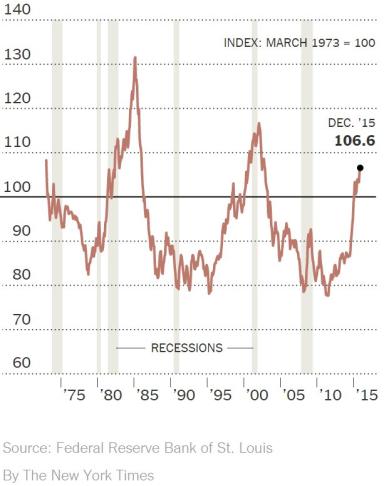
Rising Dollar
In recent years, a resilient
American economy has sent
the dollar on a sustained
ascent against the currencies
of the United States’ main
trading partners.
Real trade-weighted
U.S. dollar index
Monthly value of the US dollar
relative to major world
currencies
But with many developing economies in a tailspin, commodity prices and stock markets tumbling sharply around the world, could a rising dollar damage a fragile economic order?
Many economists argue it is mostly a good thing. A strong dollar should help Europe and Japan overcome their deeper economic weaknesses by making their products cheaper on world markets — an overall positive for global growth. The strengthening of the dollar, Olivier Blanchard, former chief economist at the International Monetary Fund, told me, “is a fundamentally healthy process.”
But there are reasons to be cautious. A strong dollar will squeeze American manufacturers, which have otherwise benefited from falling energy prices and rising wages in China. That will weigh on growth in the United States and further suppress inflation, which is already well below the Fed’s target.
Stanley Fischer, the Fed vice chairman, said in a speech in November that, according to the central bank’s models, a 15 percent rise in the dollar could cumulatively trim almost 2.5 percentage points off gross domestic product after three years, if its rise did not turn around and it was not offset by easier monetary policy or more public spending. And it could reduce 2015 inflation by as much as half a percentage point.
This has prompted some calls for corrective action. In November, C. Fred Bergsten, former head of the Peterson Institute for International Economics, argued that the euro and Japanese yen were sharply undervalued against the dollar, and urged policy makers to pursue a rerun of the deal struck by the Reagan administration and America’s chief trading partners at the Plaza Hotel in New York in 1985, when they agreed to coordinate their actions to weaken the value of the dollar.
And the effects in the United States are not the principal worry.
Federal Reserve officials can get cranky when foreigners criticize their policies. The Fed was accused of starting a “currency war” when quantitative easing sent the dollar sharply lower. Now it is criticized when interest rates and the dollar are going up.
And yet the critique, articulated most forcefully by Raghuram Rajan , the governor of India’s central bank, has merit. That’s because these swings, even when justified by the needs of the American economy, can induce enormous volatility around the world.
Superlow interest rates in the United States sent money streaming into emerging markets, where returns were higher, leading them to amass lots of dollar debt . An appreciating dollar makes this debt more difficult to manage, especially as the prices of the commodities these countries export fall .
Policy makers in developing countries can remember the last two times the dollar went through periods of sharp appreciation. There was the first half of the 1980s, when Latin America fell into what is remembered today as the “lost decade,” and the second half of the 1990s, when much of Asia ended up underwater. The memories aren’t pleasant.
The added factor today is the new role of China in the global economy, since it is now a significant presence, with a currency that is no longer as insulated from outside forces as it was in the previous two episodes.
The dollar’s appreciation has rekindled populist attacks against Beijing, from Senator Chuck Schumer’s repeated accusations of currency manipulation to Donald Trump’s promise to levy a 45 percent tax on imports from China.
The attacks are wrong. Indeed, the International Monetary Fund no longer deems China’s currency, the renminbi, undervalued. Actually, China’s currency has been mostly rising along with the dollar against the currencies of its other trading partners, squeezing an already slowing economy.
Beijing is in a pickle. Last summer, the Chinese government tried Washington’s prescription: to let market forces play a bigger role in determining the exchange rate. But then the renminbi fell, producing the expected populist complaints from the United States. What’s more, Chinese savers dashed to send their money out of the country, frightened that the currency could be on the cusp of a long slide.
The rising dollar “complicates policy management,” in China, said Eswar S. Prasad, a former head of the I.M.F.’s China division who teaches at Cornell University. “If the renminbi were to drop by a couple of percentage points, the implication would be that the central bank wants a much cheaper currency, which would lead to more capital outflows.”
Professor Prasad, like most economists, says he believes the dollar’s gain is benign. “The United States is the only country whose currency can appreciate like this without its economy suffering badly,” he said. “This is something of a blessing for the world.”
And yet he allows for a kink in the analysis.
Remember the financial crisis, visited upon the world by the American housing market and its banks? Despite being at the center of the disaster, the dollar didn’t weaken but instead strengthened. Gripped by abject fear, investors could think of nowhere else to run.
The dollar has gone haywire before. In the two years before the Plaza Accord, it continued to soar even after the Fed chairman at the time, Paul Volcker, relaxed his grip on interest rates. The misalignment led to devastation in the Rust Belt, helped lay the groundwork for the Japanese bubble and fostered enormous trade imbalances.
Today perhaps it is safe to say the dollar is driven mostly by natural forces that should reverse when growth picks up elsewhere in the world. But in this choppy world economy it would be foolhardy to ignore one of the main forces driving financial flows through history: irrationality.
Tags
Who is online

114 visitors
I seeded this for one reason: it underscores the fact that there are some economists who, consciously or unconsciously, allow a political agenda to guide their public pronouncements. Since political agendas are rarely in tune with the economy, this leads these people to make jackasses of themselves.
There are economists who have been predicting inflation, just around the corner, for eight years, now. Without ever explaining why they were wrong yesterday, and why we should believe them today. Despite being wrong, they are regularly invited to give their wisdom to viewers of cable "news".
Reading one article is not a safe basis for forming an opinion...
there are some economists who, consciously or unconsciously, allow a political agenda to guide their public pronouncements.
The most outstanding example of that would be Paul Krugman . But in his case it is clearly conscious political bias ...

You've just proven that you know nothing about Krugman.
You need to explain that Bob . From what I've seen of Krugman his liberal bias is constant & perpetual .
From what I've seen of Krugman
How much is that? He writes in the Times just about every day. How often do you read his column?
This is an indirect way of asking two things. Do you have enough first hand knowledge to form a valid opinion? Or is your opinion copied from somewhere?
I ask, because I read his column every day, so I consider that my first hand knowledge is sufficient for a valid opinion.
Every time you post one of his columns here I am struck by how biased & partisan the coverage is ...
I am honored, Petey, that you presume that my small selection of Krugman's work is a statistically significant sample.
So you are picking on Ron Paul because ONE of his MANY predictions has not come to pass YET?
Looks to me like he knew/knows lot more about the economy than the folks who's horn you love to honk.
BTW, do you really think the fact that the US dollar is rinsing against other currencies proves it is stable, or does it just prove that the currencies it is valued against are less stable?
Actually the value of the dollar keeps declining.
Read the article, Dean. You're completely off-topic.
How on earth is the value of the dollar off topic on an article about the value of the dollar? If you are trying to argue it doesn't matter that the purchasing power has dropped because it has stayed in step with the decline of other currencies then I fully understand why you have so many delusions of Keynesian economics.
Good Lord!
Are you serious? Please tell me that you know the difference between purchasing power and exchange rate...
Are you serious? Please tell me you are not trying to insinuate that purchasing power doesn't matter as long as the exchange rate is "acceptable" (in your opinion).
Please tell me you are not trying to insinuate that purchasing power doesn't matter as long as the exchange rate is "acceptable" (in your opinion).
I have said nothing of the sort. I have not used any notion of "acceptable" for anything, here.
Just stick to what I actually say. No need to make stuff up.
As was indicated in the article, the rising value of the dollar does squeze manufacturers whose substantial markets are abroad, and consideration should be given to the effect that might have on employment. My personal concern is the fact that the Canadian dollar in the past few years seems to have lost 20 to 25% of its value - a boon to Canadian exporters, but a disaster for an expat like me who relies partially on the value of a Canadian pension.
When we bought our condo in Yuma, the euro was at $1.40. Now it's $1.08. Our retirement is in euros, so our cost of living has gone up 25%, during the six months we're here.
On the other hand, should we sell the condo, we'd get a 25% windfall...
It's a sign people gained confidence in the government when the Dems lost congress and have no confidence in the euro trash governments.
In fact, Dean... The Dems won the House popular vote by over a million. But gerrymandering gave the House to the Reps. Probably definitively.