
Marines investigating claim about men in Iwo Jima photo



© AP Photo/Joe Rosenthal, File FILE - In this Feb 23, 1945 file photo, U.S. Marines of the 28th Regiment, 5th Division, raise the American flag atop Mt. Suribachi, Iwo Jima, Japan.
DES MOINES, Iowa — The Marine Corps says it has begun investigating whether it mistakenly identified one of the men shown raising the U.S. flag at Iwo Jima in one of the iconic images of World War II after two amateur history buffs began raising questions about the picture.
The Marines announced its inquiry more than a year after Eric Krelle, of Omaha, Nebraska, and Stephen Foley, of Wexford, Ireland, began raising doubts about the identity of one man. In November 2014, the Omaha World-Herald published an extensive story about their claims and Saturday was the first to report the Marines were looking into the matter.
Associated Press photographer Joe Rosenthal shot the photo on Feb. 23, 1945, on Mount Suribachi, amid an intense battle with the Japanese. Rosenthal didn't get the names of the men, but the photo immediately was celebrated in the U.S. and President Franklin Roosevelt told the military to identify the men.
After some confusion, the Marines identified the men as John Bradley, Rene Gagnon, Ira Hayes, Harlon Block, Michael Strank and Franklin Sousley. All were Marines except Bradley, who was a Navy corpsman.
Block, Strank and Sousley were killed in fighting at Iwo Jima before the photo was distributed in the U.S.
On Monday, the Marines issued a statement saying, "The Marine Corps is examining information provided by a private organization related (to) Joe Rosenthal's Associated Press photograph of the second flag raising on Iwo Jima.
"Rosenthal's photo captured a single moment in the 36-day battle during which more than 6,500 US servicemen made the ultimate sacrifice for our Nation and it is representative of the more than 70,000 US Marines, Sailors, Soldiers and Coast Guardsmen that took part in the battle. We are humbled by the service and sacrifice of all who fought on Iwo Jima."
Iwo Jima, a tiny island 660 miles south of Tokyo, was the site of an intense 36-day battle that began Feb. 19, 1945, between about 70,000 Marines and 18,000 Japanese soldiers. Capturing Iwo Jima was deemed essential to the U.S. war effort because Japanese fighter planes were taking off from the island and intercepting American bomber planes.
Hal Buell, a retired AP executive news photo editor, had long discussions with Rosenthal about the flag-raising picture and in 2006 wrote a book about the famous image. It's hard to understand the photo's power in 1945 to Americans, who were weary of the war and horrified by the incredible number of deaths by servicemen, especially in locations of Asia most had never heard of, Buell said.
"People were just tired of the war, and all of a sudden out of nowhere came this picture that encapsulated everything," Buell said. "It showed that victory was ultimately possible."
Buell said after Rosenthal shot the photo, the flag-raisers quickly moved onto other tasks, and it was impossible for him to get their names. That task was left to the Marines after the picture prompted an overwhelming response and the government decided to use the image in an upcoming sale of war bonds to finance the continued fighting.
Rosenthal died in 2006.
The identification of the six servicemen has been accepted for decades, but the World-Herald reported that while recovering from an operation Foley had lots of time on his hands and began noticing possible discrepancies in the picture. He enlisted the help of Krelle, who maintains a website dedicated to the Marines' 5th Division.
After examining the famous photo along with other pictures taken that day of the men, they concluded that the man identified as Bradley was actually Harold Henry Schultz, a private first class from Detroit. Schultz died in 1995.
Krelle declined to comment on the Marine's investigation, telling the World-Herald he had signed a confidentiality agreement with a third party. A message left by the AP at a phone number listed to Krelle wasn't immediately returned.
In 2014, Krelle had told the newspaper, "People can hold onto what they have always known in the past. But to me, the photos are the truth."
Discrepancies identified by Krelle and Foley included:
— Bradley wore uncuffed pants in the famous photo but other pictures shot that day shows in him tightly cuffed pants.
— The bill of a cap is visible beneath the helmet in the flag-raising picture but not in other images of Bradley made that day.
— The man identified as Bradley is wearing a cartridge belt with ammunition pouches, and a pair of wire cutters hangs off the belt. But as a Navy corpsman, Bradley would typically be armed with a sidearm, not an M-1 rifle, and he'd have no need for wire cutters. Other photos that day show him wearing what appears to be a pistol belt with no ammo pouches.
Bradley's son, James Bradley, wrote a best-selling book about the flag raisers, "Flags of Our Fathers," which was later made into a movie directed by Clint Eastwood.
Bradley told the AP he was shocked to hear the Marines were investigating the identity of the men.
"This is unbelievable," said Bradley, who interviewed the surviving Marines and Rosenthal before writing his book.
"I'm interested in facts and truths, so that's fine, but I don't know what's happening," he added.
The Marines didn't give a timeline for its investigation.

Tags
Who is online
107 visitors
So these "history buffs" are saying that three of the men depicted by the statue were not really there?
Wow! At least they aren't trying to say Ira Hayes wasn't really there... yet. But since Indians are Invisible People, they probably just overlooked him.
Actually, when they first posted the list, it was inaccurate, they didn't know the names of all the participants and they dispersed too quickly for their names to be recorded. once the pic was published, EVERYONE in the media wanted the names of the men. Which they didn't have, so the Marine Corps sent out an order to compile the list of names, that is when they found out that two had died shortly after the pic was taken and a third before they could locate him in the remaining battle. (three days before the end by a sniper) On orders the remaining men were removed from the island to prevent any more getting killed. They were not happy about it. (Ira was reputed to have said many times that that pic ruined his life) It was Gagnon that first listed the names (only five) and refused to reveal Ira Hayes name (at Hayes Request) It took a presidential order and a visit from the commandant to get him to reveal it.
There was some issues with the listing of names and Hayes was ordered by the corps to be quiet about it. And officially he was. but upon separation, Hayes went to Block's parents and told them that indeed their son was one of the raisers.
I'm all for evidence but come on, someone who was actually there? Actually did it? I would go with it. Anything else at this point is pure speculation. They not only know who was there, they know why theyr were there and what each ones orders were that put them there.. They know exactly which flag was which, where they came from and how they got to the top of that mountain. with the testimony of those that actually jives with the known orders and actions.
Geese louise! The wiki article about the flag raising goes over this at length, once you read it you will have to wonder at what people are thinking.
The sculptor who created the statute for the memorial was a US navy petty officer, Felix de Weldon, and when he got a copy of the pic the immediately set out making a model of the scene. When the Commandant (General Vandegrift) saw the model, he immediately transferred de Weldon from the navy to the corps. (De Weldon was actually commissioned to build the statute for the memorial in 1951, his model, made in 1945, currently sits in the Marine Corps commandant's office on a table befitting it's significance.
One MUST understand to be recognized as part of that iconic picture and hence the statue is one huge financial windfall given interviews, stories and images. The fact that the Marine Corps is actually investigating with all the hard evidence they have in hand just boggles the mind.
Not really sure where the Ira Hayes thing comes in? If no one said he wasn't there, how is he invisible?
Not sure this is the right article to try to take that particular discussion.
All of those who served during WWII faced horrible conditions and many met a horrible death. Does it matter who put the flag up? I think it matters more that U.S. Servicemen were there and they raised the flag.
From the "comment" section following the article....
Richard Terry ·
Seriously, I had two uncles in the army in Europe and one uncle in the marines in the South Pacific. My marine uncle died there and never made it home. The brave soilders that fight to protect this country have my respect.
There have been rumors about this for as long as I can remember. Mostly stemming from the fact that there were actually two flag rising's that day. The first one it was decided that the flag was not big enough so a larger flag was ordered to be raised and it's that flag raising that was caught in the iconic picture. The resulting picture and war bond drive provided hugely needed money for the war effort. Personally I really don't think it matters who the Marines were who actually were in which picture. They raised the flag for all of the Marines there, those that died and those that survived. And in a larger sense for every Marine, Sailor, Soldier and Airman of the war, as well as every doctor and nurse and person on the home front and in the factories right on down to the kids saving balls of tin foil to give to the war effort.
What you have just said, Randy, is the prevailing opinion of the hundreds who posted comments.
Don't wish to be contrary here but......
The First Flag raising was photographed. By Sgt Lou Lowery of the 5th marines photographic detail. (not released until 1947)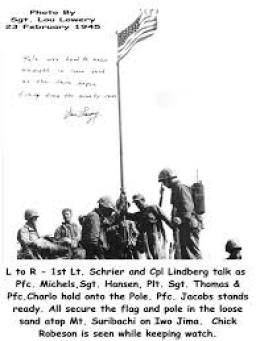
From what I can tell, this is the issue.
John Bradley is second from the right in the famous photo
here you seem him in a freeze frame of a movie made of the flag raising
They are talking cap under the helmet? that's not a cap, it's his helmet liner. Standard Infantry usually they do not show but if loose they could. That is what is being seen in that photo. ALL the boys in the photo are wearing them. And you didn't wear a helmet without one.
They are also wearing camo pattern helmet covers
Very moving video, John.
This is a photo from the first flag raising. John Bradley is identified, in this and other photos , by a medical bracelet around his right wrist.
The gear around his waist does not match what appears to be the gear around the waist of the figure in the flag raising photo identified as Bradley. Also in the first flag photo Bradley is seen with cuffed pants and leggings and not in the flag raising photo.
At least that is what they say.
That is not a cuff, that is the sewn hem of the pants leg, it is seen on the others also, a cuff is a fold at the bottom of the pants leg where you can actually see the edge. look at the other marines they have the same line about an inch and a half above the pants leg but no edge showing. They are hems not cuffs.
I think the people raising the issue got too much time on their hands. And need their eyes checked.
Exactly as he is supposed to be, at the time and place he is known to be. No rifle, but might have had a pistol usually a .45 colt, but only if he wanted one. (it wasn't required of corpsman to be armed)
I think this whole thing is a bunch of crap to get their names in the news.
It surprises me that the Marines are actually investigating this and wasting their time.
I don't really have an opinion about it, but there does appear to be some visual discrepancies . Maybe Bradley rearranged his gear between the two photos.
The author James Bradley says that if his father was not in the photo the son believes that his father would have said something about when he was dying. Who knows?
I am with you on this John... if any of the men credited with raising the flag were not there, or any that were there are not credited with it, it seems they would have talked about it before now.
Everyone here has made good points... as the person commenting on Yahoo News said:
Only God and the participants know the truth. For the rest of us it's only speculation. Let's not further try and rip this apart. They all were heroes.
I see a money making project in the works - "Krelle declined to comment on the Marine's investigation, telling the World-Herald he had signed a confidentiality agreement with a third party."
Somebody definitely trying to scam something.
Exactly, 1stwarrior.
When you think about it, there was not only the men who raised the flag, but others were still there as well. With all the media hoopla it seems someone would have set the story straight. I can't really see the government... at that time not as powerful in private citizen's lives.... as having the wherewithall to silence all those who witnessed the event or knew the men involved.
It did, indeed, ruin the life of Ira Hayes.
The Ira Hayes issue with reporting Hansen as not part of the team raising the flag the reason ws that the bond drive had already started, and Hansen's mother was participating with the drive. It was when Ira found out during one of the dinners about why Mrs Hansen was there. He went to one of the PR detachment "handlers" and reported it. (public relations handled all bond drive tours) He was told to let it go as not to upset the bond drive with any controversy. When he replied that he thought it was important enough to correct, (it was) he was paid a visit by the PR detachment commander who ordered him to keep quiet about it. Which he did until he separated form the Corp and the first thing he did at that point was go to Blocks parents and tell them that their boy was one. He actually wrote them an affidavit to that effect upon their request which is what they took to their congressman to get it corrected.
AS well as it should have been. They say that Ira suffered from survivors syndrome. He didn't consider himself a hero, and it took a presidential order for his participation to be revealed. Personally I believe that the guilt over that bond tour is what killed him, now on that bond tour they went to the point of several time recreating the flag raising in real life. Which is where Ira first got in trouble with his drinking. He actually said to Bradley once after such an exhibition that he couldn't do them without being drunk. They both angered and depressed him that much. It got so bad that they eventually quit the recreations. But the damage was done. Ira believe that he was no hero for doing what he was ordered to do. (much like my father said in response to "Hero" talk, in fact it was my father that first told me about Ira Hayes, AND what they did to him)
Ira Hayes hated that picture.
And it killed him as sure as any bullet in Iwo could have.
My father had four heros of WWII, Captain Murphy, Major Bong, General MacArthur, and PFC Ira Hayes. (and what is similar to them all, they all received great notoriety as "Heros" but they all rejected the label of "Hero" emphatically.
This is interesting, because it reveals that there was an earlier misidentification of one of the men there.
"In March 1945, President Roosevelt, wishing to clear up the confusion, ordered the Marine Corps to identify the flag raisers and return the survivors to the United States. That order came with an ulterior motive: Roosevelt wanted the flag raisers to help sell war bonds to fund the costly war effort.
Pfc. Rene Gagnon, a runner for the 5th Division's E Company, had carried the flag up Mount Suribachi and was known to have appeared in Rosenthal's photo. So Marine higher-ups went to him and asked a seemingly simple question: Who are the men who helped you raise that flag?
Gagnon gave them four names: John Bradley, who had been wounded shortly after the photo. And Franklin Sousley, Michael Strank and Henry "Hank" Hansen, who had all died in the fighting that raged on Iwo Jima days after Rosenthal snapped his photo.
Gagnon intentionally didn't name Pfc. Ira Hayes, a Pima Indian from Arizona.
Hayes was in the photo but had already told Gagnon that he had no interest in being famous or going on a war bonds drive. In fact, Hayes had threatened Gagnon "with bodily harm" if he identified him as a flag raiser, according to statements given later by Marine Corps officials and Hayes himself.
But Gagnon seemingly made another error, this one an accident. He incorrectly identified the Marine standing at the base of the flagpole.
That's Hank Hansen, he told the Marine Corps.
Both Gagnon and John Bradley signed affidavits swearing that Hansen was pictured at the base of the flagpole. Hansen's mother joined the war bond tour for months.
But in 1946, the family of a Marine named Harlon Block, who had also died on Iwo Jima, sent a letter to their congressman containing a bombshell: a note from Ira Hayes stating that Block — not Hansen — was in the famous photo.
Within a year, the Marine Corps opened a special investigation to look into the Hansen-Block dispute. Bradley and eventually Gagnon signed new affidavits, and in January 1947, the investigation board issued its verdict. The sixth flag raiser was Harlon Block.
Hansen's family, furious, demanded the release of evidence compiled during the investigation. The Marine Corps refused.
Since then, the Marine Corps has attached six names to the famous flag raising photo: Gagnon. Bradley. Hayes. Sousley. Strank. Block."
This is news I have never heard of, John. Thank you for the information.
It appears Ira Hayes tried to rectify the mistake.
Indeed he did.
Good find John - thanks.
Ira Hayes may not have felt that he was a hero, but to me, he was. Every man there was a hero. I thank them for their courageous fight, and I thank them for the freedom they ensured for me.
Dear Mr. Hayes, I hope you see this in heaven: You WERE a hero to many, even more so because you tried to set the record straight. Mr. Bradley, you were a hero, too, whether or not you actually raised that flag. EVERY man there was a hero!
Copy the url of the video from You Tube (not the embed code) and paste it into the box you see when you click on the "embed local media" icon ( the one next to the smiley face on the bottom row and you click on the blue "You Tube" box.
Hit enter after you paste the url in. That is all you need to do, then post the "reply".
Thank you, John!
Ira Hayes
Ira Hamilton Hayes is a full blood Pima Indian and was born in Sacaton, Arizona, on the Pima Reservation on Jan 12, 1923. His parents Joe E. and Nancy W. Hayes were both farming people. When he enlisted in the Marine Corps, he had hardly ever been off the Reservation. His Chief told him to be an "Honorable Warrior" and bring honor upon his family. Ira was a dedicated Marine. Quiet and steady, he was admired by his fellow Marines who fought alongside him in three Pacific battles.
President Franklin D. Roosevelt called the brave survivors of the flag raising back to the United States to aid a war bond drive. At the White House, President Truman told Ira, "You are an American hero." But Ira didn't feel pride. As he later lamented, "How could I feel like a hero when only five men in my platoon of 45 survived, when only 27 men in my company of 250 managed to escape death or injury?" Later, they were shuttled from one city to another for publicity purposes with questionable sincerity on the part of the American military. Ira Hayes asked to be sent back to the front lines, stating that "sometimes I wish that guy had never made that picture".
Ira tried to drown his "Conflict of Honor" with alcohol. Arrested as drunk and disorderly, his pain was clear . . . "I was sick. I guess I was about to crack up thinking about all my good buddies. They were better men than me and they're not coming back. Much less back to the White House, like me."
He was never able to get his life back in balance again. Ira Hayes died of exposure at the age of thirty-three on Jan, 24th 1955. He was memoralized by the Pima people and characterized as "a hero to everyone but himself". He is buried in Arlington Cemetery. He never married.