This is how fascism comes to America


Robert Kagan is a senior fellow at the Brookings Institution and a contributing columnist for The Post.
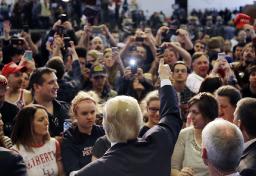
But of course the entire Trump phenomenon has nothing to do with policy or ideology. It has nothing to do with the Republican Party, either, except in its historic role as incubator of this singular threat to our democracy. Trump has transcended the party that produced him. His growing army of supporters no longer cares about the party. Because it did not immediately and fully embrace Trump, because a dwindling number of its political and intellectual leaders still resist him, the party is regarded with suspicion and even hostility by his followers. Their allegiance is to him and him alone.
And the source of allegiance? We’re supposed to believe that Trump’s support stems from economic stagnation or dislocation. Maybe some of it does. But what Trump offers his followers are not economic remedies — his proposals change daily. What he offers is an attitude, an aura of crude strength and machismo, a boasting disrespect for the niceties of the democratic culture that he claims, and his followers believe, has produced national weakness and incompetence. His incoherent and contradictory utterances have one thing in common: They provoke and play on feelings of resentment and disdain, intermingled with bits of fear, hatred and anger. His public discourse consists of attacking or ridiculing a wide range of “others” — Muslims, Hispanics, women, Chinese, Mexicans, Europeans, Arabs, immigrants, refugees — whom he depicts either as threats or as objects of derision. His program, such as it is, consists chiefly of promises to get tough with foreigners and people of nonwhite complexion. He will deport them, bar them, get them to knuckle under, make them pay up or make them shut up.
That this tough-guy, get-mad-and-get-even approach has gained him an increasingly large and enthusiastic following has probably surprised Trump as much as anyone else. Trump himself is simply and quite literally an egomaniac. But the phenomenon he has created and now leads has become something larger than him, and something far more dangerous.
Republican politicians marvel at how he has “tapped into” a hitherto unknown swath of the voting public. But what he has tapped into is what the founders most feared when they established the democratic republic: the popular passions unleashed, the “mobocracy.” Conservatives have been warning for decades about government suffocating liberty. But here is the other threat to liberty that Alexis de Tocqueville and the ancient philosophers warned about: that the people in a democracy, excited, angry and unconstrained, might run roughshod over even the institutions created to preserve their freedoms. As Alexander Hamilton watched the French Revolution unfold, he feared in America what he saw play out in France — that the unleashing of popular passions would lead not to greater democracy but to the arrival of a tyrant, riding to power on the shoulders of the people.
This phenomenon has arisen in other democratic and quasi-democratic countries over the past century, and it has generally been called “fascism.” Fascist movements, too, had no coherent ideology, no clear set of prescriptions for what ailed society. “National socialism” was a bundle of contradictions, united chiefly by what, and who, it opposed; fascism in Italy was anti-liberal, anti-democratic, anti-Marxist, anti-capitalist and anti-clerical. Successful fascism was not about policies but about the strongman, the leader (Il Duce, Der Führer), in whom could be entrusted the fate of the nation. Whatever the problem, he could fix it. Whatever the threat, internal or external, he could vanquish it, and it was unnecessary for him to explain how. Today, there is Putinism, which also has nothing to do with belief or policy but is about the tough man who single-handedly defends his people against all threats, foreign and domestic.
To understand how such movements take over a democracy, one only has to watch the Republican Party today. These movements play on all the fears, vanities, ambitions and insecurities that make up the human psyche. In democracies, at least for politicians, the only thing that matters is what the voters say they want — vox populi vox Dei . A mass political movement is thus a powerful and, to those who would oppose it, frightening weapon. When controlled and directed by a single leader, it can be aimed at whomever the leader chooses. If someone criticizes or opposes the leader, it doesn’t matter how popular or admired that person has been. He might be a famous war hero, but if the leader derides and ridicules his heroism, the followers laugh and jeer. He might be the highest-ranking elected guardian of the party’s most cherished principles. But if he hesitates to support the leader, he faces political death.
In such an environment, every political figure confronts a stark choice: Get right with the leader and his mass following or get run over. The human race in such circumstances breaks down into predictable categories — and democratic politicians are the most predictable. There are those whose ambition leads them to jump on the bandwagon. They praise the leader’s incoherent speeches as the beginning of wisdom, hoping he will reward them with a plum post in the new order. There are those who merely hope to survive. Their consciences won’t let them curry favor so shamelessly, so they mumble their pledges of support, like the victims in Stalin’s show trials, perhaps not realizing that the leader and his followers will get them in the end anyway.
A great number will simply kid themselves, refusing to admit that something very different from the usual politics is afoot. Let the storm pass, they insist, and then we can pick up the pieces, rebuild and get back to normal. Meanwhile, don’t alienate the leader’s mass following. After all, they are voters and will need to be brought back into the fold. As for Trump himself, let’s shape him, advise him, steer him in the right direction and, not incidentally, save our political skins.
What these people do not or will not see is that, once in power, Trump will owe them and their party nothing. He will have ridden to power despite the party, catapulted into the White House by a mass following devoted only to him. By then that following will have grown dramatically. Today, less than 5 percent of eligible voters have voted for Trump. But if he wins the election, his legions will likely comprise a majority of the nation. Imagine the power he would wield then. In addition to all that comes from being the leader of a mass following, he would also have the immense powers of the American presidency at his command: the Justice Department, the FBI, the intelligence services, the military. Who would dare to oppose him then? Certainly not a Republican Party that lay down before him even when he was comparatively weak. And is a man like Trump, with infinitely greater power in his hands, likely to become more humble, more judicious, more generous, less vengeful than he is today, than he has been his whole life? Does vast power un-corrupt?
This is how fascism comes to America, not with jackboots and salutes (although there have been salutes, and a whiff of violence) but with a television huckster, a phony billionaire , a textbook egomaniac “tapping into” popular resentments and insecurities, and with an entire national political party — out of ambition or blind party loyalty, or simply out of fear — falling into line behind him.
Tags
Who is online
112 visitors
Republican politicians marvel at how he has “tapped into” a hitherto unknown swath of the voting public. But what he has tapped into is what the founders most feared when they established the democratic republic: the popular passions unleashed, the “mobocracy.”
As Alexander Hamilton watched the French Revolution unfold, he feared in America what he saw play out in France — that the unleashing of popular passions would lead not to greater democracy but to the arrival of a tyrant, riding to power on the shoulders of the people.
Fortunately this person, Donald J. Trump, will never be the President of the United States. Are all Trump followers Fascist? Of course NOT! However all Fascist types in America do support him as is witnessed by the number of racist organizations, that he does nothing to discourage, that do support him. They see in him what they see in themselves. That all of America's problems would be solved if we just rid the country of immigrants, Muslims, Hispanics, Blacks, all of those "others" (including Native Americans) who are not good old fashioned all American Protestant White people that they used to see on TV in the 1950's and early 60's and actually believe were real.
And is a man like Trump, with infinitely greater power in his hands, likely to become more humble, more judicious, more generous, less vengeful than he is today, than he has been his whole life? Does vast power un-corrupt?
No.
Why couldn't Hamilton watch it from America, and see what was happening in France from America, ? in the same way that the British prime minister and the King of England watched and saw the American Revolution unfold from the other side of the Atlantic.
I don't see your point or your argument. Hamilton was Secretary of the US Treasury for much of the French revolutionary period, and then was involved in pushing for war against France during the Adams administration.
Sounds like he was following events in France.
Why couldn't Hamilton watch it from America, and see what was happening in France from America, ? in the same way that the British prime minister and the King of England watched and saw the American Revolution unfold from the other side of the Atlantic.
No reason at all. In fact it happened that many times, since there was no mass media or airline transportation, many government officials watched events unfold in different parts of the world without actually being there.
Sounds like he was following events in France.
I sure would be if I were him at the time. Closely, in fact. It would be part of his job.
I watched Vietnam play out and I was never personally in country. I watched the Cold War play out because I was a part of it. You don't have to be physically present to watch a revolution or war play out, you just have to know what's happening there and your comment, your excuse, your reasoning, is one of the most ridiculous pieces of bullshit I have ever heard. Even from you. It's completely worthless.
Then again it doesn't surprise me one bit.
He didn't watch it play out. he read about it, probably from Jefferson who wrote extensively about it. and actually watched it play out. (jefferson after leaving the ambassadorship spent two years traveling France to record the revolution and what actually transpired. (came home when it was obviously the better part of valor)
Most of our understanding/knowledge of the French revolution comes from Jefferson's writings. Of which he described as true democracy at work.
Not the MOBOCRACY the article writer calls it. Government didn't fail in France during the revolution, it changed from an aristocracy to a direct democracy to a dictator.
The articles author is claiming that the same thing is happening here and Trump represents the dictator at the end.
And his claims are poppycock. Political puke of the most smelly kind.
And that is being generous.
And his claims are poppycock. Political puke of the most smelly kind.
IYHO, "And that is being generous."
Yep, in MY humble opinion.
LOL! We're not going to go through 20 posts of IMHO's and IYHO's like a few weeks ago are we?